

ST. LOUIS • The biggest winner to come out of the Gateway Arch tax measure this April wouldn’t be the Arch.
It would be the parks and trails of St. Louis and St. Louis County.
The sales tax, if it passes, would add about 2 cents to a $10 purchase in the two counties and could raise an estimated $780 million over the next 20 years.
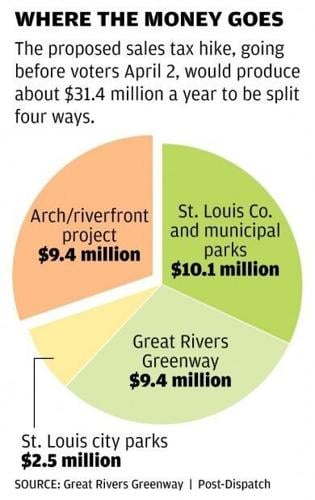
The tax measure, on the ballot April 2, was first intended to support the sweeping renovation of the Arch grounds. The final bill, however, splits the proceeds four ways:
The Arch project would get 30 percent of the money. Trails, under the direction of the Great Rivers Greenway district, would get another 30 percent. And the remaining 40 percent would be divided between St. Louis and St. Louis County parks.
So while the tax would contribute an estimated $9.4 million a year to the Arch grounds, it would raise more than double that each year for parks and trails, providing a windfall for the agencies that run them.
People are also reading…
Parks in the city are projected to get $2.5 million a year. Parks in the county would add $10 million a year, bailing the county government out of the “major cuts” of which some are warning.
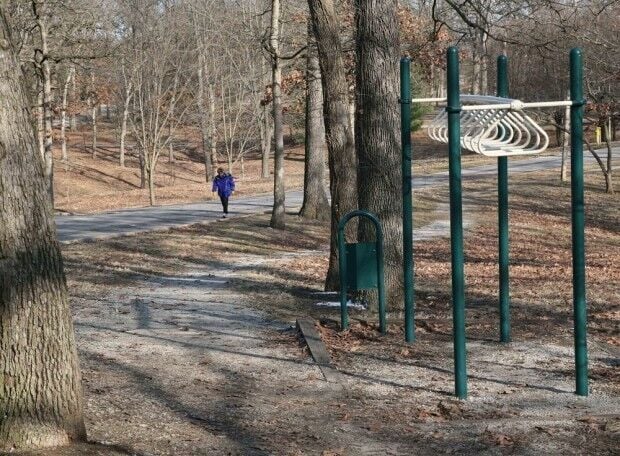
And Great Rivers Greenway, the tax-funded agency that has built more than 100 miles in walking and biking trails, would pull down $9.4 million, roughly doubling its annual income — and opening the door for another 130 miles of trails.
Critics, however, worry that the region’s residents cannot afford the proposal. Sales taxes in sections of the city and county already rank among the highest in the state.
And some liken the division of funds to bribery — a way to dole out money to help get the tax passed. The tax has to be approved in both the city and county to go into effect.
“It’s just money to get the votes and support,” said city Alderman Antonio French. “We just funded parks. And now we’re going to fund parks again.”
St. Charles County leaders have already refused to go along. This winter, they turned down a chance to put the tax on the ballot in their county. They also questioned why local money should fund renovations at the Arch, on federal land.
But the officials charged with building and maintaining the parks and trails say the tax is no veiled attempt at bribery. The sales tax increase, they say, is meant to rejuvenate all parks in the region, not just the Arch.
Besides, several said, years of use, delayed maintenance and the demands of the recession have left parks dilapidated.
“We have nearly $200 million in repair work that’s been deferred since 1955,” said the city’s parks director, Gary Bess.
Playgrounds, he said, don’t meet new national standards for safety. Sidewalks are crumbling. Stone work slated for repair is instead simply removed.
“Things like that, for years, have built up,” Bess said. “And now it’s just a huge challenge to overcome.”
In recent surveys, St. Louis County residents have been clear, too, said Parks Director Tom Ott. Take care of what you have, they’ve told him.
NEW TRAILS
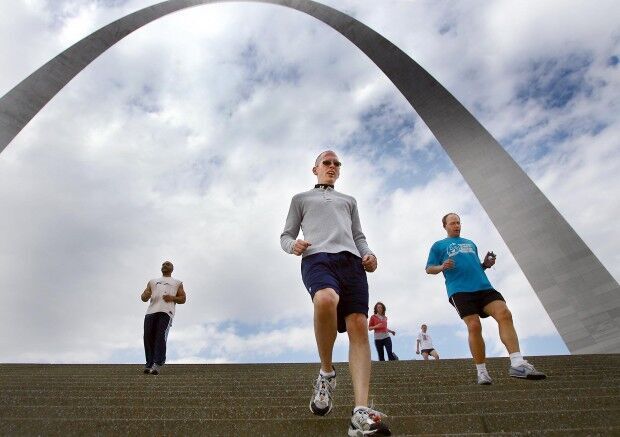
The $380 million renovation of the Gateway Arch grounds has hogged much of the publicity so far.
Construction will start this summer on a “lid” and park over Interstate 70, connecting downtown with the Arch grounds. A second major project, the elevation and redesign of the riverfront road, Leonor K. Sullivan Boulevard, just got the green light.
By 2015, the CityArchRiver foundation, spearheading the work, hopes to finish the redevelopment — renovating the Museum of Westward Expansion, demolishing the north-end parking garage, opening walkways under Eads Bridge into Laclede’s Landing, and building gardens and fields with looping trails and raised pathways.
The Arch is “a photo op right now, and that’s really all it is. In the car, out of the car,” said Walter Metcalfe, senior counsel at Bryan Cave LLP and chairman of CityArchRiver.
Private donations are expected to cover the lion’s share of the costs. But the foundation is looking to the new tax to pay for the less-appealing projects — sidewalks, sewers and the like. The Arch’s portion of the tax, assuming 2 percent annual growth, would raise about $230 million over its 20-year life. The foundation is aiming to borrow $90 million on that future income, and use about $7 million a year to repay the debt; the rest would go toward yearly maintenance.
The Arch is one of the great public sculptures in the world, on par with the Eiffel Tower and the Golden Gate Bridge, Metcalfe said. “It should be an experience.”
Still, adding tax money for the region’s parks wasn’t an afterthought, he said. Over the past few years, he’s heard the urgent need.
St. Louis County administrators said they’d spend most of the new cash to improve old infrastructure: build new restrooms at Tilles Park, renovate sea walls at Sailboat Cove in Creve Coeur Park and repair the stone building, walks and grand staircase at Fort Bellefontaine Park, among other things.
“This department is 63 years old and a lot of the infrastructure was built in the 1960s and ‘70s,” said Ott, the county parks director.
The tax would add $6 million a year to the St. Louis County’s $23 million parks budget. Ott has identified $30 million in needs so far. Municipalities would get the remaining $4 million of the county’s portion, more than doubling their current tax funding. They’ve listed $177 million in needs.
The city of St. Louis has a $168 million list, from stone step repair in Bellerive Park to bridge replacement in Forest Park to a velodrome rebuild in Penrose Park. The new tax would add 10 percent to the city’s $19 million parks budget.
The most widespread impact of the new tax, however, could come from Great Rivers Greenway.
In 2000, residents of St. Louis, St. Louis County and St. Charles County — passed a 1/10th-cent sales tax for the region’s parks. Half of that tax has stayed within each of the counties in which it was raised, to pay for park additions and improvements.
The other half created the Greenway district, aimed at building a ring of walking and biking trails surrounding and crisscrossing the region.
The district has since built 114 miles of trails, set up 83 miles of on-street bike routes, and purchased 1,516 acres of land for greenway conservation.
“An awful lot of cities are interested in putting in trails,” said Tim Fischesser, executive director of the St. Louis County Municipal League, charged with doling out the tax money to municipal parks. “And while many of the older, established cities already have parks and are looking to fund their maintenance, newer cities like Chesterfield, Maryland Heights and Wildwood have never had much in the way of parks.”
Great Rivers Greenway has collected proposals for at least 130 new miles of trails, more than double its current mileage, at an estimated cost of about $160 million.
If the tax passes, Greenway officials say, the district would connect trails stretching from Washington University through the University of Missouri-St. Louis to Ferguson, from Forest Park to Creve Coeur Park, and from Grant’s Trail to Jefferson Barracks, among other plans.
When finished, St. Louisans would be able to get on their bikes at the old barracks and ride greenway paths all the way to the Katy Trail.
WORTH THE EXPENSE?
Some officials have been skeptical.
In the county, a few council members have challenged that parks needs are as desperate as described.
When County Executive Charlie A. Dooley threatened more than a year ago to close parks unless he got support for a tax increase, the council balked, producing budget figures that called Dooley’s into question.
In the city, aldermen have argued that other priorities top parks for use of a precious sales tax increase.
Average Missouri sales taxes are already higher than most states. St. Louis city sales taxes — at nearly 10.5 percent in some neighborhoods — rank among the highest in the state. That means, aldermen have said, that they can’t be raised without serious consideration.
The Arch grounds and parks maintenance aren’t even in the top 10 concerns, Alderman French said, for most of his constituents.
“If that money went toward public safety instead, I’d look at it differently,” he said.
Jeff Rainford, chief of staff to Mayor Francis Slay, agrees that safety is No. 1. But the city, he said, spends a “small fortune” on public safety. “Parks are really, really underfunded,” he said.
“Our citizens view parks as an integral part of life in this city,” he added. “They should not be an afterthought.”
The need is obvious at many parks.
In Castlewood State Park, south of Ballwin, the Meramec River has washed out a few hundred yards of trail, cutting off miles of biking pathway.
In Penrose Park, just south of Interstate 70, tennis courts are overgrown, with broken asphalt and missing nets.
And the stone steps running down the hill at Bellerive Park, on Broadway in south St. Louis, are coming precariously loose.
Mike Thompson, 52, of the Bevo Mill neighborhood, was parked at Bellerive one day last week, resting before work. He said he enjoys the region’s parks and likes getting off the city streets.
But this is one tax, he concluded, that’s not going to get his vote. He’d rather the money come from the existing city budget. “I’d like to see the parks maintained,” he said. “But I think we have the funds to do it.”
Susan Trautman, director of the Greenway district, said that an Arch tax would probably have passed were it put on the ballot by itself. But that’s not the point, she said. “The Arch is our signature park. It’s an icon. It’s the front door for the region,” she said. “But the legacy is the whole. And the need is so great.
“Parks are always at the bottom of the list.”
David Hunn covers taxpayer spending on regional cultural institutions. Follow him on Twitter @davidhunn.


