

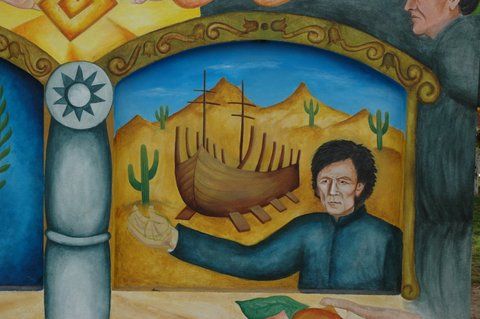
In my last blog I mentioned Father Kino’s travelling companion, Juan Mateo Manje. He is a man worth meeting. An officer in the Spanish army, he was born in 1670 in Aragón, Spain. He arrived in Sonora in 1693 with his uncle, General Jironza, the military governor of that province. He became the lieutenant in charge of the companía volante or flying column, and served as Kino’s escort on seven journeys of exploration between 1694 and 1701. He wrote an account of these expeditions, which he entitled Luz de Tierra Incognita, or “Light of the Unknown Land.” Unfortunately, there is no English translation of this work currently in print, but you may find the 1954 translation by Harry J. Karnes, published by Arizona Silhouettes, in local libraries.
On his second trip with Kino, in March, 1694, Kino started to build a boat in Caborca, with the idea of hauling it to the coast in sections and using it to supply the Baja California missions. The work involved felling a huge cottonwood tree. Let Manje tell his story: “When the tree was felled, it was prevented from falling off its base by the taproot that the hatchet could not reach. I went up the tree to tie a rope so the men could pull it, but while I was thus engaged, the tree fell over with me holding on to its trunk.” (Karnes 1954, p. 31). Work on the boat was eventually halted by orders from Kino’s superiors.
People are also reading…
In 1699, Kino and Manje went to the village of Pozo Verde, where they heard the story of the Ho’ok, which I retold in an earlier blog. Manje recounted a brief version, remarking that he did not know whether or not it was “a fable.” A few days later they passed by Baboquivari Mountain, which they named “Noah’s Ark.” That name, like so many they bestowed on the land, did not stick.
A final vignette: In late October, 1699, Kino and Manje visited San Xavier del Bac. Manje and others climbed a small hill near the village. At the top they found a stone wall encircling a half-buried white rock. Thinking this might be some sort of idol, the soldiers dug it up. As they were going down the hill, they were struck by a tremendous wind that blew all night. The Indians explained that they had opened up the house of the “Wind God,” and went up and covered the hole in the morning, whereupon the wind stopped. This probably took place on what is now called Grotto Hill, just to the south and east of the present mission. There is now a cross on the summit.
So that’s Juan Mateo Manje, and that’s why his book is worth reading.


