

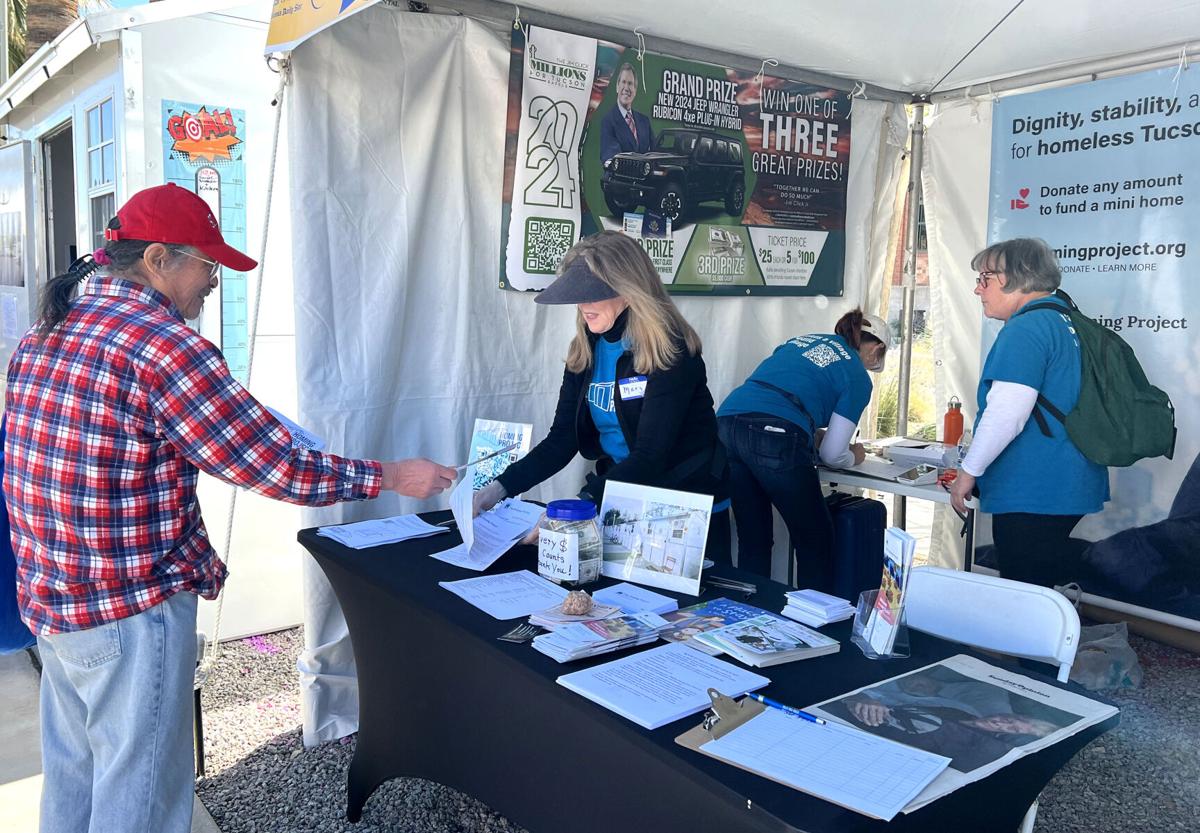
It’s a hoedown to provide housing for the homeless: The Homing Project Line Dance Party and Fundraiser will begin at noon on Sunday, July 14 at The Maverick, 6622 E. Tanque Verde Rd.
“We really just kind of want to do events that are fun and different and the next one is line dancing with a live band, Mama Cole. So if you have ever wanted to try line dancing, this is the perfect opportunity. You can go take free line dancing lessons and enjoy live music and BBQ from noon to 4 p.m., and get back home when it is still daylight,” said Rita Gray, the event planner for The Homing Project, an all-volunteer local charity that is creating a village of tiny prefab homes and other services for those who are unhoused.
The nonprofit venture, which was co-founded in 2021 by J. Kristin Olson-Garewal, M.D., and her son, Raj Garewal, seeks to provide 15 one-room houses, 12 of which will be available for living spaces.
People are also reading…
The remainder will be utilized as office spaces and communal areas including a kitchen, laundry, bathrooms and showers, a library and more. The space will also offer an open-air dining room with a canopy and cooling unit.
The village will be located on land leased for free from the Southern Arizona Land Trust in the Keeling Neighborhood near Glenn Street and Stone Avenue. Slated to open in December after permitting and property infrastructure have been completed, the village will require the services of a general contractor, architect, electrical and plumbing contractors and a civil engineer.
The work comes with a price tag of approximately $1.4 million.
Olson-Garewal, who has successfully written grants for the University of Arizona Department of Family & Community Medicine, is working hard to attain grants to assist with the expenses.
“It has been an education for us. I have done lots of grants in the past in my area of expertise, which is health care delivery, and never had problems, but it is a bit of a learning curve to figure out how to do grants for philanthropies. There are multiple foundations and they all have different priorities with different amounts for grants and there is so much competition. It has been a challenge, but we are making steady progress,” Olson-Garewal said.
The progress is representative of support for a housing-first model to address homelessness and associated issues such as mental health disease and addiction, according to Olson-Garewal.
“No one can be treated for anything effectively until they have housing. Expecting someone who is coping with living on the streets by using alcohol or drugs to stop that behavior is not realistic,” she said.
Starting with free, safe housing and other basic needs in order to reduce stress and stabilize homeless people prior to addressing other issues may seem counterintuitive, according to Gray.
“Lots of times people look at the homeless and think they are on the streets because they are alcoholics or drug addicts, but homelessness is often the reason they become alcoholics or drug addicts. If I were living in a sewer, I think I would have substance abuse issues, too,” said Gray, a retired professional events planner who has been a long-time supporter of homeless-related nonprofits.
Olson-Garewal emphasized that the housing-first model doesn’t require residents to be in recovery, but they will not be allowed to bring drugs or alcohol into the village.
“They are not allowed to bring substances or use them inside the village. It will be fenced with a security guard, and we have social workers who can refer them for treatment and any services they need. This is something they have to want,” she said.
Ultimately, the idea is for residents to become self-sufficient; hence, services include job training and assistance with learning financial skills and other basic life skills.
“If residents are work-force eligible, we can help them assess their skills and send them for training so they can earn a living wage. For someone to get into an apartment in Tucson and be able pay with their own income, they need to make $20 an hour, which is considerably more than minimum wage. If someone is too old or too young or has disabilities and can’t work, we will help them look into getting funding in other ways,” Olson-Garewal said.
The concept involves building a community of support for residents—and recognition that the support must be ongoing while they attain life skills and save money for housing that is reasonably priced.
“The difference between the Homing Project and some other programs is that when they come into our village they will have help: Medical care, people to help them apply for jobs and a person who is kind of a like a sponsor with Alcoholics Anonymous who they can call when they need extra help. We know that just because they come in they aren’t healed; that takes time. They are going to be part of a community and we expect them to stay for a couple of years,” Gray said.
She and a force of 150-plus volunteers believe that the Homing Project’s free tiny homes can help to fill the gap in affordable housing that contributes to the homeless problem locally. During the next few months, volunteers will be needed to assist with construction of the village, assembly of the tiny pre-fab homes, fencing, landscaping and more. After the village opens, volunteers will be needed for mentoring, teaching financial management and life skills and other duties.
Gray said that the Homing Project is distinguished by its ability to bring together the individual strengths of volunteers with diverse backgrounds.
“Kris allows us to excel at our strengths. I am the group’s event professional, so I do my part and you do yours and we all come together for a good cause,” said Gray, who has spearheaded fundraisers such as a BBQ at the DeGrazia Gallery in the Sun; an Egyptian Tea at the Scottish Rite Cathedral; a Murder Mystery Dinner at Maynards Kitchen and the upcoming hoedown at The Maverick.
Gray is gratified that the events raise both funds and awareness for the Homing Project. She and other volunteers have found that once people understand the mission, they are eager to donate time and treasure.
Every bit of support — no matter how small — adds up, according to Yolanda Sethi, Volunteer Coordinator for the Homing Project.
“So many people feel that homelessness is an overwhelming problem and that this is a drop in the bucket, but for the people who are going to live in the village, it is their lives,” Sethi said.


