

For Byron Brown, the Masten District is home turf, having represented its neighborhoods on the Common Council before becoming mayor in 2006 and still maintaining a home there. In his mayoral runs before, Brown could always look to the district as a stronghold.
But this mayoral election, Brown didn't win the Masten District.
Even as his write-in candidacy succeeded overall, India Walton received 2,920 Masten votes, compared with 2,566 write-in votes, most presumably for Brown, according to unofficial election returns.
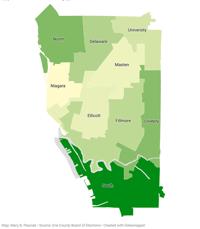
The South District, where many city employees live, saw 84% of voters write in a candidate's name.
So what happened in the neighborhoods once considered his stronghold?
The results startled some.
“Quite frankly, I’m very surprised,” said George Nicholas, pastor of Lincoln Memorial United Methodist Church on Masten Avenue. “I think her message resonated."
People are also reading…
He noted continuing violence, poor academic achievement of Black children and health disparities in the district.
“I think there was a number of Black people that looked around their community and saw the lack of progress to the core issues that resonate with them, and they felt like they were willing to give India Walton an opportunity to see if she could do better for them,” he said.
Jesse Myerson, Walton’s campaign spokesman, agreed her message resonated with Masten voters.
“Our success in Masten reflects the tenacious work of our volunteer corps and the resonance of India’s vision with poor and working-class Black Buffalonians,” he said. “The fact that his own neighbors voted for India should serve as a wake-up call to the mayor.”
Voting for change
The Masten District extends from Main Street to as far east as Bailey Avenue, an area that runs south from University Heights to MLK Park, encompassing all or parts of the Hamlin Park, Delavan Grider, Fillmore-Leroy, Kensington Bailey, Genesee-Moselle and MLK Park neighborhoods.
The district includes six census tracts where the percentage of households below the poverty level ranges from 23% to 43%, with four of the census tracts above the city average of 27.5%, according to 2019 census estimates.
Brown captured 69% of the vote against two well-known rivals in the Democratic primary four years ago but didn't do quite as well in the June primary, winning 55% to 41%, a factor in his surprising primary loss to Walton, a democratic socialist.
And then he lost the district on Tuesday, when he ran as a write-in candidate.
“When you see every other neighborhood getting help and yours is not, then you just have to ask yourself, ‘Well, maybe it’ll be better to get a change,’ and I think that’s what happened,” Nicholas said. “You look at the situation, and you say, ‘Maybe somebody else needs the opportunity to see if they can do better for this community than the people who have been there.' "
Masten Common Council Member Ulysees O. Wingo Sr., one of Brown's staunchest supporters on the Council, said the picture will be clearer once all the votes, including the mail-ins, have been counted.
“We still don’t have the absentee ballots yet, either, so we don’t know how well she did overall,” he said.
“I know my district, and the folks who voted for Mayor Brown have a point of reference. They can look back and see exactly how his administration has made inroads and has made positive impacts in the Masten District," he said. "We don’t have all the blight and dilapidated houses. We have community centers. All the parks have been done. They can see streets being repaved. And they can see crime going down and opportunities for young folks to be employed. All those things make a difference when you’ve seen the city move through this timeline."
But Walton struck a chord for voters who viewed the mayoral race as a personality contest, he said.
"Clearly, she has the charisma to make an appeal to much younger voters, who always see the establishment as archaic, and they always tend to want this proverbial new blood to come in and exact some type of change," Wingo said.
Asked for Brown's view of the vote count in Masten, city spokesman Michael J. DeGeorge said, "The voters in the City of Buffalo spoke loud and clear on Tuesday night with Mayor Brown receiving overwhelming support in every section of the city – north, south, east and west."
On top in Fillmore
Walton did well among immigrants, particularly in the Niagara District.
But she lost the Fillmore District, winning 2,299 votes versus 2,957 write-in votes.

India Walton received just over half of the votes cast in the Niagara, Ellicott and Masten districts in Buffalo's mayoral race.
Fillmore is similar to Masten in terms of pockets of poverty and public safety concerns. Fillmore, too, has a burgeoning immigrant population, primarily Bangladeshi Sunni Muslims living in the Broadway Fillmore neighborhood. It also suffers from foreclosures and property abandonment – issues that Walton successfully campaigned on in Masten.
But Fillmore's diverse neighborhoods and safety concerns affected the outcome differently.
"The large swaths of Muslim populations on the east side of the Fillmore District began arriving in Buffalo in 2008-2010 to once-vacant neighborhoods. Regardless of some of the persistent challenges that still exist, they have seen their neighborhoods improve, and I believe it correlated to their support for the incumbent,” said Fillmore Council Member Mitchell P. Nowakowski.
Broadway Fillmore's issues with crime also likely factored in that district's voting in the mayor's race, Nowakowski said.
Reports of stolen cars increased 106% in 2020, according to the Police Department. Residents have said the sheer number of crimes – 434 last year, including 73 assaults, 80 burglaries, 39 robberies and 66 car thefts – is too high. The actual number of crimes is higher because many go unreported due to language barriers or fear of police.
Walton campaigned on promises to cut $7.5 million from the police budget.
"The Fillmore District has a large and thriving immigrant and Muslim population, whose primary concerns now are public safety. Those voters are often engaged with their community police officers and frequently interact with the Police Department at their neighborhood events," Nowakowski said. "Any messaging that conflicts with that, they will reject."
Fillmore District also has more diverse neighborhoods than Masten, including the Allentown, Lower West Side, Broadway Fillmore and First Ward neighborhoods and stretches along the waterfront.
“The Fillmore District is a collection of many unique neighborhoods with diverse needs and interests," he said. "But outside of Allentown and the Lower West Side, neighborhoods from the Old First Ward to Broadway Fillmore have a tendency to be moderate voters. It’s my belief those neighborhoods tend to lean more toward pragmatic approaches and messaging."


