

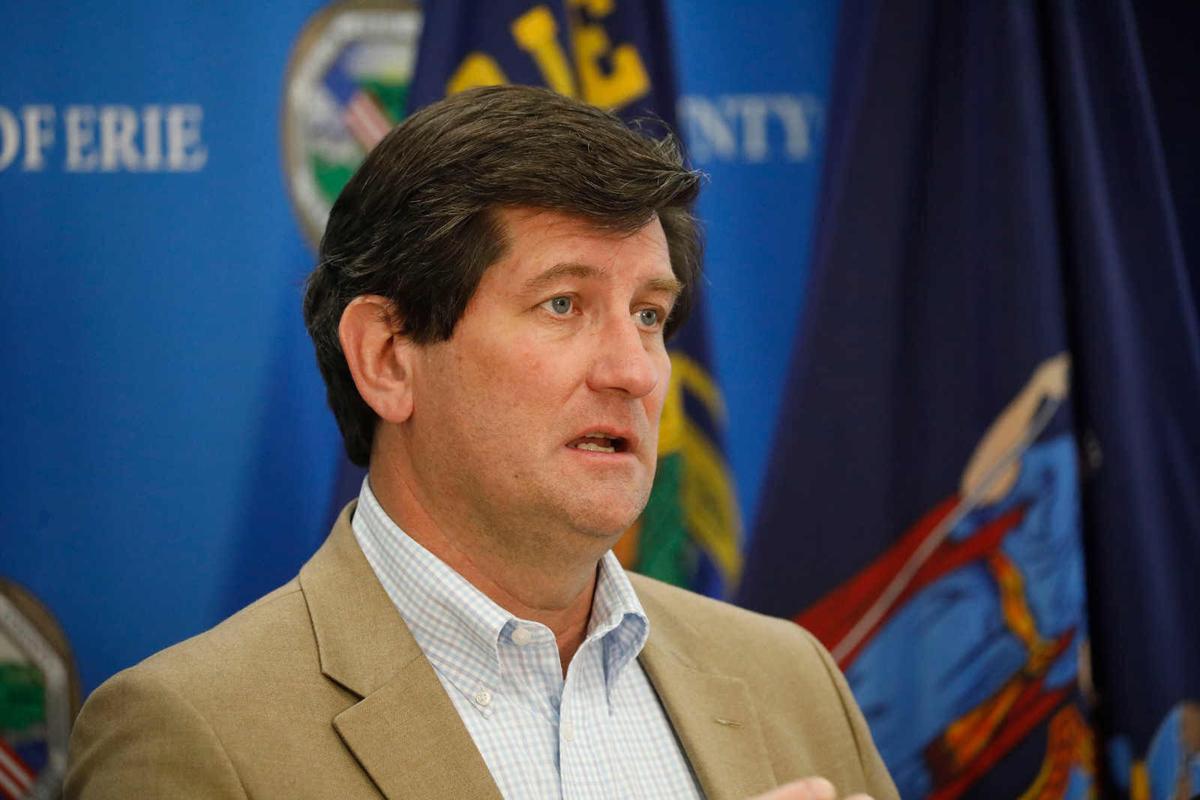
Erie County taxpayers should see no increase in property taxes as a result of the deal to build a new stadium for the Buffalo Bills, even though the agreement calls for a $250 million county contribution, County Executive Mark Poloncarz on Monday.
"There will be no tax increase because of this deal. We can handle this through the dollars we have already," he said, adding, "Anyone who's saying this is going to raise my taxes – this will not raise your taxes. This we can afford using or current resources in county government."
The terms of the new deal would result in less cost to Erie County going forward than if the terms of the existing stadium lease deal were extended, he said.
People are also reading…
The trade-off is that Erie County will no longer have any ownership stake in the stadium. The state would become the new leaseholder and the Bills would be a tenant.
"I made my commitment to the people of Erie County that I was going to get us a fair deal, and I believe I have," Poloncarz said. "Erie County will no longer be in the football business.
In addition, the amount of agreed county and state contributions would be locked in, he said.
The $250 million in county money would be no more than 18% of the total estimated cost of a $1.35 billion stadium deal, Poloncarz said. Because the Bills would be responsible for covering all cost overruns, the total percentage of public state and county share for the stadium construction may be even smaller by the time the structure is built.
The county executive intends to allocate $75 million from the county's year-end budget surplus for 2021 to cover a portion of the $250 million cost. That is not expected to be any burden on the county since it currently estimates it will close its 2021 budget books with a surplus of more than $150 million. The remainder of the county share would borrowed.
That borrowing is not expected to require an increase in property taxes to cover because the county has retired roughly $130 million in prior debt service, including debt for for Erie County Medical Center and the 2013 Bills lease deal, he said.
Under the pre-existing lease deal, the county has borrowed between $1.6 million and $2.5 million a year since 2013 to support capital improvements to the stadium, not including other operating assistance.
Since Erie County would no longer own the stadium under the terms of the new deal, the greatest financial benefit to the county is that it would no longer be on the hook for any specific, future capital or operating assistance, Poloncarz said.
Erie County currently pays more than $6 million a year in operating and construction, renovation and maintenance-related assistance, he said.
That annual burden would go away under the new deal, but the county would be required to contribute to a capital improvement account that would be funded by county surcharges generated by ticketing, marketing and concessions, he said.
That would essentially be a tax on Bills fans and other stadium users. The percentage of surcharge, or flat amount, must still be negotiated with the Erie County Legislature and ultimately collected by the county, Poloncarz said. The Bills estimate that surcharge could bring in up to $4 million a year in stadium revenue, he said.
"Whatever amount is generated is the amount that's to be contributed as sort of Erie County's commitment, though Erie County itself will have no commitment to fully fund any money ... with regard to future operating expenses of the team as well as capital expenses," Poloncarz said. "In effect, the capital improvements and the repairs that will be done in the future from the county's portion, so to speak, will be paid for by the users of the facility."


