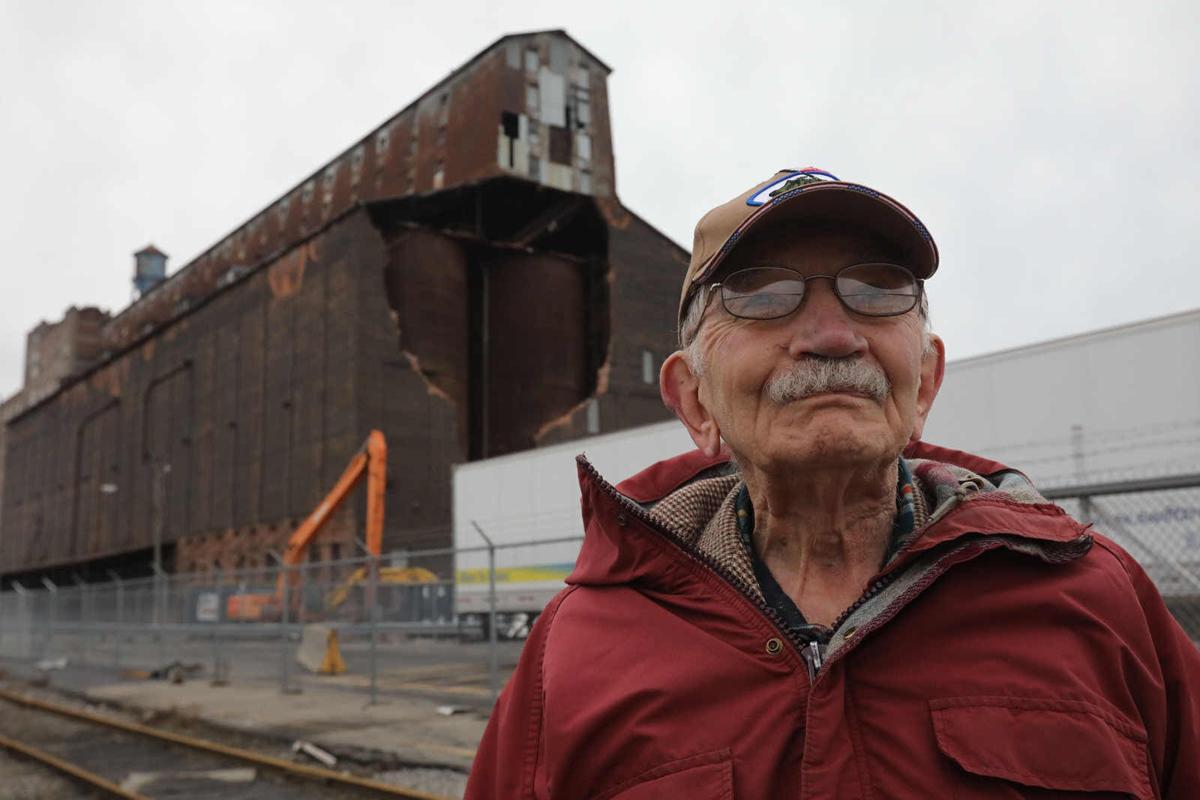
Henry Baxter was away for Christmas, spending the holiday with his daughter Ellen and her family in Pennsylvania. Ellen and her husband, Robert Kavash, drove Baxter back to Buffalo on Monday, before they all grabbed a quick night's sleep and climbed into the car again, this time for a short ride to Ganson Street.

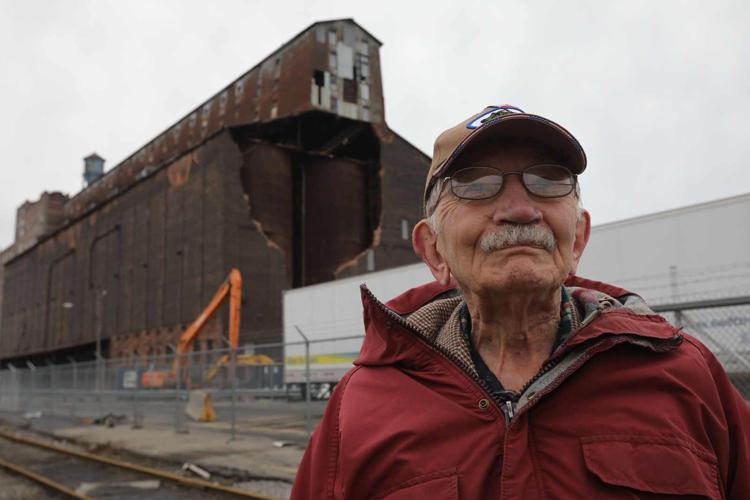
Henry Baxter, 98, who spent his lifetime working around and designing grain elevators, takes in the damaged Great Northern elevator on Ganson Street for the first time, Tuesday, Dec. 28, 2021. (Derek Gee / Buffalo News)
It was a chance for Baxter to study the wind damage done to the 1897 Great Northern grain elevator, though the Old First Ward is a frequent destination whenever one of his three children return for a visit. In a larger way – as it always is for him – this was about truly being home.
“I appreciate the impact these grain elevators had on the development of the city,” said Baxter, an engineer who – like his father and grandfather – spent years devoted to that district and its longtime purpose in Buffalo.
At 98, he offers testament to the days when grain storage and milling were an economic engine fueling growth in a booming Great Lakes city. His family, he said, played a direct role in designing at least four new grain elevators in Buffalo, and in expanding or repairing many more.
People are also reading…
For Baxter, what has already been lost in that district over the years only underlines the visceral impact the Great Northern commands on Buffalo's ancient and almost primal waterfront skyline. He wishes the structure – repaired and reinforced – could survive the demolition order sought by Archer Daniels Midland, its owner, whose representatives declined to comment for this piece.
The problem, as Baxter put it, is that “rebuilding is not cheap.” It leaves him wondering if anyone, on short notice, can provide the kind of capital that would make it possible to save the structure.

Developer Douglas Jemal has scaled back his holdings in Buffalo Niagara after growing frustrated while waiting for state and local governments to provide more financial assistance to help overcome higher borrowing expenses and rising costs.
A few blocks away, in downtown Buffalo, Douglas Jemal raises his hand.
Jemal, a Washington, D.C., developer, arrived in Buffalo a few years ago and found a way to turn the lights back on in the long-dormant Seneca One tower, the city's tallest building. His Buffalo projects include a restoration of the Statler Hotel, whose sheer dimensions for years had been a formidable obstacle to restoration.
He said those efforts – the idea that he took on projects that it sometimes seemed might never be done – ought to establish just how serious he is. Almost immediately, after a December windstorm knocked a hole in Great Northern and the city granted ADM a demolition order, Jemal told The News' Mark Sommer that he was willing to work with the Bakery, Confectionery, Tobacco Workers and Grain Millers Local 36 in an attempt to safely restore the building.

"This hearing will be limited to the issue of how the city reached its decision and, specifically, whether the commissioner had a rational basis for issuing the order for the demolition," State Supreme Court Justice Emilio Colaiacovo said.
In a phone conversation Thursday, Jemal repeated that commitment. He described Great Northern as a civic treasure, an industrial “Mona Lisa” that captures the city’s heritage in a singular way. He said he has received dozens upon dozens of messages of support since offering to step in, and the central point should be clear:
The community cares so much about Great Northern that it warrants extraordinary measures to save it. Jemal knows that State Supreme Court Justice Emilio Colaiacovo has ordered a hearing for Monday on whether the city acted rationally in swiftly issuing an emergency demolition order. Jemal said the answer is evident: Razing the structure makes no sense.
If ADM wants out of the situation, Jemal said he has a quick solution: Once the company provides a fair appraisal, “I’ll write them a check,” he said.
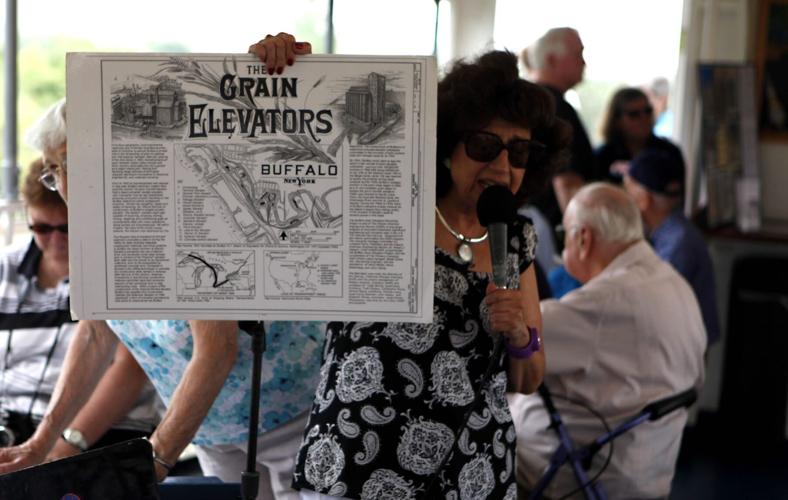
As for Baxter, I met him through Lorraine Pierro, president of Buffalo's Industrial Heritage Committee. While she and the Campaign for Greater Buffalo History, Architecture and Culture – the organization that went to court to stop demolition – share a passion for the building, their visions for what comes next diverge in a big way.

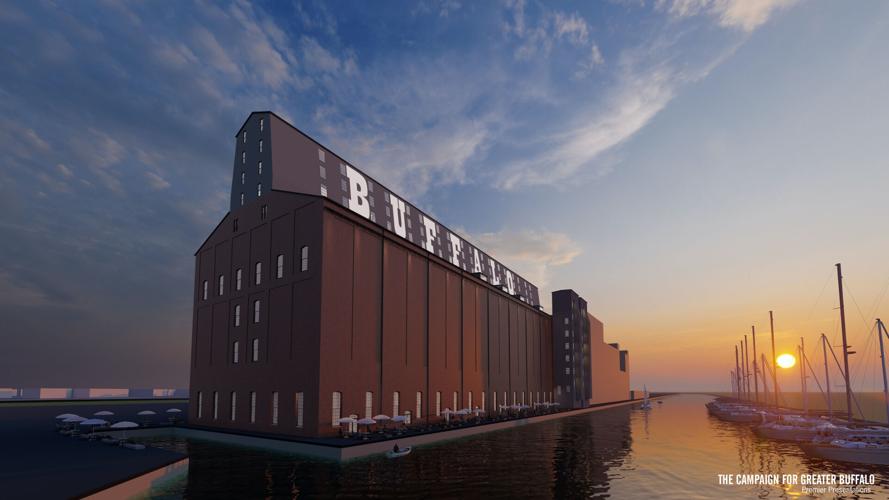
The Campaign for Greater Buffalo has reimagined a restored Great Northern grain elevator with this rendering.
“It’s almost like a billboard for Buffalo,” said Paul McDonnell, Campaign for Greater Buffalo president, whose group released a rendering that envisions the vast ground floor as entrepreneurial space, while making recreational use of a sweeping wharf. McDonnell dreams of Great Northern as an illuminated nighttime centerpiece when national television crews visit for Bills games.
To Pierro, the structure is intertwined with a functioning industrial milling area, meaning the most practical use would be as a giant, high-profile civic monument. “Shore it up,” she said, patch the vast hole with glass or plexiglass, and she said the view of the old metal bins inside would provide testament to what the Baxter family represents:
A time when Buffalo was a world capital for grain storage, which is the tale of Baxter's life.

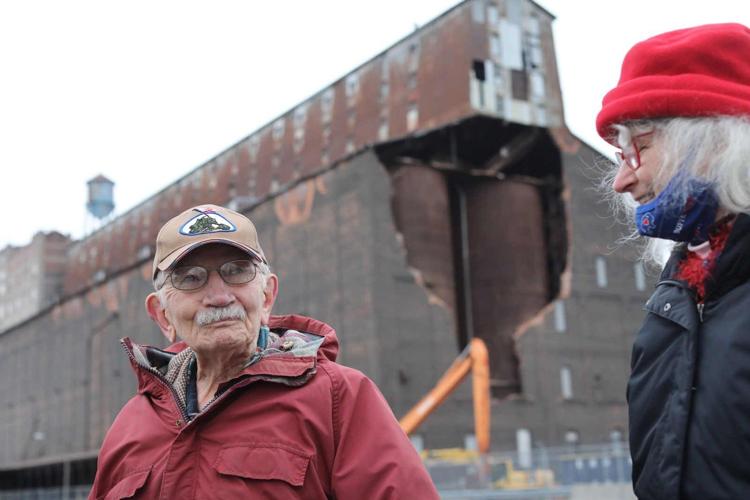
Henry Baxter, 98, shown with his daughter Ellen near the wind-damaged Great Northern grain elevator, still enjoys quiet visits to Buffalo's historic milling district.
His grandfather, Alfred E. Baxter, was an engineer who moved to Buffalo from Milwaukee in the 1890s to work in the burgeoning grain industry. That career was embraced by Henry’s father, Allan, and by his late brother, Edward.
Henry Baxter met his late wife, Gloria, here, and they built a marriage of 56 years. He wrote a book about the city's grain elevators. He eats Cheerios every morning, and he laughed when asked if that is because they are made on Buffalo's waterfront – creating an aroma that floats across the city.
“It’s a nice town,” he said of why he never left, but the truth is that his family is in the fabric of the place.
As an engineer, he tries to approach this debate with the sensibilities of his profession. In what amounts to a kind of difficult contradiction, he said the most compelling reason to save Great Northern is the same reason sustaining it might be so difficult.
The metal bins, now visible, are protected by vast brick walls. More than a century ago, grain companies eventually realized that was a needless cost, since the bins provided adequate shelter by themselves.
Baxter said the Great Northern, built before the turn of the century, is one of the last to use what he calls “a shell of masonry" - what Chuck LaChiusa on his Buffalo Architecture and History web page describes as the “sole surviving 'brickbox' working house elevator in North America.”
“It shows you how things were done in 1896,” Baxter said, of a transition point for the industry, which he also said is the best reason for saving it.

Lorraine Pierro: Grain elevators as civic testaments.
The question, always the question, is the money. Baxter could not get close enough Tuesday to offer thoughts on structural integrity, but he summarized the core of the debate in a sentence:
“Certainly, there is a value in saving it, but whether the cost is up to the value is the real question mark.”
Jemal insists he can provide that lift, and that a community so passionate about the building would help him work out some creative mix of, say, museum space with offices for community organizations, or whatever makes sense.

To most of us, the grain elevators are a kind of industrial Stonehenge, haunting and mysterious forms from some distant past. Not to South Buffalo’s Wally
As for Baxter, he is a living witness to a time when that industry attracted thousands upon thousands of workers to process millions of barrels of grain, pouring into the waterfront. He is always moved by what the surviving grain elevators evoke, a concrete atmosphere that McDonnell would agree offers a kind of concrete Stonehenge effect that still ignites sheer awe.
Barely two months away from turning 99, Baxter has been here long enough to know these truths: Everything that offers hope to this community – the staggering architecture, the beautiful vista of the lake and river and more than anything the magnificent and vibrant assortment of human beings, arriving here to build new purpose – began with the city’s magnitude as a port, and its apex as a granary for the world.
“It put Buffalo on the map,” Baxter said, “and we’re lucky for our location.”
That much holds true. Even now, he feels it. The question is – as we again debate what ought to stay or go – just how much it is worth to try and save that feeling for our kids.