

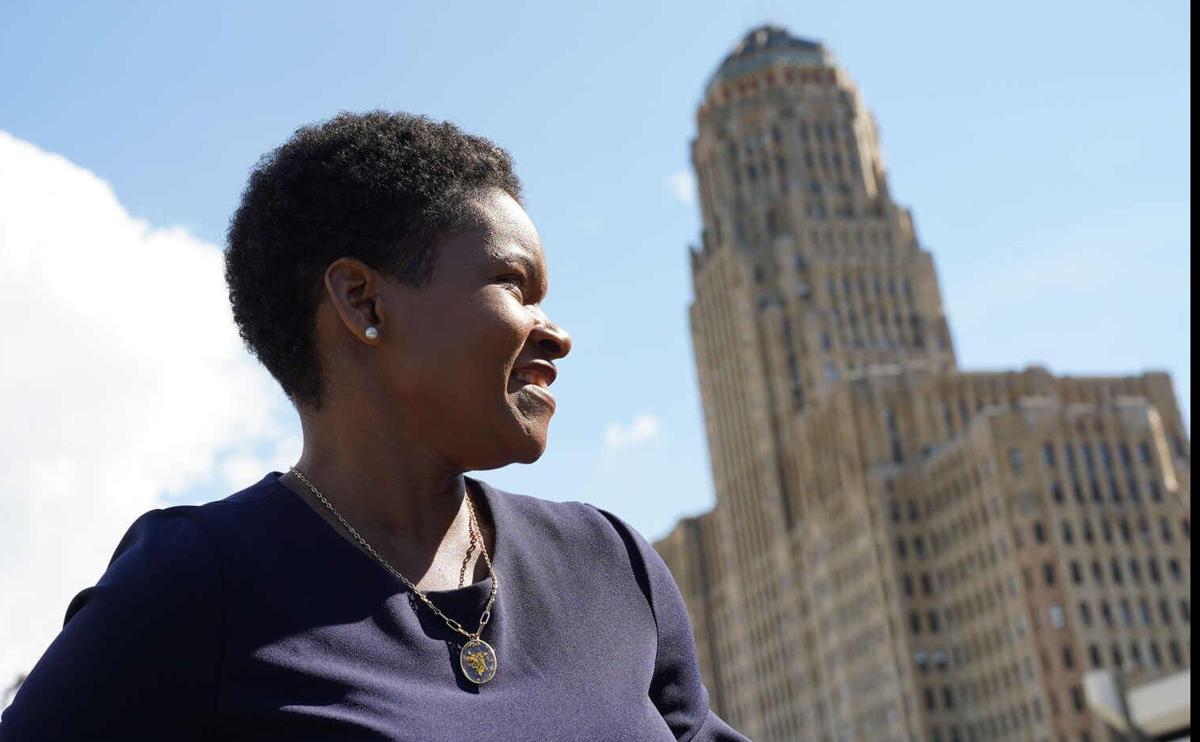
Even as she basked in her surprising primary win, India B. Walton put elected officeholders in City Hall – and beyond – on notice with her promise to "support the next generation of progressive candidates that are going to come into leadership."
“The exciting thing to me is that we have built the infrastructure with this campaign to be able to run School Board members, to be able to run Common Council seats, to really get progressive, forward-thinking people into these seats," she told The Buffalo News.
Several now holding those seats seem nonplussed by her proposition, and one suggested a different tack for someone who's never before served in public office.
"If I had won an election, and I had absolutely no experience in government, I would be reaching out to work with people rather than attacking people right off the get-go," said North Council Member Joseph Golombek Jr. "I don't think it bodes well should she win the November election that there's going to be a working relationship with her. She seems like a bully."
People are also reading…
Walton's comments don't come as an idle threat.
Walton's volunteers made 19,000 calls the night before the primary. They called “every Democratic primary voter in Buffalo with a phone number in the voter file," campaign spokesman Seamus Gallivan said.
On primary day, her supporters sent almost 100,000 text messages, he said. And the campaign dispatched more than 150 volunteers to enough poll sites to talk to half of those who voted. The effort demonstrated what Walton can accomplish with resources from the Democratic Socialists of America and the Working Families Party, both of which backed her campaign.
The New York Working Families Party worked in “deep collaboration” with Walton’s team to help raise more than $140,000, put together an outreach program responsible for tens of thousands of voter contacts and produce mail, TV and digital ads, said state WFP Director Sochie Nnaemeka.
“Our members look forward to working alongside India to build a more just and equitable future, invest in our communities, and make Buffalo a national beacon for progressive governance,” Nnaemeka said.
The next election for the nine Council seats will be held in 2023.
“I’m already on notice because every single day I work," said University Council Member Rasheed N.C. Wyatt. "I’m working for my community, and so I don’t need someone to tell me that someone’s going to run against me."
Wyatt, now in his second full term, did not endorse four-term incumbent Byron W. Brown and said he looks forward to working with Walton.
What kind of working relationship Wyatt and his fellow Council members would have with a new mayor remains a question.
Walton, who emerged from Primary Day as the only candidate on the ballot in the November election for Buffalo mayor, would face a nine-member Common Council that has grown more assertive in the past year and a half, compared with its historically placid relationship with Brown during most of his years in office.
The Common Council, for example, disagreed with Brown on the installation of speed cameras in school zones, and after more than a year of battling over the cameras, council members voted 6-3, a veto-proof majority, to eliminate them by September.
"I think the Council has proven its independence, and that independence will remain regardless of who occupies the second floor," said Council President Darius G. Pridgen, referring to the mayor's City Hall office.
'We are coming'
After her victory Tuesday, Walton struck a hawkish tone.
“This victory is ours, and it’s the first of many," she said. "If you are in an elected office right now, you are being put on notice. We are coming.”
The city lawmakers with whom she is poised to become governing partners said they do not feel threatened by her comments.
“If there wasn’t a challenge, I would be disappointed,” Pridgen said. “It’s OK for someone to want change and to coalesce partners that think like they do. I don’t think that every sitting elected official feels threatened by that. I think that if people think the same and are working together for the same things, those are people that you end up partnering with.”
She has the right to back candidates, but voters will decide who fills seats on the Common Council, he said.
If Walton occupies the mayor's office, she'll learn what those already in elected office have learned, Pridgen said.
"Most people who are elected usually come in with a lot of things you thought you could do, and when we get there, we learn that some things you thought you could do, you just cannot do because this is not communism," Pridgen said. "You have to go through the process of government."
Majority Leader David A. Rivera, in his fourth term representing the Niagara District, said residents just want to hear things are getting done.
“The voters at the very end will make the determination whether or not that elected official has been responsive to them,” Rivera said. “You just have to continue to do your job, be responsive to your constituents.”
Two-term Masten Council Member Ulysees O. Wingo Sr., who supported Brown’s re-election campaign, said those who are not doing their job ought to be nervous about Walton’s focus on other elective offices.
"If an elected official should ever get to the point where they’re comfortable in their seat, they no longer deserve it," Wingo said.
A newcomer as mayor
It's not Walton's comments or even her lack of political experience that worries South Council Member Christopher P. Scanlon.
"It is her lack of governmental and managerial experience that concerns me," Scanlon said. "Her assuming the office of mayor is akin to allowing a first-year medical student to perform surgery on a loved one. This is a $500 million operation, and any suggestion by Walton or her supporters that she has the requisite experience to do the job is simply not true. Why do they think that this person, with zero experience, can adequately oversee a complex, multidimensional city government and ensure that the services they need – public safety, public works – would be maintained and delivered?"
Brown and his predecessors Anthony M. Masiello and James D. Griffin became mayors after serving in the New York State Senate and the Common Council.
Walton has no experience as an elected official.
Rivera said it would be helpful if Walton surrounds herself with the best people she can.
“I think the key for India is going to be just try to hit the ground running, learn as quickly as possible, surround herself with a great team," Rivera said. "She’s going to be making appointments to very important positions in her administration: economic development, police, fire, community development, public works. She’s going to want to surround herself – I’m sure she will – with people that will be knowledgeable and bring professionalism to their departments,” Rivera said.
Lovejoy Council Member Bryan J. Bollman is a year and a half into his first term, but brought 13 years of experience working in the Lovejoy council office before his election.
“There’s always people that will doubt you, but it’s how you respond to the challenges of the job and work through them," Bollman said. "We’ll see how she handles things."


