

ALBANY – The Omicron variant of Covid-19 has not yet arrived in New York State, but officials expect it’s just a matter of when and not if.
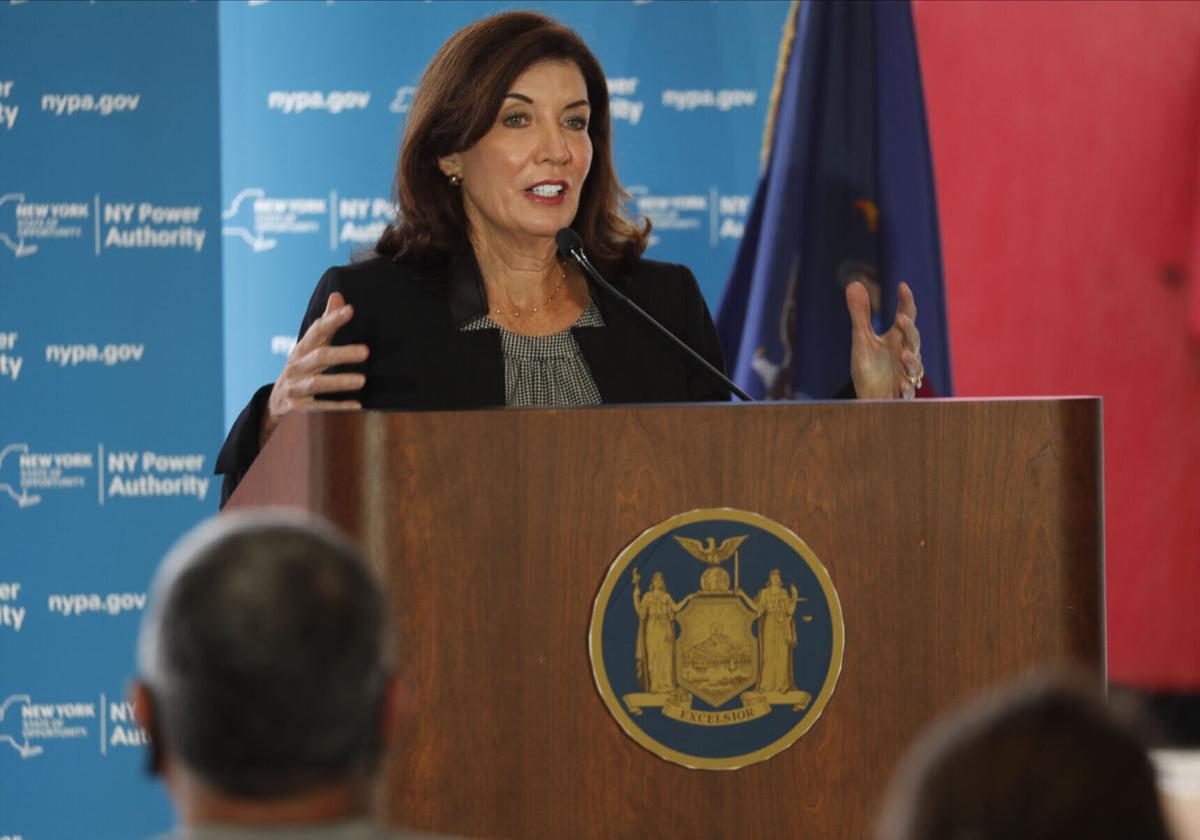
“But here’s the good news," Gov. Kathy Hochul said Monday. “We’re not defenseless," she said of vaccines widely available to anyone over age 5 that weren’t in the public health arsenal a year ago.

The 10.15% positive test rate for Western New York was the highest in the state, and nearly six times greater than the lowest region, New York City.
While all response options are on the table, especially if the new variant proves especially dangerous and spreads rapidly, Hochul said that as of Monday: “We’re not talking about shutdowns” or “other harsh measures.”
But the state is moving, as Hochul announced Friday, to temporarily stop elective surgical procedures at hospitals with bed capacity levels below 10 percent. Thirty-seven hospitals are set to be affected, including Erie County Medical Center, Mercy Hospital and Sisters of Charity Hospital in Western New York.
People are also reading…
For Hochul, her Covid-19 moment is now front and center. It has been coming for the governor, who has adopted both a different style and approach to the ways of her predecessor, Andrew Cuomo.
But the new wrinkle is the new variant, coupled with a winter surge that appears certain in New York following weeks of mounting virus cases and hospitalizations. In some upstate counties, Covid-19 positive rates have gone above 14 percent.

While Erie County leaders continued to alert residents about rising percentages of Covid-19 cases, data indicated the situation is much worse in the region’s rural counties.
With the spread of the new Omicron variant, all eyes in Albany now watch scientists attempting to discover whether existing vaccinations can be effective against it – and whether Omicron is less or more deadly than the Delta variant.
National and state leaders on Monday said it is a matter of when, not if, Omicron cases emerge and spread in the United States. The variant has made its way to Ontario, Canada, a growing number of European nations, Israel, several African countries, and Asia and the Pacific.
Hochul’s effort, for the most part, has been to leave the pandemic response to counties. She has pressed ahead with a statewide vaccination mandate on health care workers – which is about to get more strict later this week as religious exemptions declared by thousands in hospitals and nursing homes will end.
Hochul has been a cheerleader for vaccinations, and has urged mask-wearing – even as she has been photographed working crowds without masks. Last week, she declared a disaster and said the state could act in high-Covid-19 areas to limit “non-essential” surgeries at hospitals, which can include everything from certain cancer procedures to hip and knee replacements.
She said her order regarding elective surgeries will apply to hospitals with bed capacity below 10 percent. As of Monday, that would affect 37 hospitals, a number that could change when the order becomes effective at the end of the week.
Western New York’s virus numbers are hot and getting hotter. Heading into a season of holiday gatherings, there’s little reason to think they’re going to settle down.
Besides life and death for some New Yorkers, the Covid-19 situation is rapidly entering the state’s political world. Attorney General Letitia James, who is running against Hochul for governor in 2022, recently suggested the governor has been slow to respond to rising upstate Covid-19 numbers.
On Monday, U.S. Rep. Thomas Suozzi, a Long Island Democrat, declared his gubernatorial run against Hochul. One of the points he stressed: He’s going to work full-time on Covid-19 and the pandemic’s impact on the state economy.
Hochul has been expanding her portfolio of interests and time to include an increasing number of ribbon cuttings and big spending announcements for various projects. She has released daily data on Covid-19 cases, deaths, hospitalizations and vaccinations, but she only recently was in New York City speaking of the pandemic in the past tense.
Now, Hochul is seeing troubling numbers in upstate regions. Since August, the state has lost 4 percent of its hospital bed capacity, but 70 percent of the total loss is in upstate, and some facilities are in dire positions with fewer beds – including those in intensive care units – available.
Without providing details, she said some downstate facilities have offered to send staff to upstate nursing homes, which have even worse staffing problems, and that the National Guard “can” be deployed to assist upstate facilities. She says she has offered local officials any help they need, from extra supplies to mass vaccination sites run by the state.

If things get much worse, Erie County Executive Mark Poloncarz warned Wednesday, the county may have to order all elective surgeries canceled or postponed at the area's hospitals.
As for whether Erie County – which has been seeing Covid-19 rates above 10 percent – should be moving on to Phase 2 – requiring vaccination proof for entry to restaurants, bars, entertainment venues and other public places – Hochul said that decision is up to Erie County Executive Mark Poloncarz. The county is in Phase 1, requiring mask wearing indoors in public places.
The upstate numbers Monday again showed wide disparity. Statewide, the Covid-19 positivity rate Sunday was at 31.4 per 100,000 residents. In New York City, it was 16.4. In Western New York, it was at 65.
Hospitalizations again ticked up Sunday to 2,829, up 73 from Saturday, and 41 people died across the state in hospitals and nursing homes.
The governor, in her media availability, sent mixed messages of fear and hope. She all but guaranteed a surge in cases following the Thanksgiving holiday, but then defended her approach of more heavily relying on local officials to make the call regarding Covid-19 rules. To that end, she said she is “recommending” that businesses in New York get patrons and staff to wear masks, but she did not mandate it.
And while she openly worried about health care staffing problems, she defended her decision to require vaccines of hospital and nursing home workers – a move that has since been held up by the courts.
“I will not be backing off on that," she said when asked if she might continue the current religious exemption route thousands took but which comes to an end this week.
The governor again sought to portray her administration as engaged in the Covid-19 response, but this time around tapping the expertise of local health officials on a regular basis. She again sought to press two of her key goals she wants to keep in place: children attending school in-person and businesses remaining open.


