

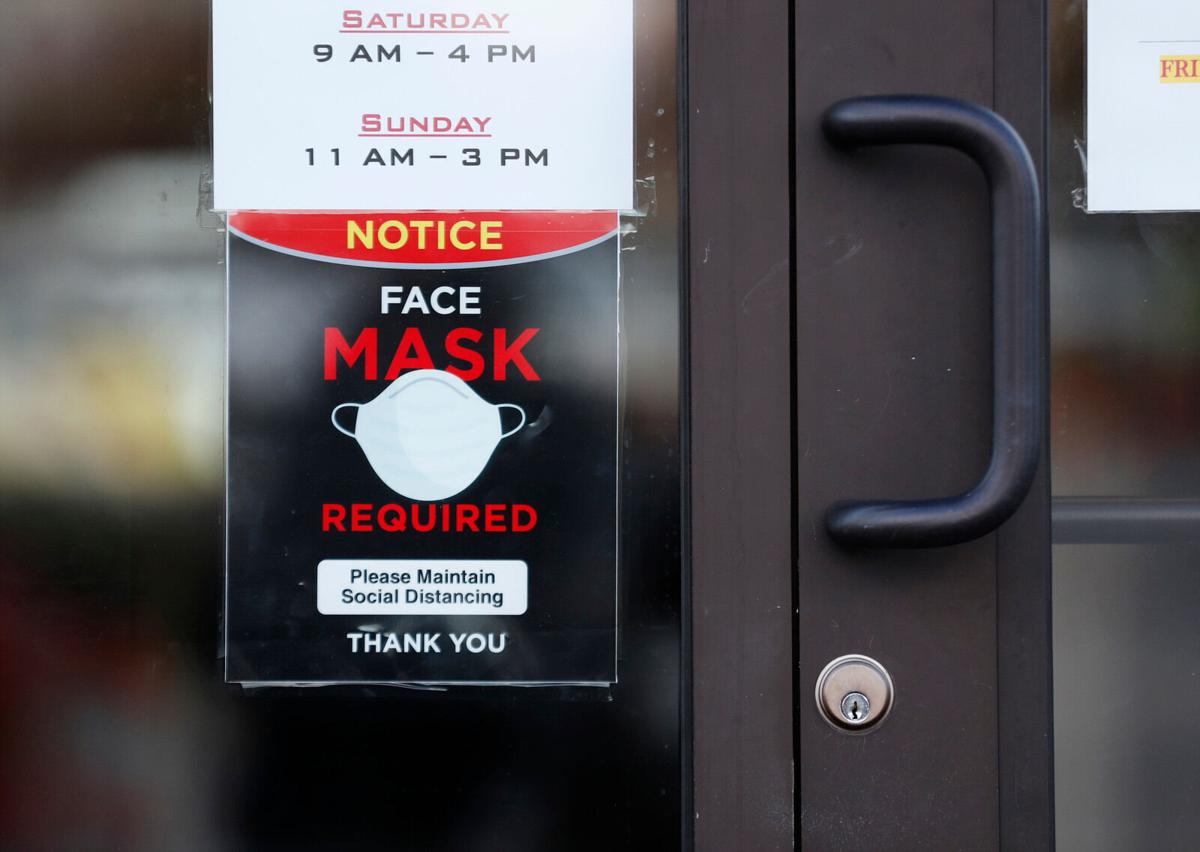
Erie County Executive Mark C. Poloncarz and Health Commissioner Dr. Gale Burstein continued Tuesday to promote the county's mask mandate as a means of quelling record-high Covid-19 caseloads while warning that even stricter measures could be coming.
But they are leading a parade with no followers among other county governments. None of the other counties in the region has imposed any mask mandate, or any other type of mandate, on businesses or the general public. And none plan to change that, unless it becomes a mandate handed down at the state level.
That's true even though most of them have higher infection and positivity percentages than Erie County and some of their hospitals are filling up with Covid patients.
“We just feel that the mandates are not something that is going to be effective in getting the message across," Chautauqua County Executive Paul M. Wendel Jr. said Tuesday.
People are also reading…
"We have a new ad campaign or new messaging that is going to come out, hopefully by Friday, to encourage the masking when you’re in public places, but we don’t feel the mandate is the way to go. Those words itself turn people off," Wendel said. "But I’ve told people if the mandate was the thing to do, the governor would have done it already.”
Orleans, Genesee and Wyoming counties, which for state purposes are considered Finger Lakes counties, have decided to act in unison with the other counties in that region.
“There is a consensus among ourselves that if there is going to be additional public mask or vaccine mandates that we should try to do this on a regional basis, because having a patchwork of having one county do one thing and another county do another thing is largely in our opinion ineffective and difficult to enforce. It’s going to be confusing for the public," said L. Matthew Landers, Genesee County manager.
The leaders of Genesee and Orleans counties issued a joint news release declaring that public mask mandates merely make the pandemic worse, while harming businesses.
“We believe new mandates will only push residents into private settings where spread will still continue but local businesses will suffer," the statement said. "For almost two years, businesses across the region have taken various measures to protect their workplaces and we trust them to do the same at this time.”
Landers said in an interview that Paul Pettit, the health director shared by Orleans and Genesee counties, has told him stores aren't where most of the Covid action is.
“The vast, vast, vast majority of our spread is in private settings, in people’s homes, gathering recently around the holidays," Landers said. "Even having additional measures at shopping centers is not where the science or the evidence is showing we’re having much spread.”
He pointed to Monroe County, whose county executive, Democrat Adam Bello, declared a state of emergency Tuesday, but without any mask mandates, except for county employees and visitors to county buildings.
“You don’t manage a public health crisis by dropping a hammer,” Bello said, according to the Associated Press. “That’s why we’re going with the phases approach.”
In addition, Bello announced that Monroe County has purchased and will distribute 750,000 free Covid testing kits.
“This is not the same pandemic as last year,” Bello said. “Phase one enacts proactive measures, not just restrictions. By year’s end we should see that these common sense solutions are working. We do not need to live in a permanent pandemic.”
"People in Genesee County can go shopping at a store in Monroe County without a mask, but in Erie County they have to have a mask," Landers said. "That’s the problem when you have counties coming out with policies individually. Ideally, you’d have a statewide approach, and the state would be coming out with measures and assistance in enforcing those measures.”

From left, Niagara County Emergency Management Director Jonathan F. Schultz, Public Health Director Daniel J. Stapleton and County Legislature Chairwoman Rebecca J. Wydysh at a news conference on March 18, 2020.
Rebecca J. Wydysh, chairwoman of the Niagara County Legislature, also advocates making testing more widely available. She thinks that would do more to quell the current surge than any mask mandates.
"That is the most important thing in my opinion, to know who has Covid and to be able to stop that spread," Wydysh said. "We truly believe if there was a free, easy testing site available that more people would take advantage of it. It’s not just that it’s becoming harder and harder to find an appointment to go get a test somewhere, but there are a lot of people who can’t afford to pay $100 or more each time they need to go do that.”
Wydysh said people should continue to use the common sense measures that have become commonplace: social distancing, hand washing and – most importantly – vaccination.
Poloncarz has emphasized that many of the patients crowding Erie County hospitals, which were at 89.3% capacity as of Sunday, are from outlying counties, more so than last year, when the pandemic was entering its first winter and vaccines had yet to be released. And he said those counties' hospitals are under more pressure than they were a year ago.
On Nov. 28, 2020, according to Poloncarz, there were 327 Covid patients in hospitals in Erie County, and 59 in the hospitals in the other counties of what the state calls Western New York – Niagara, Chautauqua, Cattaraugus and Allegany.
A year later, Erie County hospitals contained 334 Covid patients, and the other four counties had 150 virus sufferers in their hospitals.
"We've seen a slight increase in Erie County hospitalizations, not a huge increase, year to year, but a big increase for the other counties," Poloncarz said. "We know the other counties' hospitals are at or near capacity as well, so we're seeing a lot of Covid-19 in these other counties, and their patients are not only in their own hospitals. Some of them are coming to Erie County."
“I get the theory," said Wendel of Chautauqua County. "Mr. Poloncarz is entitled to his opinion, but I’m not going to have a war of words with the county executive.”
Wendel said patients are being transferred to the three hospitals in his county – in Jamestown, Dunkirk and Westfield – from facilities in other counties, such as Olean General Hospital in Cattaraugus County.
Dr. Kevin D. Watkins, Cattaraugus County public health director, said Olean General is at 92% to 93% capacity, and admissions and ambulances are being diverted or delayed there.
"I’m not sure how long we can maintain ourselves or sustain this, but we continue to try to battle this surge," Watkins said.
Wendel noted that the Jamestown and Westfield hospitals are owned by Pennsylvania-based groups, which means their most seriously ill patients tend to be transferred, not to Buffalo, but to Erie, Pa., or Pittsburgh.
Wendel and Wydysh said the inability of nursing homes to take discharged hospital patients, because of the nursing homes' own staffing crunches, is contributing to hospital crowding.
"That is where we see our bottleneck currently," Wendel said.


