

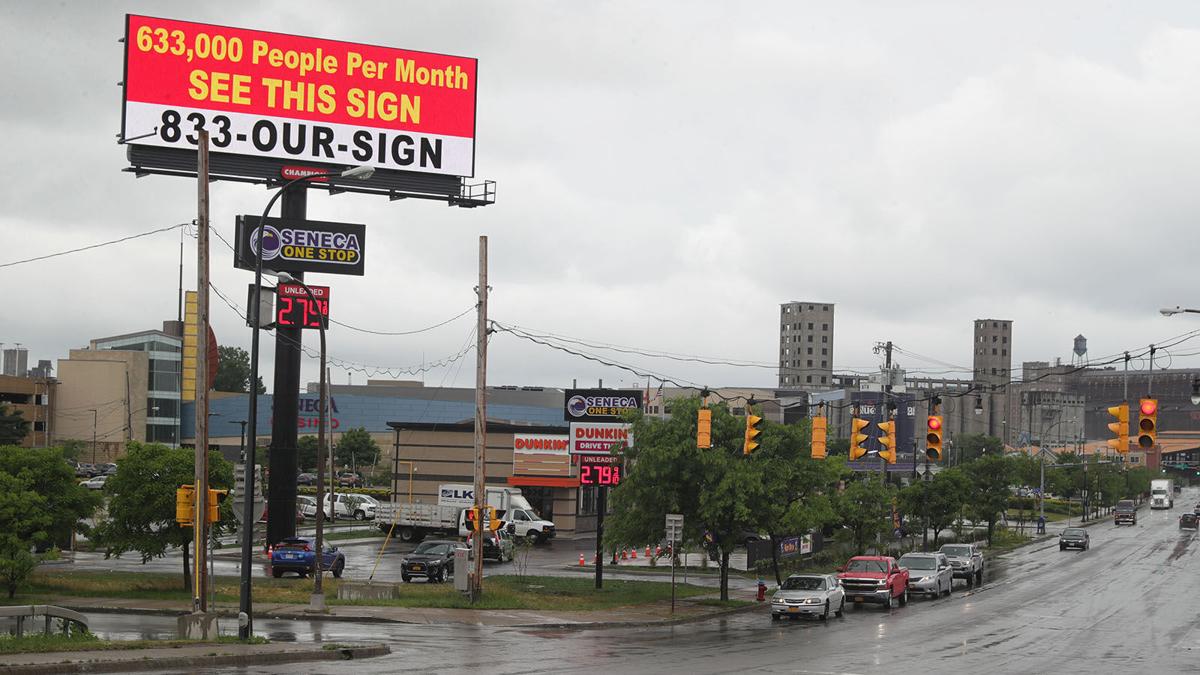
A new addition to the Buffalo skyline, visible to southbound drivers on the Interstate-190, went live last week with little fanfare.
It is a digital billboard, a structure that typically wouldn't merit much notice, but its location is noteworthy:

The new facility at 180 Perry St., which will celebrate its grand opening Friday morning, is located across from the Seneca Buffalo Creek Casino.
The 80-foot sign was built at the downtown site where the Seneca Nation of Indians recently opened a Seneca One Stop gas station, convenience store and Dunkin' Donuts shop.
The soaring billboard went up quickly and did not require prior approval from city officials because it is located on the tribe's sovereign territory.
It is the latest case of the Senecas staking a claim to land in downtown Buffalo and expanding a presence that traces back to 2007, when the Seneca Gaming Corp. opened a temporary casino. It also raises the question of whether development of this kind, whether in Buffalo or Niagara Falls or Salamanca, is good for the region or just to the benefit of the Senecas.
People are also reading…

The Seneca Nation of Indians has torn down a squat one-story storage building it owns across from its Seneca Buffalo Creek Casino in downtown Buffalo. But the nation isn’t saying what its plans are for the site. The tribe, which owns the former Graybar Electric Co. property at 180 Perry St. through its Seneca Erie Gaming entity, did not
The Senecas say they have invested more than $200 million, all told, along both sides of Perry Street and that the expanded Buffalo casino employs 500. And they say the casino draws visitors to the Cobblestone District and Canalside, creating a spillover benefit in the neighborhood.
“We are thrilled to once again invest in our sovereign land to develop a project that will provide a needed and convenient service to our neighbors and visitors in Buffalo and Western New York,” Seneca Nation President Matthew Pagels said at the opening of the One Stop.
The downtown casino faced considerable opposition initially and opponents question whether it has generated new economic activity.

Counties across nearly a third of upstate as well as cities and school districts from Niagara Falls to Salamanca are financial losers in the battle between New York State and the Seneca Nation of
Now, city officials are frustrated that the casino remains open while the Senecas have stopped making revenue-sharing payments to the state and the host community, and some business owners complain about competition from sales of tax-free cigarettes and gasoline at the downtown site.
"The agreement was always designed to be mutually beneficial, and not a one-way street," Buffalo Mayor Byron W. Brown said. "Right now, until that dispute is settled, it really casts a cloud over the benefits of the agreement."
The Senecas opened the temporary Buffalo Creek Casino on 9 acres at South Park and Michigan avenues in July 2007, a $7 million, pre-fabricated metal facility that was tiny compared to the tribe's casinos in Niagara Falls and Salamanca.
Seneca leaders promised to eventually invest $125 million in the under-utilized area, hire 1,000 people and make revenue-sharing payments of up to $7 million to Buffalo as the host community.
Critics, however, said the Senecas were bending federal law to open the casino at the downtown location and a group of opponents went to court to try to block it. They argued that a Buffalo casino simply would cannibalize spending from other area venues and would not attract out-of-town visitors or create new economic activity here.
The legal efforts to stop the casino failed and the permanent casino opened in 2013. It was scaled back from the original plans and no longer included a hotel or performing arts space to avoid competing with other downtown establishments.
The Senecas in 2017 unveiled a $40 million expansion with a total of 1,100 slot machines in a complex covering 124,000 square feet, along with what is now 36 table games.

Seneca Nation President Rickey Armstrong Sr. bet $40 on the Bills to beat the Steelers, ushering in sports betting at the Seneca Buffalo Creek Casino on
At the time, Seneca officials said the casino drew about 3 million annual customers, most from within a 60-mile radius that included Canada.
Has the city received a boost, as promised, from the downtown casino? Observers offer mixed opinions.
"It's probably almost exclusively a local business with local clientele," said Bruce L. Fisher, a former Erie County executive who opposed a downtown casino.
The Seneca casinos were meant to capture spending from people who previously trekked to Canada to gamble, said Donald A. Grinde Jr., a retired scholar of Native American studies at the University at Buffalo. Casino approvals on Long Island, in South Florida and in California came for similar reasons, he said.
"This is not unique," Grinde said. He also pointed out that the state entered into a gaming compact with the Senecas in part to resolve disputes over land taken from the tribe.
The Senecas helped to spur the revival of the Cobblestone District, said Michael T. Schmand, the executive director of Buffalo Place.
"If you recall what was down on those streets 20 years ago, it was empty warehouses," Schmand said. "It was a deserted area."
Pegula Sports and Entertainment praised the Senecas' investment.
"The Seneca Buffalo Creek Casino certainly enhances the gameday experience for both Bills and Sabres fans," Ron Raccuia, PSE's executive vice president, said in a statement.
However, there were complaints as far back as 2014 that the Senecas weren't fully living up to the terms of the gaming compact, particularly in marketing the casino to gamblers outside of metro Buffalo and in making required street improvements.
And James Sandoro, a downtown property owner, said he asks every visitor to his Buffalo Transportation Pierce-Arrow Museum, located a few blocks from the casino, why they stopped by. Five to 10 people a year say they were on their way to or from the casino, Sandoro said.
"There's no spillover effect that I know of," he said.
Today, the city's biggest complaint is that the Senecas have stopped making the revenue-sharing payments included in the compact, arguing they are no longer required to do so.
The Senecas owe an estimated $35 million to the City of Buffalo alone, said Brown, who didn't agree with the federal government's decision to make way for the latest development while the revenue-sharing dispute was unresolved.
The Senecas in May opened a $5 million Seneca One Stop convenience store and gas station, featuring tax-free cigarettes and gasoline, along with a Dunkin' Donuts. It expects to employ 12 people.
"The Seneca Nation has always been good neighbors to us," said Benjamin N. Obletz, president and CEO of First Amherst Development Group, which developed the nearby Lofts @ Elk Terminal apartments. "While the gas station and newly erected billboard on the corner of Scott and Michigan avenue is not exactly what we had envisioned would be in keeping with the historic fabric of the neighborhood, we understand and respect their rights as a nation."
Developer Carl Paladino's Ellicott Development Co. led the overhaul of the Fairmont Creamery building, next to the new Seneca development, and he owns the gas station located downtown near the Central Library.
Paladino, once a supporter of a downtown casino, said he's frustrated his gas station must pay sales tax while the Senecas don't.
"They completely destroyed that business," Paladino said. "They've got an unfair advantage."
Last week, Champion Outdoor Ventures put up the billboard at 180 Perry St., off Michigan Avenue, at a spot leased from the Senecas. They didn't need permission for a sign on land designated sovereign territory in early 2020.
Monday, it was displaying digital ads touting the availability of the space, including the fact that 633,000 people per month will see this new billboard.
News Staff Reporter Jonathan D. Epstein contributed to this report.


