When Iran's Ayatollah Khomeini called for the death of novelist Salman Rushdie in February 1989, a Tucson reporter turned to local Muslim leaders for comment.
Rashad Khalifa, who then led the small Masjid (Mosque) of Tucson, showed the reporter a copy of Rushdie's controversial book The Satanic Verses and noted he had actually read it, unlike many people protesting it. He called Rushdie "an extraordinarily gifted novelist and very knowledgeable of Islamic history."

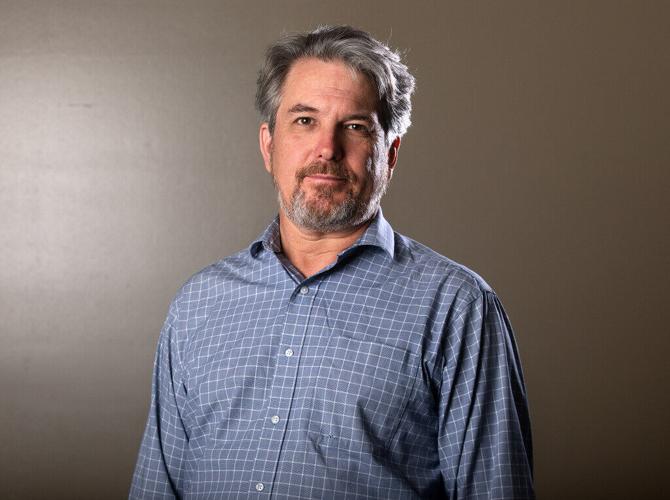
Arizona Daily Star columnist Tim Steller
"Those up against the book did not read the book," Khalifa told Arizona Daily Star reporter Doug Kreutz.
Khalifa rejected the idea that Islam endorses killing an author for his writing and predicted little would come of the controversy in the end. As it happened, though, Khalifa's destiny would become tragically tied to Rushdie's in coming weeks.
People are also reading…
Both, it turned out, had written of "satanic verses" in the Quran, Islam's holy book. Rushdie focused on two well-known verses in his novel, and Khalifa focused on two others in his commentary. Both were labeled apostates by an Islamic council meeting in Saudi Arabia later in February 1989. Both of their lives would be drastically altered by the events of that month.

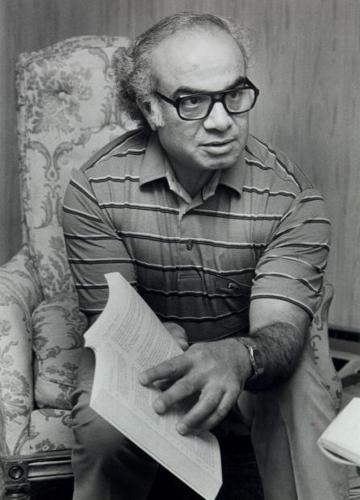
This is a 1989 file photo of Rashad Khalifa, 54, a controversial imam, who was murdered in 1990.
Rushdie, who speaks at the Tucson Festival of Books today, was forced into hiding for years, while some translators and publishers of his 1988 novel were attacked. The Japanese translator of The Satanic Verses was killed.
Eventually, in 2022, a man stabbed Rushdie nearly to death at a literary event in Chautauqua, New York, where he was advocating for the protection of threatened writers and artists.
Khalifa didn't survive nearly that long. Threats came in after the council singled him out. And on Jan. 31, 1990, a man stabbed him to death in the mosque, the building at 739 E. Sixth Street still painted with the phrase "Happiness is Submission to God."
Biochemist, religious scholar
Khalifa was a biochemist by trade but a religious scholar by devotion. He moved from his native Egypt to Arizona in 1959 to pursue a master's degree at the University of Arizona. After moving to different states and countries for his studies and jobs, he settled in Tucson.
His son, Sam Khalifa, graduated from Sahuaro High School and went on to become a Major League Baseball player for the Pittsburgh Pirates. He declined to comment for this column.
Dissatisfied with the existing translations of the Quran into English, Rashad Khalifa decided to translate it himself. But he remained troubled by the meaning of chapters (known as surahs) that begin with certain Arabic letters.
"I started my own research," Khalifa explained in a video. "After many attempts and many failures, I decided to put the whole Quran in the computer. I didn't know what to look for. So I had the computer count every letter in every surah. The objective was to look for any mathematical connections or any mathematical pattern that involves these letters."
He said he found something even bigger.

The former mosque at the corner of North Euclid Avenue and East Sixth Street was home to Masjid Tucson. It is where Rashad Khalifa, 54, a Muslim spiritual leader who ran Masjid Tucson, was stabbed to death on Jan. 31, 1990.
"After four years of research, a mathematical pattern emerged," he explained. "Every element of the Quran, the number of verses, the numbers assigned to the surahs, numbers of words, the letters. Every letter in the Quran is mathematically composed beyond human capability. The common denominator that binds all these mathematical, physical facts is the number 19."
Khalifa believed that his computer analysis proved God's authorship of Islam's holy book. This numerological idea, sometimes known as Code 19, won him some renown around the Muslim world.
"They celebrated Rashad’s discovery," said Edip Yuksel, a longtime associate of Khalifa and Tucson resident who moved in recent years to Ohio. "They published his books. The kings invited him to their conferences. He was in Turkey. He was a hero."
Khalifa became a target
But that celebrity transformed gradually into notoriety as it became clear that Khalifa also embraced ideas that were unacceptable to large swaths of Islam.
One of the biggest was that Khalifa rejected the Hadith and Sunnah, the sayings, teachings and practices of the Prophet Muhammad that are a key source of behavioral and moral guidance as well as religious law. He thought only the Quran, as the word of God, should be followed.
Another: In 1986, he pronounced himself a messenger of God. This was controversial within Islam, because the Prophet Muhammad is considered God's only messenger. Khalifa described himself as "a consolidating messenger. His mission is to purify and unify all existing religions into one: Submission (Islam)."
Khalifa also declared that two of the verses in the Quran were not godly, but inserted by humans and in fact satanic. Those verses, chapters 9:128-129, don't jump out to an outsider. They read:
There certainly has come to you a messenger from among yourselves. He is concerned by your suffering, anxious for your well-being, and gracious and merciful to the believers.
But if they turn away, then say, ˹O Prophet,˺ “Allah is sufficient for me. There is no god ˹worthy of worship˺ except Him. In Him I put my trust. And He is the Lord of the Mighty Throne.”
What convinced Khalifa these verses were satanic is that they did not fit the mathematical pattern based on the number 19 that he said God used.
"He's rejecting two verses from the Quran. According to them, therefore he should be killed," Yuksel said. "Their hero became a disappointment."
Rushdie's novel
Rushdie, as far as I've been able to ascertain, was unaware of Khalifa and his claim of satanic verses in the Quran when he was writing The Satanic Verses, which was published in 1988. He declined through his agent to comment for this column.
That novel's name derives from two other verses in the Quran in which the Prophet Muhammad praises three traditional deities in Mecca. This recognition is contradictory to the central tenet of Islam, that there is only one God. In later verses, the prophet confesses the mistake, explaining that prophets are sometimes tempted by Satan as a test of their faith.
It wasn't Rushdie's discussing these well-known verses in the novel that angered so many Muslims. Possibly the greatest offense was taken from the fact that Rushdie used the names of the Prophet Muhammad's wives for characters who were prostitutes in a brothel, something Khalifa labeled "bad taste, but nothing else."
The Satanic Verses is a freewheeling novel, in Rushdie's style. Part of it takes place as a conversation between two main characters who fly from Mumbai to London, survive a terrorist bombing of their plane and talk as they plunge toward Earth.
Khalifa, a religious devotee who discovered a mathematical pattern in his holy book but went from hero to villain in his community, would probably fit well in a Rushdie novel. But he was a real person, with all that entails.
Khalifa's killer
Khalifa had plenty of detractors, including those who found flaws in the supposed mathematical pattern and those who thought he had become unhinged in his beliefs about his own religious significance. To some extremists, his declaring himself God's messenger and finding satanic flaws in the Quran made him a heretic who deserved death.
The man who killed Khalifa, Glen C. Francis, moved to Tucson and started attending the mosque in January 1990. It was apparently part of a plan to kill Khalifa for his controversial beliefs. He disappeared from Tucson after stabbing Khalifa 29 times and wasn't arrested until April 2009, when he was living in Calgary, Alberta.
Rushdie lived in hiding and under police protection for years, under the assumed name Joseph Anton, which is the title of a memoir he wrote about the period. He gradually returned to public life, eventually moving about without security guards, although Khomeini's edict against him never was lifted.
On Aug. 12, 2022, Rushdie was set to speak at the Chautauqua Institution on "the United States as asylum for writers and other artists in exile and as a home for freedom of creative expression," the organization's website said. He had agreed with his interviewer beforehand to tour the United States to promote the idea of "cities of asylum" for threatened writers.
Before Rushdie could begin speaking, Hadi Matar, a man from New Jersey, rushed the stage and stabbed him 15 times, leaving Rushdie severely wounded and blind in one eye. Later, in an interview with the New York Post, Matar said he believed Rushdie had attacked Islam, though he admitted he had only read "a couple of pages" of The Satanic Verses.
That's the thing about these violent attacks on free expression, whether it takes the form of a daring novel or unorthodox religious claims. They usually come from a place of ignorance and insecurity. Secure and confident societies and people can accept unwanted and even blasphemous words without lashing out violently.
They might even read the book before forming an opinion.
Contact columnist Tim Steller at tsteller@tucson.com or 520-807-7789. On Bluesky: @timsteller.bsky.social

Tim Steller
Columnist


 Tim Steller's column: TUSD moving to new HQ amid financial crisis