When someone steals a bike or a tool from you in Tucson, your first inclination may not be to call the police.
You may not even bother making an online report.
Arizona Daily Star columnist Tim Steller
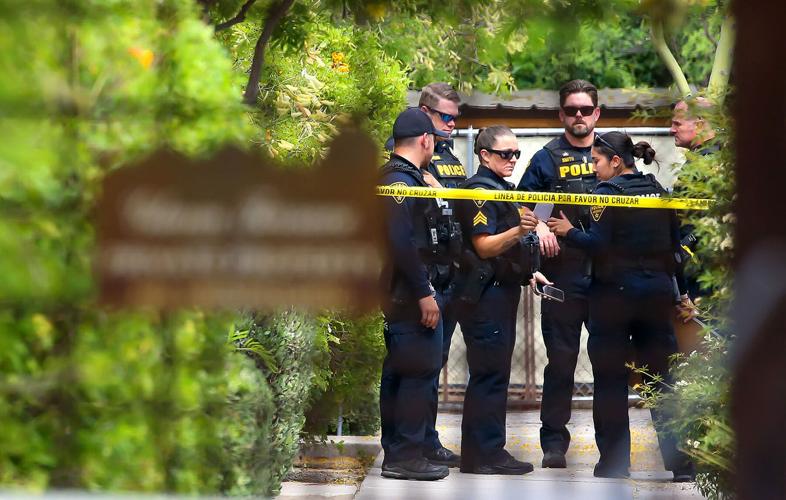
It's ingrained in many of us by now that Tucson police often do not respond in a timely way, if at all, to reports of minor crimes. Even some more serious incidents go without a prompt response if officers are too busy at the time.
An ongoing survey is aiming to get a sense of how common unreported crime is in Tucson. The survey, sent out as a QR code on a postcard to 375,000 addresses a few weeks ago by the city, could help paint some new hues on the local public-safety picture.
That's because we have a good sense of the awful crimes that appear in the news or fill our social media feeds. There were four significant shooting incidents the week of March 12-March 18, for example, including one that killed a 13-year-old boy and another that happened in Park Place mall.
People are also reading…
These shocking crimes, which happen too often in Tucson, with tragic ramifications, at least are noticed.
But I doubt that we have a good sense of how prevalent lesser crimes, like property crimes, are, because so many go unreported. The new survey, led by UA Professor of Government and Public Policy Seung-Ho An, aims to get a handle on how common crime really is. It asks questions like:
"In Tucson in 2025, did anyone break in or try to break in where you or someone in your household was living?"
"In Tucson in 2025, was a vehicle stolen from you or someone in your household, or were parts or accessories taken from it?"

The city has a new survey that zeroes in on unreported crime.
And: "In Tucson in 2025, were your or someone in your household physically attacked by anyone, with or without a weapon?"
A "yes" answer prompts the respondent to elaborate.
"National research shows that more than half of crimes in the United States are never reported to police, and recent evidence shows this trend increasing post COVID-19 Pandemic," Tucson police said in a document explaining the research. "This survey helps fill in those gaps by capturing experiences that never make it into official records, so Tucson can direct resources where they are needed most."
This narrow focus on crime is different from the broader approach we've been getting from the city of Tucson on public safety. For example, Mayor Regina Romero's Safe City Initiative, announced last year, focuses on social issues like homelessness, mental illness and access to treatment, to go along with efforts like preventing violence.
Romero wrote in the introduction to a report on another public-safety survey last year, "Research shows that poverty, lack of opportunity, and exposure to trauma are key predictors of violence. By targeting these conditions through coordinated interventions, we are building a proactive model of public safety."
While I've criticized the framing of the safe city initiative as overly broad, I have to acknowledge that people see "public safety" as something more than just preventing and solving crime.
In 2021-2022, a group called Just Communities Arizona conducted a survey, funded in part by the city, of 1,206 Tucson residents. The resulting report, titled Reimagining Community Safety, had some surprising results for people who think crime is the top issue in Tucson.
The survey asked respondents what is the most prominent problem facing their community. The top 10 answers were:
- Homelessness (21% of respondents cited this)
- Inequality (12%)
- Housing (11%)
- Education (11%)
- Employment (7%)
- Environment (6%)
- Neighborhood quality (5%)
- Healthcare (5%)
- Crime (4%)
- Traffic/infrastructure (4%)
That's right — crime placed ninth among Tucsonans' top concerns, tied with traffic and infrastructure. Granted, this survey took place about four years ago, but that was during a peak of homicides in Tucson.
Last year, the city conducted a survey of 288 residents in the city's four areas that are the focus of its Violence Interruption and Vitalization Action, or VIVA, program.
In each of the four neighborhoods, the measure that respondents favored the most to help reduce gun violence was to increase the availability of activities for young people. The second most popular measure: To improve lighting and other infrastructure. Third: Reduce homelessness and increase the accessibility of housing.
The results of these surveys are almost unbelievable if you follow any of the scanner pages common on social media. These are the pages that post about daily police calls that people are following on police-scanner programs. A common refrain on these pages is that crime in Tucson is out of control, the mayor is to blame, and more police is the solution we need.
Public safety does feel like a crisis some days in Tucson. That's especially true if you also consider the daily danger and tragedy of traffic collisions, which take more lives in Tucson than homicides do.
But it will be good to gather some data that is neither like online catastrophizing nor burying the crime problem under layers of social-service discussion.
"The collected data will guide decisions about where to invest in public safety, how to strengthen community programs, and how to build trust between residents and the institutions that serve them," the Tucson police analysis team said of the survey.
I took the survey, which lasted less than 10 minutes, and only had one problem. The postcard and the online survey repeatedly says to email An, the professor running the research, with questions. But it turns out he is on sabbatical now and not answering his email. The timing, in that sense, wasn't great.
The results, if they get up to the maximum 20,000 they can handle, could be useful, though, as we struggle to get a handle on one of Tucson's most intractable problems.
Contact columnist Tim Steller at tsteller@tucson.com or 520-807-7789. On Bluesky: @timsteller.bsky.social

Tim Steller
Columnist


 Tim Steller's column: New info justifies recall against Sheriff Nanos