

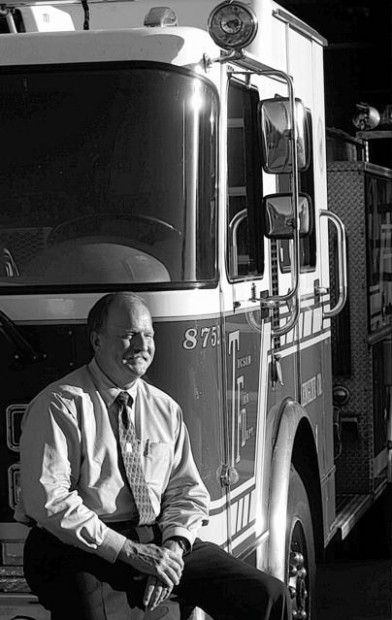
When Dan Newburn walked into of the Tucson Fire Department's Downtown station on Friday, it was the last time he would do so as chief of the department.
Newburn retired after more than 34 years on the job, including the last seven as fire chief.
Newburn said he believes the department is more sophisticated in a lot of areas — ranging from its vehicles and safety equipment to its education and outreach programs — than it was when he took over.
Newburn said he wishes he could have hired more blacks to further diversify the Fire Department.
He had to navigate the department through a few controversies during his time, including allegations of discrimination and harassment leveled against the department by a female employee, a dispute with the union on how to fill vacant inspector posts, and the disciplining of eight firefighters who pulled sexually inappropriate pranks on recruits.
People are also reading…
But when he talked with the Star, Newburn said he has had few regrets about his career and his tenure as chief.
Question: Which accomplishments are you most proud of as fire chief?
Answer: On the personnel side, we managed a huge attrition, a retirement program and we lost about 30 percent of the Fire Department.
We had about a 3 1/2-year period where we had back-to-back training classes — we had back-to-back promotional testing in all ranks — so it put a little tension on the system. But I think we did a great job of managing.
We had the opportunity to do numerous capital projects. We built four new fire stations. We built a new maintenance facility. We have replaced almost (all of) our entire fleet of fire apparatus.
Q: Are there any specific programs that you're most proud of?
A: We began to question why we're sending a firetruck with four people to a person who fundamentally doesn't feel good.
So we took two EMTs (emergency medical technicians), and we had some used pickup trucks, and we put in a minimal amount of equipment. They drive with normal traffic, and we assist the patient just like we would if we had arrived on a firetruck.
Then we took it to the next level and said: "Well, what we're seeing here is people who need more than just our help. How do we connect them with a social-service agency?"
We started working much more closely with some social-service agencies, and we're starting to see some significant results.
Q: What are some of the biggest challenges the department will face?
A: I think the first challenge right now that we face is just an economic challenge, because the economy has taken such a downturn. We have long-range projections that include additional fire stations, and that's all just on hold now.
In our financial-stability plan, we had one new station a year for the next eight years. Because of that, we would've hired another 300 people in the next eight years.
By the time the economy turns around, we'll be behind the curve again. But we'll catch up.
Q: What are some of the challenges your successor will face?
A: Here's my quote: "Anybody can manage during the good times, but managing during the tough times like this requires some extra effort." So my successor is going to have to be prepared to do that.
At the same time, I think there's opportunities for success.
My successor is going to lose two of the assistant chiefs, one in December and one in January.
So my successor is going to inherit my team to an extent, but two of my team members are leaving. They can start to develop the foundation for their team, so it will be nice.
It's a mild challenge, but if it was me, I'd be looking at it optimistically. Everybody wants to build their own team.
Q: What did you gain most from this job?
A: I'd been an assistant chief for quite a few years, but chief is significantly different.
A lot of work is done outside of the Fire Department — things not Fire Department-related.
Rather than wear a Fire Department hat, I have to wear a city hat. I have to understand other city departments pretty deeply.
It's fascinating when you understand what it really takes to run a zoo, what it really takes to run community services.
Q: Is there anything you haven't been able to accomplish as chief that you wanted to accomplish?
A: One of things I tried to do, but just couldn't do, I tried to improve our success relative to minority recruiting. One of the efforts that we made was to recruit African-American males and females.
We worked very closely with Clarence Boykins, who was head of the (local) NAACP at the time, and faith-based community ministers.
I learned a lot, and we worked hand in hand, but I wished I could've done better.
Interim leader
Assistant Fire Chief Randy Ogden will serve as interim chief while city officials conduct a national search for a new chief.


