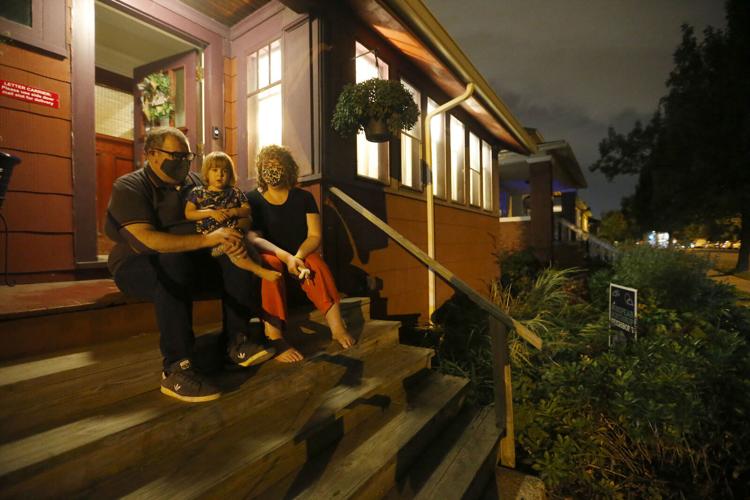
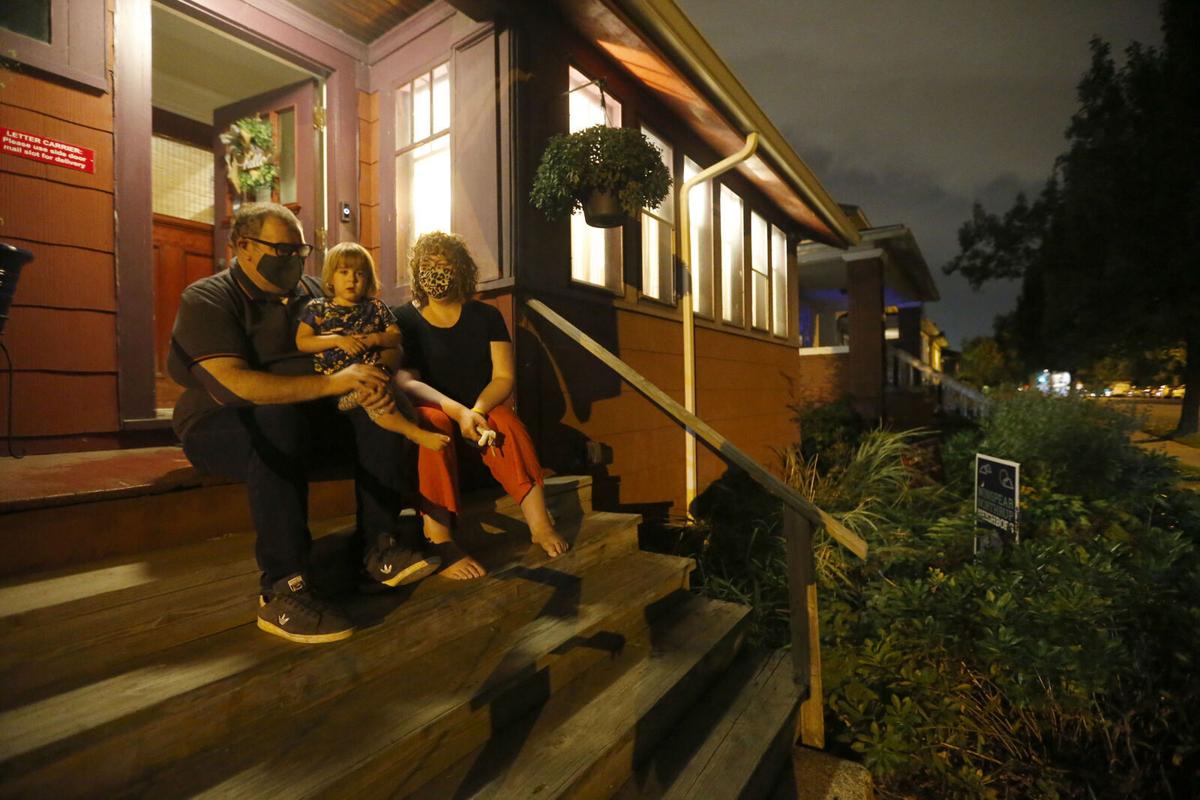
Molly Dahl Poremski loves her University Heights neighborhood. More than that, she fiercely advocates for it. She has lived in the neighborhood since 2015 with her husband, Ben, and her 3-year-old daughter, Inez.
But as Inez recently played at the edge of the family’s backyard, guarded by a brown picket fence, Poremski watched as three college students walked by. None were wearing masks.
Inez has a chronic lung disease that could be exacerbated by Covid-19, a highly transmissible, airborne disease. One wrong breath could spark a chain reaction for Poremski, for her family and for her community.
“I don’t want my daughter, who was in the NICU for five months, who has lung problems, to get sick from you," Poremski said. "That is the concern I have now. During a pandemic, I am getting nervous.”
The return of the school year means the return of the many University at Buffalo students to the University Heights neighborhood. They add another yarn to the fabric of the community, but on Thursday, Friday and Saturday nights, some of them add a nuisance and a potential community health risk by throwing parties or patio gatherings, and stumbling along the dimly lit streets.
People are also reading…
Turn onto Northrup Place, and rows of houses have students milling on the porches and steps. Others mingle in groups on the sidewalks. Few are wearing masks.
Other streets aren’t as loud, but a low thud of music creates a constant soundtrack and the smell of stale alcohol fairly screams junior year of college. Students meander the street in small groups in search of clandestine basement parties, and again, few wear masks.
Even on a Thursday afternoon before the start of classes at UB, four coeds staged a game of beer pong on the front porch of a house on Winspear Avenue. They also stood unmasked, above dozens of yellow cups perched atop a table.
The town-gown relationship is always fraught. But more than ever, the neighborhood wants their college-aged neighbors to know that in a time of worldwide contagion, community safety has to be a shared priority.
“We’ve noticed a lot of people are moving back in, and we haven’t talked to them a lot, as much as I’d like to get to know people on my street a little more,” said Anthony Lasker, a junior at UB who lives in University Heights. “But they’re all coming from different areas that I don’t know, so I’m trying to contain myself, in a sense. It’s all up to us to slow this thing down.”

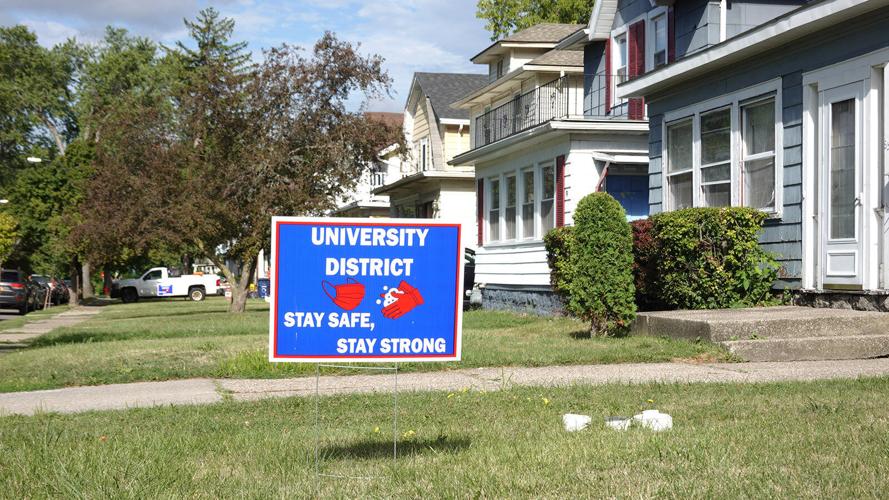
Signs warning "stay safe" on lawns in University Heights in Buffalo.
Relationship building
Mayor Byron Brown announced Aug. 20 that students who host the kinds of massive parties notorious in University Heights will face a $1,500 fine, part of a city effort to mitigate the spread of Covid-19 in off-campus neighborhoods populated by college students.
“College communities across the nation are facing a special challenge this fall,” Brown said. “Many of us in this community are working together to address the difficulty of bringing students back to the city in a manner that is safe for them and safe for the neighborhoods they will be living in.”
Brown’s announcement came as videos of large-scale student gatherings at Auburn, Alabama, Texas, Penn State and Syracuse were widely circulated on social media. The University of Alabama reported Friday that 1,043 students have tested positive for Covid-19 since classes resumed.
Scenes from Auburn tonight: pic.twitter.com/i8XW5CC0gx
— Giana Han (@giana_jade) August 23, 2020
Gov. Andrew M. Cuomo said Thursday if a college in New York has 100 students infected, or 5% of its campus population, it must switch to remote-only learning for two weeks. Classes already have gone to a remote format at several colleges across the country and in New York, due to Covid-19 outbreaks in the campus community.
SUNY Oneonta began two weeks of online learning Monday because of an outbreak, and the University at Albany suspended four students Sunday for alleged involvement in off-campus parties, at locales in close quarters that could foster Covid-19 exposure.
Mickey Vertino doesn’t necessarily agree with punishing offenders. He’s the longtime president of the University Heights Collaborative, and he’s a former landlord in University Heights and a former corrections officer.
He believes in restorative action and informing students who are community members about their role in University Heights.
“We’re not here to rain on their parades, in order to get them to understand the consequences," Vertino said. "But I’m waiting now, to find out when we can round up students and landlords and discuss what is happening and what their perspective is.”
Days before he spoke with The News, Vertino walked through the neighborhood and saw a house party on Main Street. He estimated 100 kids were on the front porch and front yard of the house.
“I’ve talked to a couple students, and they listen, but they haven’t really given me feedback,” Vertino said. "They say they’re not going to have big parties, and I’ve talked to reasonable students, but not the ones who are throwing big parties.”
The pandemic – which has forced people to physically keep their distance – hasn’t led to a meeting. Instead, Vertino and members of the University Heights Collaborative aim to canvass the neighborhood to meet with homeowners and tenants.
“It’s really challenging to engage people, especially during Covid-19,” Vertino said. “But we’re going to go door to door, as long as the infection rate stays low. We’re going to go out and build relationships.”
Read the full story from News Reporter Jay Tokasz.
'We have to do our part'
The garage of the Poremski house abuts Northrup, a block of houses largely populated by college students, where porches are covered with secondhand lawn furniture, used couches and plastic chairs.
Poremski and her neighbors typically sit on their porches and patios on the weekend nights before classes begin at UB, and watch as students pace the sidewalks. Some teeter in platform-heeled sandals and halter dresses as they look at phones and repeat directions to particular houses. Others sip from half-empty bottles of alcohol or carry cases of beer.
The next morning, some of the residents check the Ring app – a remote doorbell video system – on their smartphones, and watch videos taped in the wee hours of people urinating at the foot of doorsteps, throwing garbage at doors or staggering along the sidewalks before vomiting.
“The end of August and the beginning of September is stressful,” Poremski said. “We watch the students go by, and sometimes we have to escort drunk girls home, but we let the students know that people live here. That can get exhausting. I remember last year, staying up until 3 a.m. to sit out."
As they walked up Highgate Avenue, Lasker and Nikita Oarcea stopped to talk, but then quickly paused.
“Hang on, let me put my mask on,” Lasker said, before he approached.
Oarcea just returned to University Heights on Friday from the Hudson Valley. He is realistic about what could happen at UB – and what already has happened at other schools.
“I think we’re all going to be sent home in two weeks,” Oarcea said, with a long face. “As soon as there's more than, like, 10 cases, they're going to shut the school down."
Lasker stayed in University Heights this summer. He said he is mindful that he lives in a neighborhood and not just a campus community.
“I make sure I stay out of close contact from people, because the neighbors, they go home. They have families," he said. "The last thing I would want is a kid to die from Covid-19. We have to do our part.”
Farther up Highgate, the Stillman family was on the porch, waiting for the college students to walk by. The family laughed as their father told a story about an unexpected party that none of them were invited to – in their own backyard. They woke up one morning a few years ago and found their pool filled with high-heeled shoes, stray clothing and student ID cards, and front-patio furniture scattered around the backyard.
They said the student behavior has gotten better. But it remains to be seen if it will continue to improve, even with the heightened concern over Covid-19.

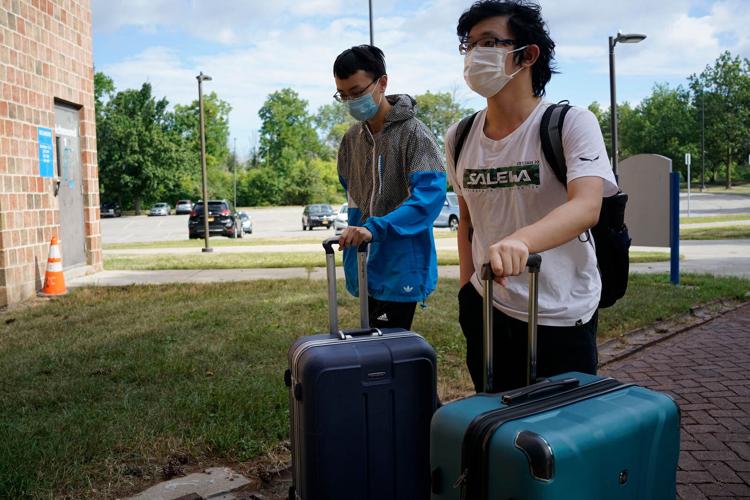
UB students Zuyang Li, left, and Huang Hongxu, both from China, who stayed on campus throughout the summer because they couldn't go home, move their belongings across campus to their new dormitory.
A community issue
Poremski is a humanities librarian at UB and praises the school for its Covid-19 planning and outreach to students. She also sees hope for the neighborhood.
On a mid-August evening, the Mister Softee ice cream truck stopped on one of the neighborhood streets, and Poremski and her husband took their daughter to get cones. They watched as college students congregated, and Inez was thrilled to see her part of the community bustling.
Those students, Poremski said, were mindful of social distancing as they stood in line for ice cream. They wore masks. For those moments, it seemed University Heights had reached a happy medium.
“It’s a community issue,” Poremski said. “The students, they don’t just stay in their houses like I do. They go to restaurants, they go to 7-Eleven, they go to Target, they go to Wegmans. Anyone could get infected (with Covid-19). Careless behavior is what they're looking out for. I’m hopeful. I’m very hopeful the right moving parts will come together and if a party happens, they’ll get shut down.”
She understands the fatigue level – and a certain amount of cabin fever – that comes with living in the Covid-19 pandemic. But she also knows that one party or one afternoon of beer pong could cause a community emergency.
“People want to get back to normal, quickly,” Poremski said. “And I’m worried about that. New York has a low (positivity) rate, but it can spike at any moment. That’s the terror we’re living with. I don’t want to see what has happened at North Carolina, or at any other school that has had an outbreak. I’m worried we’ve been doing all this work at UB to keep students safe on campus, for classes and labs, and all the sudden, it has to go back online. That would be heartbreaking to see, for everybody."