

BLOOMINGTON — Conversations about mental health have been more prevalent on college campuses around the country in recent years.
According to the American Council on Education, more than 6 in 10 students indicated some level of agreement that they needed help in the past year for emotional or mental problems, such as feeling sad, blue, anxious or nervous.
Slightly more than 1 in 4 students strongly agreed they needed help.
With the unique challenges that come with academic pressures, social adjustments and personal growth, student mental health has become a growing priority for institutions of higher learning.
In Bloomington-Normal, Illinois State University, Illinois Wesleyan University and Heartland Community College are working to support student well-being through counseling, education and community care.
People are also reading…
"We never want there to be a barrier to students being able to access really needed care," said Carrie Haubner, director of Student Counseling Services at ISU. "We're only a phone call away; there's always somebody who's available and that is only one point of entry."
The office provides a range of support options for students, including individual therapy sessions, group therapy, crisis intervention and consultations, Haubner said. The office offers same-day appointments for urgent needs, and walk-in hours during peak times, such as midterms and finals.
In the past year, Haubner said, they had about 1,200 clients visit the office for services. While that number has been higher in past years, Haubner noted the office previously had more staff who could accommodate more students.
To meet those needs, the office has 17 clinicians on staff, including four doctoral candidates enrolled through an accredited internship program, Haubner said. Two graduate assistants are available to help with outreach services and the office's relaxation room.
Haubner said the office provides a mental health speaker series and a consultation space to provide support and training to faculty and staff to better express care and concern to students.
Other programs include the Body Project, which aims to reduce eating disorders and body image concerns for students, and outreach by request, which is when faculty, staff or students request someone from the office to talk about certain mental health topics.
The office also provides virtual counseling through TimelyCare, and is available anytime and anywhere for students who may not feel comfortable going to in-person counseling, Haubner said.
"We wouldn't ever want anybody to silently be suffering, and we recognize that for some individuals, coming through the threshold and physically coming in to the office can be a lot for a number of reasons," Haubner said. "The staff in this department on this campus work really hard, and we are proud and ready to serve students in any capacity."
'Talking it out'
At Illinois Wesleyan University, students can access counseling services via individual therapy sessions, crisis response intervention and outreach programming, which also is available to faculty, staff and student organizations upon request.
Christina Armstrong, director of Counseling and Consultation Services at IWU, said the office has seen consistently higher levels of anxiety, depression, self-esteem and loneliness among students over the years, and since the COVID-19 pandemic, there's been an increasing need for more sessions.
Armstrong said even though IWU is a smaller university, counseling staff have been able to meet the needs of most students who seek help. She added they see about 20% of the student population on a regular basis and also connect with the athletics staff and academic professors to identify any other needs from students.
"We tend to have a lot of perfectionists, so it's sometimes difficult to get them to come in or to see that it's OK to ask for help," Armstrong said. "Luckily, being on a smaller campus, some of our benefits are that we do have more relationships with professors and especially athletics to connect us with students who may need help."
The university also has student organizations like Awareness, Wellness, Education (AWE), which works to cultivate a campus culture that prioritizes mental well-being.
Brady Poisal, a junior studying political science and a student programmer with AWE, said the group holds monthly meetings alongside events that raise awareness about things like substance abuse and suicide prevention. They also talk about topics like "duck syndrome," which is the idea that students may be struggling through the pressures of higher education, all while appearing calm and put together.
The goal, Poisal said, is to make these conversations feel easy and comfortable for those who may never have talked about their struggles, and to destigmatize mental health while offering advice and resources.
"Don't be afraid if you're having a rough time to go and sit down and just talk," Poisal said. "Everyone can benefit from talking it out, and whether that is at counseling services or at any other resources on campus, I encourage everybody to find that support system."
'A sense of belonging'
At Heartland Community College, students can access personal counseling in office or virtually, and additional services like group therapy, crisis intervention and consultation.
Camille Springer, director of Student Counseling & Wellness Services at HCC, said on top of mental health, the office tends to look at a student's physical health and financial situation so they can provide any other needed resources through the college's pantry of food, clothing and personal care products.
Students also are welcome to decompress in the office's "stress reduction lab," which offers a massage chair and a calming space where students can de-stress and take a moment for themselves during difficult personal times or around final exams.
"If something in their life is going particularly stressful, they can come in and just hang out," Springer said. "We won't necessarily bother them, unless they look extra distressed, but we'll check in with them, maybe offer a snack or bottle of water. Ultimately we just want them to feel comfortable and invited in the space."
During the 2024-25 school year, the office had over 850 appointments with students, and since 2019, it has experienced a 400% increase in students using these services, Springer said.
Another resource is National Alliance on Mental Illinois on Campus, a student-led arm of NAMI that tackles mental issues by raising awareness, educating the campus community, supporting students and promoting support services and advocacy.
Oli Crutcher, a social work major at Heartland and president of NAMI on Campus, said the group works with other student organizations, like PRIDE and the Alliance of Latin American Students, to provide events like painting sessions, a hot chocolate table during finals week, and handing out support materials and fidget toys to help students cope with stress or any other mental health struggles.
"When we get to look around and see that something that we put on is bringing people happiness, it feels like a success," Crutcher said. "We've gotten a really great sense of community for me and different members, and I think people in general have a sense of belonging here on campus."
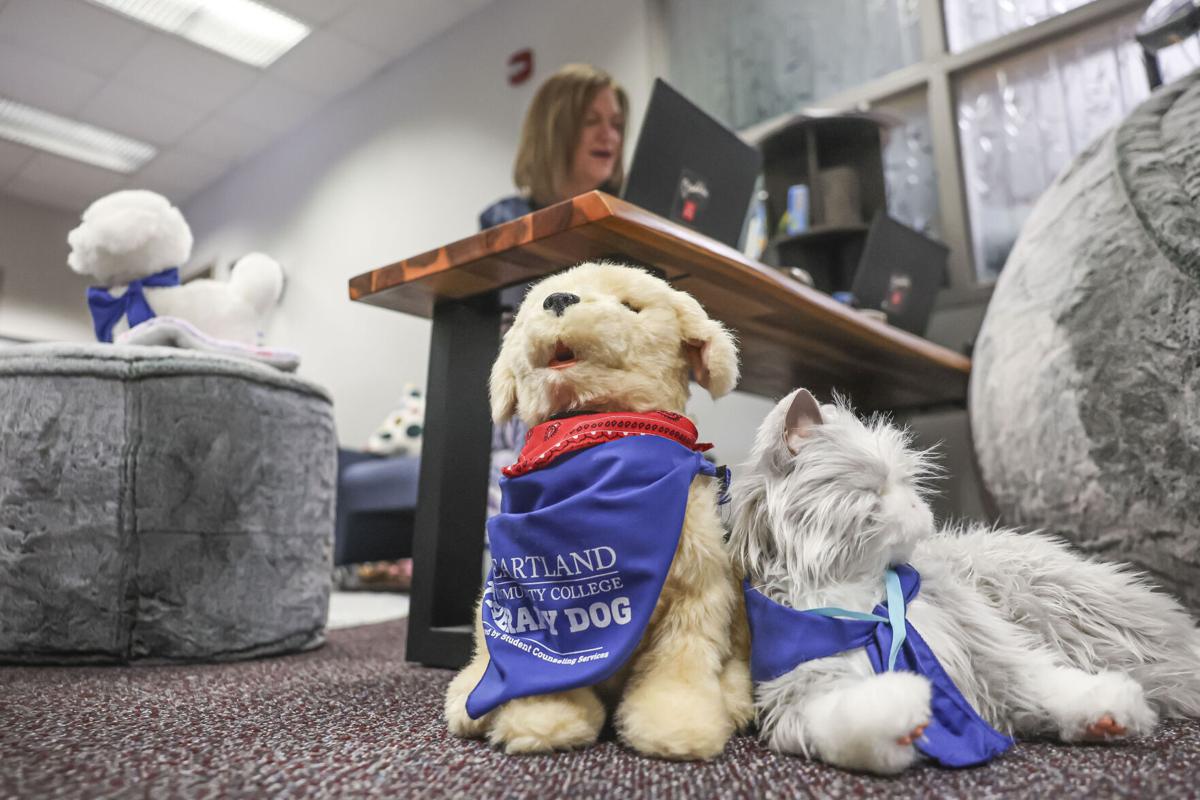
Director Camille Springer talks about mental health resources at Heartland Community College
Contact Mateusz Janik at (309) 820-3234. Follow Mateusz on Twitter:@mjanik99


