BLOOMINGTON — In Bloomington-Normal, the community's growing diversity is highlighting the importance of accessible mental health services for non-English speakers.
A national survey of mental health facilities published by the National Institute of Health found that 69% of facilities provide non-English language services, more often through on-call contract interpreters than by multilingual staff.
According to the survey, provision of language services is strongly associated with public ownership of facilities, high patient volume, and locations in states with a high proportion of residents with limited English proficiency.
And while the demand for bilingual counselors is high, the supply remains limited, prompting local organizations to implement innovative ways to bridge this gap and provide essential services.
People are also reading…
“I speak Spanish, but if I were to go to therapy, I would not want to go through therapy in my second language, because it’s not accessing those feelings in the same way,” said Sarah Mellor, social services director at The Immigration Project in Normal. “It’s important that people have access to a therapist that speaks their language and can talk directly to them in a way that’s clear and comprehensible.”
The McLean County Health Department's Behavioral Health Coordination program works with various community organizations to address behavioral health needs. While the office doesn't have bilingual staff, they use language translation services and partner with local organizations to better serve residents.
However, having individuals on staff who speak a second language proficiently is worthwhile for every organization, Landreth said.
"It's also important to say that if you are going to invest in bilingual staff, that organization acknowledges that as an additional skill that deserves additional compensation reflecting the skill that they're bringing on board," Landreth said.
In addition to providing essential legal assistance and support to immigrants, The Immigration Project has one mental health counselor on staff with a caseload of about 30 people at a time.
The project also offers support groups for migrant women and revolving around migrant grief, as there is a lot of trauma that comes with adapting to a new culture and being in a place where they may not know anyone, said Mellor.
The project has collaborated with Integrity Counseling in Bloomington to address the mental health needs of immigrants and offer affordable, donation-based therapy services.
Elsewhere in the Twin Cities, the Center for Youth and Family Solutions in Bloomington offers a range of behavioral health and counseling services with a trauma-informed approach, said Stephanie Barisch, director of therapeutic services there. Currently they have two bilingual counselors and an intern who all speak Spanish; they also use translation services when needed.
"We definitely need more Spanish-speaking clinicians," Barisch said. "We are constantly trying to recruit more, since the need and demand is there as far as language goes. That is the biggest need in our community."
Barisch said she has also seen a demand by individuals who are hearing impaired and communicate through American Sign Language and need someone to be either visually or physically present in order to translate.
Despite the hurdles, Barish said she and other organizations have services available and are willing to serve anyone, and to use local resources to bridge that language barrier, because it is what is right.
“We've seen clients that have gone through immigrant issues and have lost family members, and being able to express that grief in their first language is a big deal,” said Luella Mahannah, director of Integrity Counseling. "One thing as an agency and as a community that we could do better with is getting out to some of the churches in the community that have a large Spanish-speaking congregation to connect with groups, find potential clients, and helpers as well."

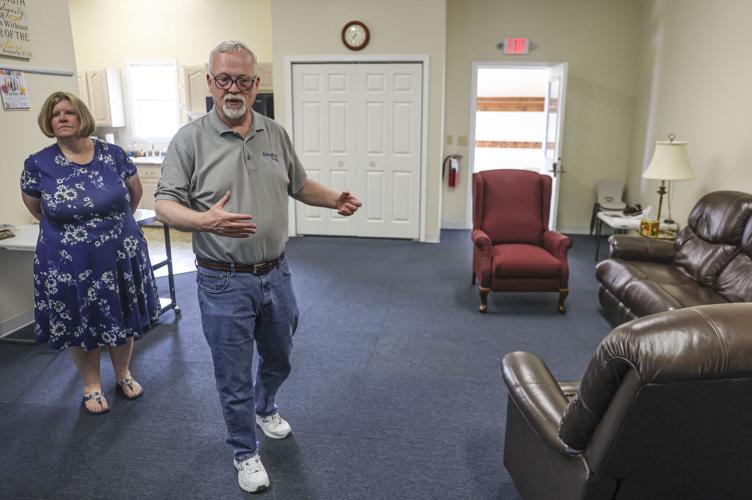
Luella, left, and Don Mahannah discuss the services offered at Integrity Counseling in Bloomington, on Wednesday, May 7.
Mahannah said Integrity Counseling provides services to around five Spanish-speaking clients and has two interns on staff who can provide Spanish-speaking services. They also partner with organizations like Western Avenue Community Center, the Center for Youth and Family Solutions and YWCA Stepping Stones to provide wraparound services.
“The services we provide and the work we do is important to provide accessible support in our community," said Migdalia Galue, a bilingual counselor at YWCA Stepping Stones. This organization provides support for survivors of sexual violence, and is in need of volunteers to translate materials from English to Spanish, ensuring that YWCA resources are accessible to Spanish-speaking individuals in the community.
Galue does therapy sessions in English and Spanish across multiple organizations in the community, and recently received further education at Bradley University in Peoria.

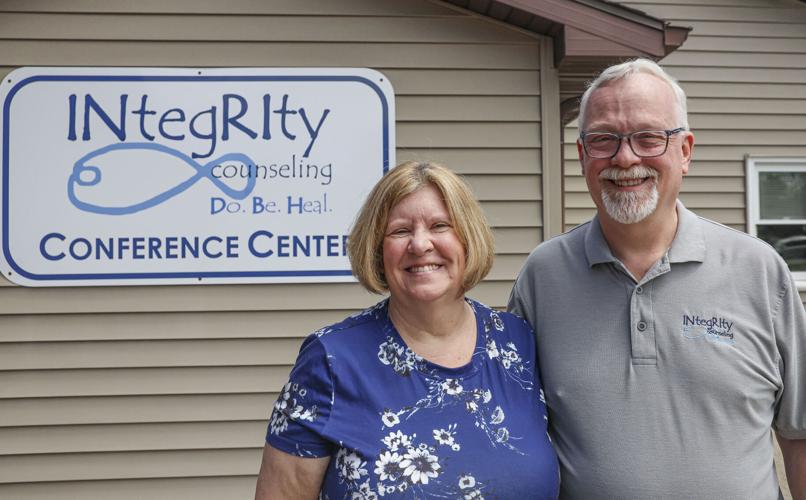
Luella, left, and Don Mahannah operate Integrity Counseling, a pay-as-you-can mental health service in Bloomington, shown here on Wednesday, May 7, 2025.
Galue said she and other counselors have caseloads of around 20 patients each, and half of her caseload is Spanish-speaking individuals. She still sees gaps in the community for bilingual and Spanish-speaking services, especially among children and in the school systems, to be able to directly assist with students.
"Services play a crucial role in assisting individuals who need support navigating the trauma of abuse and grief, and we can ensure that more people receive the help they deserve in a language they can understand," Galue said.
Holly Hall, executive director at the Community Health Care Clinic in Normal, said the clinic has hired five Spanish-speaking individuals to accommodate patients across all services. She added that 90% appointments there are conducted in Spanish.
Hall said patients tend to be resistant when faced with English service providers or translation services, but they open up more when they are able to speak in their native language.
She believes organizations should look at the community's needs and find ways to be more competitive when it comes to attracting bilingual and Spanish-speaking professionals to work here, when they otherwise might choose to work in larger metropolitan areas.
"In order to get the most out of your health care experience and the relationship you have with health care providers, we need to be able to understand them, and they need to be able to understand you," Hall said. "It creates an environment where the patient feels more safe, more heard, more able to convey what they're experiencing."
Contact Mateusz Janik at (309) 820-3234. Follow Mateusz on Twitter:@mjanik99