

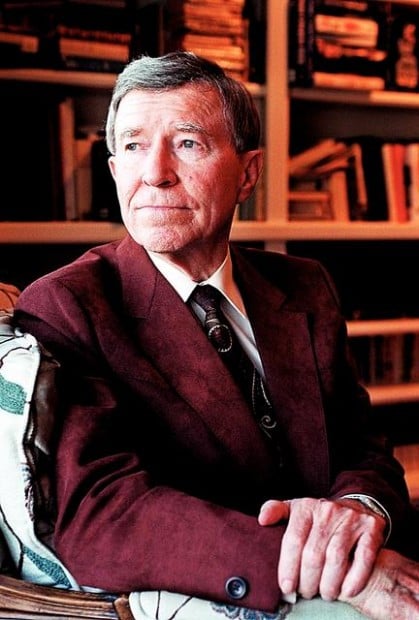
PHOENIX — Evan Mecham, the only Arizona governor to be impeached, tried and ejected from office, died late Thursday at the Arizona State Veteran Home after a lengthy illness.
The 83-year-old Mecham, the state's chief executive for less than 16 months, brought Arizona a great deal of national attention during his brief stint, much of it unwanted.
Contemporaries in state government say he changed Arizona's political landscape, although they disagree on how.
"His tenure, his impeachment, his removal has scarred the body politic in ways that are still being felt," said Art Hamilton, the Democratic House minority leader at the time.
He said the move by GOP lawmakers to oust him "energized what I call the extreme right wing of the Republican party." The backlash resulted in Republican leaders being turned out in the next primary. "It polarized the Republican Party in ways I think are still visible today," Hamilton said.
People are also reading…
Jim Skelly, a Republican and then chairman of the House Judiciary Committee, has a different take.
"Philosophically, I probably agreed with over 95 percent of what he was pushing," said Skelly. But he said Mecham was such a divisive personality he set back the causes the two of them shared.
"It was kind of a black eye towards conservatism," Skelly said. "People were turned off, not by the philosophy but by the individual." It took years to undo that damage, he said.
Jane Hull, at the time the speaker of the House of Representatives who later became governor, agreed Mecham did the conservative movement no good because he focused on the wrong things.
"He focused on, rather than the big picture, the trivial picture," Hull said.
Mecham was at the center of a controversy over a paid state holiday to honor slain civil-rights leader Martin Luther King Jr. and drew raised eyebrows with some of his comments, which were considered racially insensitive.
But it was two unrelated incidents that led legislators to vote for his removal: a charge of obstruction of justice for telling the director of the Department of Public Safety not to cooperate with an investigation of death threats involving two aides, and loaning $850,000 in inaugural ball receipts, which had been in a "protocol fund," to his own Pontiac dealership.
While the Senate voted to convict him on April 4, 1988, it did not invoke a clause that would have barred him from ever again seeking public office.
That freed Mecham to make an unsuccessful independent bid for the U.S. Senate in 1992, losing to John McCain.
He spent many of his final years trying to convince others he was illegally ousted from office, even self-publishing a book "Wrongful Impeachment" and hawking copies himself at a booth he rented annually at the Arizona State Fair.
His time in politics, which also included a brief stint as a state legislator in the 1960s, had broad effects on politics and the futures of those with whom he came in contact.
Rose Mofford, the Democrat secretary of state when Mecham was ousted, ended up finishing his term.
Fife Symington, then just a developer with political aspirations, gained prominence in 1987 as being the first major Republican to call for Mecham's resignation. At that time, Mecham faced a criminal grand-jury probe for failing to report a $350,000 loan from developers to his gubernatorial campaign.
Symington, who was elected governor in 1991, later had to swallow his words a week after he was indicted on criminal charges of lying to creditors about his assets to obtain a loan for one of his partnerships. He called the former governor and apologized.
Joe Lane, a Willcox lawmaker who was House speaker during the impeachment hearings, had his political career cut short when Mecham supporters targeted his re-election bid.
And Ed Buck became Arizona's first high-profile gay political activist by leading a recall against Mecham.
Mecham's election itself as governor in 1986 was a precursor of schisms that still exist within the Republican party.
House Majority Leader Burton Barr was the favorite of the state GOP organization for the party's gubernatorial nomination, but Mecham capitalized on that status, calling him a tool of special interests.
Mecham also benefited from a three-way general election against Democrat Carolyn Warner, who had been state school superintendent, and Democrat-turned-independent Bill Schulz, and thus needed only a plurality of the vote to get elected.
Mecham considered one of his legacies putting an end to tax increases.
But it was one of his first actions that created headlines and became the hallmark for which his administration was known: repeal of an executive order issued by Bruce Babbitt, his predecessor, to create a state-paid King holiday.
Mecham said, correctly, state law prohibited the governor from making such a move, pointing to an opinion by Attorney General Bob Corbin. But it created a battle line from the outset of his tenure.
His defense of the use of the term "pickaninnies" in a book touched off marches on the Capitol and prompted groups to start canceling national conventions they had scheduled for Arizona.
The governor raised eyebrows again with his claim Corbin had microwaves trained on the ninth floor executive offices in an effort to overhear the governor's conversations.
Mecham's claim of wrongful impeachment was fed by the fact a jury acquitted him of the criminal charges relating to the campaign loan — a point legislators chose not to take up during his impeachment.
Some of those involved in the Mecham administration are still around and active in politics.
One of those is state Sen. Karen Johnson. The Mesa Republican, who has been in the Legislature since 1998, worked for Mecham during his term as governor and later.
"I would hope that, in many ways, I was trying to carry on the legacy of Evan, who always wanted to do what was right and wanted government to be smaller and constitutional," she said.
And Ron Bellus, who was Mecham's press aide, now handles the television services for the Legislature.
While he acknowledged Mecham's style often got him in trouble, Bellus said some of the public's negative image of his former boss was due to a distorted image painted by the media.
"Ev made the comment to me one time, saying, 'You know, if I believed everything the press said, I'd hate me, too,' " Bellus recalled.
Read more on the ex-governor at Kim Matas' Last Writes blog: go.azstarnet.com/lastwrites


