It's spring in Tucson. The flowers are blooming, the birds are chirping and the Africanized bees are swarming.
Northwest Side fire officials say there have not been any Africanized bee attacks this year, but they are preparing for an active season.
"We haven't had any calls for bees recently," said Rick Flores of Rural/Metro Fire District. "But we are anticipating the season to start any time now."
When temperatures get warmer, bees don't necessarily get more active, but they do tend to swarm, said Gloria Degrandi-Hoffman, research leader with the Carl Hayden Bee Research Center in Tucson.
"It's warm here most of the time, so they are really active throughout the year," she said of honey bees. "This is the time of year when bees swarm — it's a natural phenomenon."
People are also reading…
Colonies build up populations in the early spring so nests become overcrowded, causing the bees to look for other places to live, Degrandi-Hoffman said.
With all of those bees out and about, local fire officials are anticipating an active season.
"It's still kind of early, but we're just getting started with the desert in bloom," said Battalion Chief John Sullivan of Golder Ranch Fire District.
Oracle Fire District has trucks prepared in the event of a bee emergency. They spray foam that will kill the swarm if necessary, said Larry Southard, fire-prevention officer.
The public would have a hard time telling the difference between a honey bee and an Africanized bee, said Katy Heiden, Northwest Fire/Rescue District spokeswoman.
"There's no way to tell by looking at them if they're Africanized or not," Heiden said. "We pretty much assume all bees have some degree of being Africanized."
Heiden said Northwest Fire has had calls, but has not had any reported attacks so far this year.
"In part because it's early, and in part I think people are aware of bees now," Heiden said.
As people get farther away from Tucson city limits, the feral bee population increases, said Degrandi-Hoffman.
"The chances of you finding an African bee colony goes up," she said. "It's the feral population that is African."
Hikers, rock climbers and people spending time outdoors should be aware of feral nests, Degrandi-Hoffman said.
"That's where they become a problem," she said. "If people are hiking they need to keep their eyes open for honeybees like they would rattlesnakes."
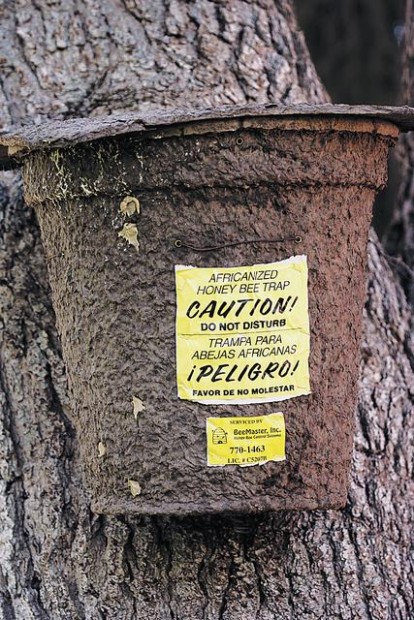
Oro Valley Country Club superintendent Darrin Baker said there is nothing the club can do to keep bees away, so it contracts with a bee-removal service and puts out traps along the golf course.
"We're managing the population, not keeping them away," Baker said. "The traps create a preferred environment for the bees, so they go there."
The club hasn't seen any attacks, he said.
The removal service visits the country club weekly to check the traps and haul off the swarms they collect, Baker said.
"Between 95 and 98 percent of those bees were Africanized, so they just assume all of them are now," he said. "Part of our responsibility is to keep people as safe as we can while they're on our property."
Collecting the bees in traps is the best way the club can aid safety, Baker said.
"If they're in the neighborhood, it's important to know where they're going to be so you can deal with them," he said.
Tips on how to stay safe in bee country
● The do's and don'ts of Africanized bees
Do check your yard regularly for bee colonies. Honeybees nest in a variety of places, so check animal burrows, water meter boxes, overturned flowerpots, trees and shrubs.
Don't keep animals near beehives or nests.
Do put screens over rainspouts and water meter boxes, and keep all holes in trees, saguaros and outside walls filled or covered.
Do keep pets and children inside when using power tools such as yard clippers and lawn mowers.
Don't destroy a bee colony or hive, especially with pesticides. Honeybees are an important part of agriculture in the U.S.
Do avoid excessive motion when near a bee colony, because bees are more likely to respond to something in motion.
Do add two tablespoons of vinegar per gallon of water in birdbaths and pet water to discourage bees.
Don't call the Fire Department to remove bee colonies or hives.
Don't remove bees yourself; instead call a bee removal or bee keeping service.
● What to do if you're attacked:
Run away without flailing or swinging your arms.
Cover your head as much as you can without slowing your escape.
Get to a shelter or the closest house or car.
Do not jump into a pool; bees will hover over the water waiting for you to come up for air.
Call the Fire Department only when bees pose a threat or cause a medical emergency.
Sources: Golder Ranch Fire District, Northwest Fire/Rescue District