

PHOENIX — When you reach Mexico's capital of ice cream, you'll know it.
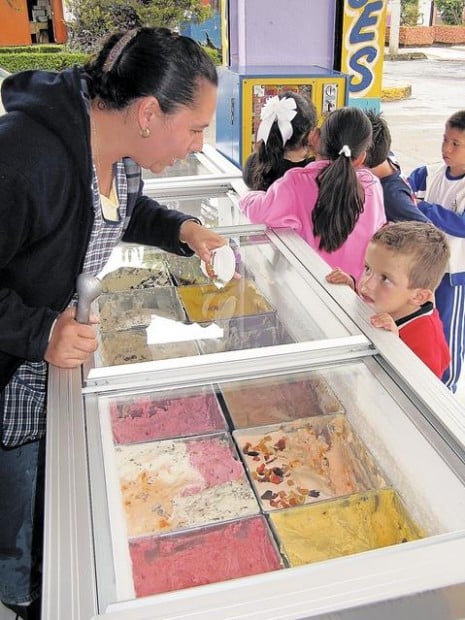
Huge bags of chocolate sprinkles in every storefront. Buckets of sweet cream stuffed into giant coolers that open onto the street. Passers-by licking Popsicles in winter.
Welcome to Tocumbo, a tiny town that has spawned an empire rivaling Baskin-Robbins or Ben & Jerry's.
Tocumbo is the home of "Michoacan" ice cream, named after the Mexican state where the town is located. A pair of shops opened by Tocumbo natives in Mexico City led to hundreds more bearing variations of the Michoacan name, from Guatemala City to Portland, Ore. An Internet search turned up at least 60 in the United States, including in Phoenix.
"We're showing the world what good ice cream is," said Norma Barragan, manager of one of four ice-cream shops near the main plaza in Tocumbo, a town of 1,500 residents.
People are also reading…
Along the way, the town has practically invented a new business model, said German Espinoza, the town's administrator. The Michoacan brand is not registered in Mexico, and anyone with an ice-cream maker and a storefront is free to use it. With no chains and no franchisees, the town makes its money by selling equipment, ingredients and know-how to small entrepreneurs.
This open-source way of doing business has created thousands of jobs and helped keep people in Michoacan, traditionally one of the biggest sources of migrants to the United States, Espinoza said.
At the town's entrance, a three-story-high sculpture shows a globe covered with ice-cream cones and Popsicles.
"When you think of how many jobs this town has created, it's truly impressive," Espinoza said.
The Flower of Tocumbo Ice Cream Shop is one of two unrelated shops with the same name within a block of each other. No matter, said manager Barragan: Imitation is part of the game in Tocumbo.
The cooler in front of her held stacks of ice-cream blocks: tequila, sweet cheese curd, cantaloupe and pine nut, among others.
Another cooler had hundreds of "paletas," Mexican-style Popsicles with chunks of kiwi, pistachios, orange papaya and homemade peanut butter.
Barragan scooped out a sample of avocado ice cream. A visitor asked what was in it.
"Cream, sugar and fresh avocados," she said, giving him a puzzled look. "What, you were expecting something artificial? This is the original stuff here."
The story of Tocumbo's rise to ice-cream supremacy is clouded by competing claims and friendly rivalries. But most people agree that it began in the mid-1940s, when Tocumbo brothers Ignacio and Luis Alcazar, along with their cousin Agustin Andrade, headed to Mexico City in search of work, Espinoza said.
The Alcazars and Andrade opened Popsicle shops, both called La Michoacana. Which shop came first is a matter of debate, but the frozen treats proved to be an ideal snack for the booming Mexican capital: cheap, refreshing and easily transported by street vendors.
The three Tocumbans didn't have a monopoly on the Popsicle business. What they did have were numerous relatives and neighbors arriving from Tocumbo.
Mexico was undergoing an industrial boom, and poor farmers from Michoacan were streaming to Mexico City in search of work.
Some of the newcomers started peddling La Michoacana Popsicles. Others started their own stores. Michoacan migrants were soon known for ice cream.
Their fame grew even more after vendors in the colonial Michoacan town of Patzcuaro introduced tourists to local nieve de pasta, an ice cream that tastes like butter cookies, known as pastitas.
About 90 percent of families in Tocumbo are now involved in the ice-cream business, Espinoza said.
In December, the town's population swells by 3,500 as returning migrants come home for the holidays and participate in the annual Ice Cream Festival. Of those, probably 2,000 own at least one ice-cream shop, Espinoza said.
In a cluttered workshop in the center of town, Alejandro Andrade is equipping the newest generation of entrepreneurs. There, workers are welding sheets of stainless-steel and copper tubing into shiny new ice-cream machines and Popsicle chillers. It's one of three machinery makers in Tocumbo.
For $30,000, customers can buy an entire ice-cream shop: machinery, tables, chairs, menus and signs emblazoned with "La Michoacana" and the logo of an Indian girl. Andrade says he sells four packages a month; 12 have gone to the United States in the past year.
Other businesses in Tocumbo specialize in ingredients. At Materias Fernandez down the street, there are jugs of extracts like chamoy, or pickled apricots; rompope, a kind of Mexican eggnog; and horchata, a rice-and-almond drink.
"People will come down from Chicago and go home with their cars full of these, because you can't get these flavors in the United States," owner Maria de Jesus Fernandez said.
There are three dairy distributors selling sweet cream, and more shops selling Popsicle molds and Styrofoam cups with the Indian girl logo.
Over the years, several people, including Andrade, have tried to trademark variations of the Michoacan name and Indian-girl logo, with limited success. "They have become so common that it can't be done," Espinoza said.


 Tucson official: Air Force won't pay for D-M groundwater cleanup now


