When Janet Cruz lost an April election for a Tampa City Council seat, she became a political casualty of an increasingly high-stakes debate over recycled water.

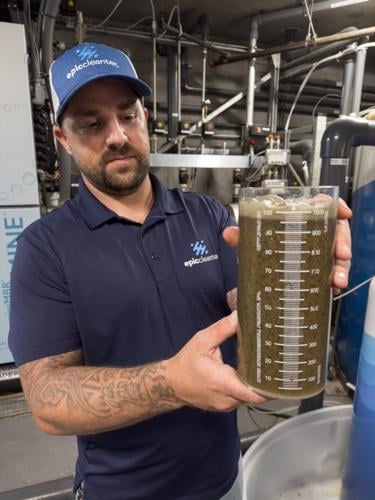
Epic Cleantec operations director Ryan Pulley holds a beaker of treated wastewater, known as gray water, from a San Francisco apartment tower.
During her time in the Florida Legislature, Cruz had supported a new law allowing the use of treated wastewater in local water systems. But many Tampa residents were staunchly opposed to a plan by their water utility to do just that, and Cruz was forced to backtrack, with her spokesperson asserting she had never favored the type of complete water reuse known as “toilet to tap.” She lost anyway, and the water plan has been canceled.
Tampa’s showdown may be a harbinger of things to come as climate change and drought cause water shortages in many parts of the country. With few alternatives for expanding supply, cities and states are rapidly adding recycled water to their portfolios and expanding the ways in which it can be used. Researchers say it’s safe — and that it’s essential to move past the 20th-century notion that wastewater must stay flushed.
People are also reading…
“There is no reason to only use water once,” said Peter Fiske, director of the National Alliance for Water Innovation at the Lawrence Berkeley National Laboratory. “We’ve got to be more clever with the water we’ve got.”
But proponents are still fighting an uphill battle to overcome the “yuck” factor. A recent study found that reused water is not only safe but that it’s actually cleaner than conventionally sourced water — yet acceptance is “hindered by perceptions of poor water quality and potential health threats.”

Epic Cleantec operations director Ryan Pulley fills a beaker with gray water cleaned to drinking water standards, to be reused for flushing toilets, laundry, and irrigation at the San Francisco apartment tower it came from.
Several projects were canceled in California in the 1990s because of such worries. In San Gabriel, Miller Brewing Company opposed a water reclamation project when people started joking about “beer aged in porcelain.”
Many forms of water reuse have long been routine. Water from yard sprinklers, for example, soaks into the groundwater. Or, if it is processed in a treatment plant, it goes into a river or lake, where it’s used again. Municipalities and others often treat a form of wastewater known as gray water to use for irrigation.
But in the world of water reuse, the gold standard is known as direct potable reuse — cleaning wastewater, including sewage, to drinking water standards.
With DPR systems, the water from showers, sinks, and toilets first goes to a conventional treatment plant, where it is disinfected with chemicals and aeration. Then it gets a second scrubbing in a multistage process that first uses a bioreactor to break down nitrogen compounds, then employs microfiltration to clean out particles and reverse osmosis to remove viruses, bacteria, and salts. Finally, hydrogen peroxide is added and the water goes through an ultraviolet light processing, which is supposed to kill any contaminants that are left.
Experts say the water that emerges at the end of this process is so clean it has no taste, and that minerals must be added to give the water flavor. It’s also free of a little-known health hazard; chlorine, often used to disinfect conventional water, can react with organic material in the water to create chloroform, exposure to which can cause negative health effects.
Big Spring, Texas, is the only place in the country with a DPR municipal water system, in which all wastewater is treated and sent back to the tap. Another notable DPR system is the Changi Water Reclamation Plant in Singapore, which cleans 237 million gallons each day.
In Tampa, intense opposition focused on the high cost of the water treatment and the possible presence of pharmaceuticals, hormones, and so-called forever chemicals, known as PFAS.
Experts reject these concerns as uninformed and say properly treated wastewater is safer than a lot of conventional drinking water sources.
With higher temperatures and long-term pressure on water sources including aquifers and mountain snowpacks, a lot more water reuse is coming.
In Texas, the state permits DPR plants on a case-by-case basis, and the city of El Paso is building one that’s slated to be online by 2026. Colorado last year began allowing DPR. In California, regulations spelling out the approach to DPR should be ready by the end of this year, with some cities setting goals of recycling all water by 2035. Florida and Arizona are also moving to expand direct potable reuse.
There’s also a lot of activity around what’s known as indirect potable reuse. Orange County, California, has the world’s largest IPR facility, which cleans 130 million gallons of water a day to irrigation standards, passes it through advanced purification, and finally injects it into groundwater, which serves as an environmental buffer. The water is then piped to all municipal users.
San Francisco is pioneering another approach. Since 2015, the San Francisco Public Utilities Commission, which operates the dams, reservoirs, and aqueducts that deliver water from the Sierra Nevada to the city, has required all buildings over 100,000 square feet be equipped for recycling gray water.
Epic Cleantec, which created a recycling system for a new San Francisco apartment tower, thought beer might help. The company last year teamed up with a local brewery to produce beer from recycled water. The Epic OneWater Brew by Devil’s Canyon Brewing isn’t sold; rather, it’s a demonstration product, given away and served at events.
While people might not want to drink recycled water, they will usually try the beer.
“We’re trying to change the conversation,” said Aaron Tartakovsky, CEO of Epic Cleantec. “We’re fundamentally trying to help people rethink how our communities handle water.”