President Donald Trump repeatedly campaigned for his second term as a champion of free expression, vowing in his January 2025 inaugural address to stop what he described as years of "government censorship."
Since then, a wave of court rulings concluded his administration has done the opposite. Reuters identified 75 federal judge rulings finding Trump’s government infringed on First Amendment rights, including freedoms of speech, religion and the press.
The pushback included repeated findings that the administration chilled or squelched the speech of citizens and groups opposing the Republican president’s agenda.
Boston-based U.S. District Judge William Young ruled in September that the administration illegally detained, deported and revoked visas of foreign students and faculty because of their pro-Palestinian advocacy.
People are also reading…
Other judges found federal agencies terminated grants awarded to universities for refusing to align with Trump’s ideological agenda; retaliated against law firms based on their legal advocacy; and used excessive force at protests.
Trump administration officials have repeatedly called federal judges ruling against them "activists" who are interfering with the president's executive authority.
Losing streak
The 75 cases that produced lower-court rulings against the Trump administration were among 93 total cases during his second term in which judges addressed First Amendment arguments, Reuters found. Trump's losing streak mostly came from judges appointed by Democratic presidents, but Republican appointees delivered decisions in 10 cases.
By comparison, during Democratic President Joe Biden's presidential term, Reuters identified just 27 cases in which lower-court judges weighed First Amendment challenges to his agenda. Judges ruled against his administration in 13 of those. Most of the lower-court rulings against the Biden administration involved its vaccine mandates, which were challenged on grounds of religious freedom.

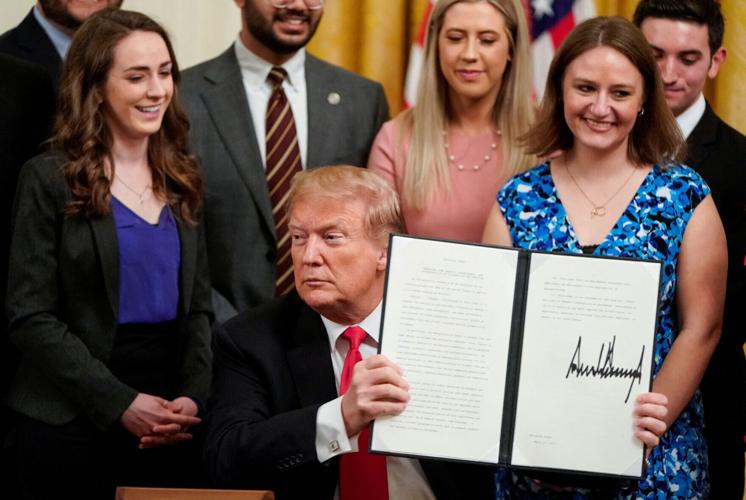
President Donald Trump shows an executive order linking free speech efforts at public universities to federal grants during a signing ceremony on March 21, 2019, in the East Room at the White House in Washington, D.C.
Reuters tallied the First Amendment cases by searching federal court records and Westlaw, a legal research service. Both Reuters and Westlaw are owned by Thomson Reuters. When similar lawsuits were consolidated by a court or when a judge issued multiple rulings in the same lawsuit, Reuters counted them as one case. The review focused on civil lawsuits filed against the Trump administration and excluded cases by self-represented litigants.
The Trump administration launched appeals in about two-thirds of the cases while electing to let other rulings stand. It chose not to challenge rulings that, for instance, prevented it from interfering with what academics can discuss in classrooms and from slashing longstanding grants awarded to legal and medical organizations that opposed the administration’s agenda.
In appeals of 15 of the 75 rulings that went against Trump, his administration successfully persuaded courts either to put a district court judge's First Amendment ruling on hold or overturn it entirely.
In an appeal in February, the San Francisco-based 9th U.S. Circuit Court of Appeals overturned a ruling that blocked the Trump administration from stripping federal workers of the ability to engage in union bargaining with U.S. agencies.
The unions argued that Trump took that action in order to retaliate against them challenging his administration's policies. But a three-judge panel said Trump would have taken the same action whether or not he intended to punish unions for their advocacy.
Other appeals courts have been less receptive. In May, the 9th Circuit agreed with a lower-court judge that terminating federal grants awarded to University of California researchers — as part of Trump's anti-DEI push — constituted viewpoint discrimination.
Railing against ‘censorship’
Trump rode to his second-term win after railing against an "online censorship regime" that he said the Biden administration imposed when it required media companies to suppress alleged misinformation during the COVID-19 pandemic and after the 2020 election. He echoed themes from his first presidential campaign, including opposition to what he called "cancel culture," as some conservatives complained that social and professional pressures discouraged expression of their political views.
Hours after his 2025 inauguration, Trump signed an executive order titled "Restoring Freedom of Speech and Ending Federal Censorship," which directed that no federal agency or employee would unconstitutionally abridge Americans' speech rights.

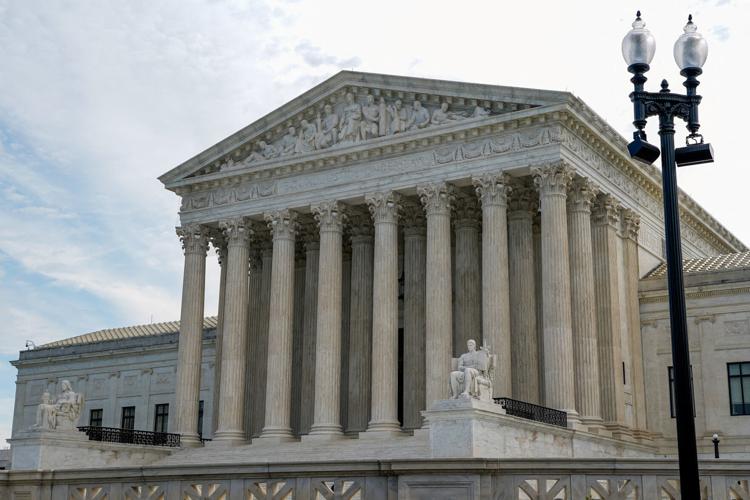
The U.S. Supreme Court in Washington, D.C., on June 25.
Critics say that promise was almost immediately undercut by a flurry of other executive orders and policies seeking to exact retribution against foes or targeting viewpoints the president opposed.
Among those early orders were those directing an end to federal funding his administration deemed as supporting "gender ideology" or diversity, equity and inclusion.
Based on arguments heard in May, a Washington federal appeals court appears poised to uphold lower courts' decisions that Trump's campaign against law firms and lawyers infringed upon free speech.
Among those decisions was a May 2025 ruling by U.S. District Judge Beryl Howell, who castigated Trump for targeting a law firm through an executive order that suspended its lawyers' security clearances and barred them from entering federal buildings based on its past work for his political opponents.
"Settling personal vendettas by targeting a disliked business or individual for punitive government action is not a legitimate use of the powers of the U.S. government or an American President," Howell wrote.