

Suicidal deer sign; 'Walking Dead' props; Detroit sick-out
- Updated
Odd and interesting news from the Midwest.
- By BARRY ADAMS Wisconsin State Journal
- Updated
BLUE MOUNDS, Wis. (AP) — Kyle LaFond began his career as a wildlife biologist, studying bear, elk and whitetail deer for the state Department of Natural Resources.
But the motivation for LaFond's new livelihood came from the perspiration of a different type of creature, one that can be oblivious to its odor and effect on those nearby.
Two years teaching science in a pungent classroom environment populated with middle school boys turned out to be the basis of a business model for LaFond's American Provenance, the Wisconsin State Journal (http://bit.ly/231Ho0k ) reported.
The business has transformed part of his family's idle dairy farm into a production facility for deodorants, body sprays, aftershaves and other body and hair care products for men and women.
Coupled with sales experience at Capital Brewery in Middleton, LaFond has his products in over 60 retail locations around the Midwest and an online business taking orders from around the country. Sales could double this year to $500,000, and it likely won't be long before the business outgrows the 1,000-square-foot space that used to be his grandfather's machine shop.
"Everything led me to where I am now," said LaFond, 37. "The science background at both the DNR and teaching helped me come up with this whole project, and then my sales background helped me go out and pitch the product."
The name of the company comes from its roots in rural America as provenance means "the place of origin." Products are also creatively named to evoke a rugged American theme. The scents in the company's men's line include Fastballs & Fisticuffs, Brass Knuckles & Branding Irons, Horseshoes & Hand Grenades and Firepits & Flannels. For the women's line there are names like Virtues & Vices, Daggers & Diamonds and Pinups & Paramours. The proceeds from the men's line Gridiron Greats benefit former NFL players in need of assistance.
The brand is aimed at consumers looking for locally made products with all-natural ingredients. Like other craft products, whether it's be beer, soda, cheese or pasta, it comes with a higher price than those that are mass produced by international corporations.
The men's deodorant, for example, is $7.75 per stick and is made with coconut oil, beeswax, shea butter, arrowroot powder, aluminum-free baking soda and a blend of lemongrass, bergamot and marjoram oils. The aftershave, $10.50 per 100-milliliter bottle, includes aloe vera, witch hazel and vegetable glycerin while hair pomades are $18.50 for a 120-gram jar and include jojoba oil, vitamin E oil and argan oil.
The artwork on the labels of all of the lines is by Andrew Holdorf, a high school classmate of LaFond and owner of Six Roses Tattoo in Middleton.
"I've always admired his artwork and I wanted to give him a platform as a local artist to show off more of his breadth and depth," LaFond said. "To Andrew's credit, I came to him with these names and these products ... and I gave him free rein. He came back in a month with renderings and I was completely blown away."
But the collaborations go beyond names and artwork. LaFond has partnered with the Oil & Ash Soap Co. in Milwaukee to create a line of bar soaps that can include olive and coconut oils and shea butter.
A line of candles with American Provenance scents are produced with the help of Katie Doescher of NatureWorks Candle Shop in Blue Mounds. Retail display cases are made from reclaimed barn boards by Steve Acker at Born of a Barn furniture and cabinet shop in Verona.
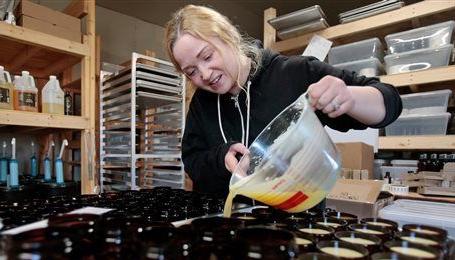
There is virtually no automation at American Provenance. Production can include mixing ingredients in 2-quart glass Mason jars, hand-filling each container with squeeze bottles and pouring melted deodorant from a glass pitcher into plastic holders. Labeling is typically done by hand. All of this occurs 100 feet from an old chicken coop and 250 yards from where LaFond bagged a 14-point buck in 2012.
The mount hangs in the shop near vintage beer trays and a stringer of walleye caught in Canada. LaFond had converted his grandfather's shop into a hunting camp but transformed the space into a production area after launching his business last spring.
A small, homemade bar is now used as work space for labeling products, while the bunk beds have been turned into shelving to hold bulk containers of ingredients.
Greta Geiger worked with LaFond at Capital Brewery but is now one of four employees at American Provenance. Her day can include mixing products, labeling and packaging.
"I have the same outlook on the products as him," Geiger said of LaFond while filling bottles with Fastballs & Fisticuffs Aftershave. "With his sales background and his drive, I didn't have any doubts about this."
The 120-acre farm in southwestern Dane County was purchased by LaFond's great-grandfather and later farmed by LaFond's grandfather, Delmar Zentner. He quit farming in the mid-1980s and died in 2014 just a week after his 91st birthday.
LaFond's mother purchased the property about 20 years ago, and LaFond has warm and inspirational memories of his grandfather, who milked 40 cows a day. They had names like Debbie and Patsy, their name plates still affixed above the worn empty stanchions in the lower level of the classic red barn on a ridge overlooking the headwaters of the Sugar River.
"This is part of my family legacy," LaFond said. "Being out here and having a business out here is a great way for me to carry forward my grandfather's legacy."
After graduating from Middleton High School in 1996, LaFond attended UW-Madison, where he studied wildlife management. That led to a job after graduating in 2000 with the DNR in Madison. In 2007, he enrolled at UW-Platteville to become a science teacher and spent two years teaching in New Glarus and Belleville.
"Middle school boys smell awful," LaFond said. "When they come back from lunch and recess, it just wafts in the room, the stench of BO."
LaFond kept a supply of deodorant in his desk that he would pass around to his students, but after reading the labels and noticing the amount of chemicals they contained, he began making deodorant with natural ingredients in his kitchen. Six years later, after several trials and eventually positive reviews from family and friends, LaFond used $30,000 in savings, borrowed $30,000 from the Small Business Administration and had family members invest another $30,000 to help him launch his company in May 2015.
LaFond worked part time at Capital Brewery beginning in 1999 but in 2011 was named director of business development, a position that had him calling on distributors around the Upper Midwest. His sales skills have helped him quickly grow his list of retailers that include natural food stores and co-ops like Willy Street, Viroqua Food and Milwaukee based Outpost. Products are also available at Community Pharmacy, 13 Hometown Pharmacies, Metcalfe's Market and in 20 Hy-Vee stores. LaFond is working to get his products in all of Hy-Vee's 250 stores, a move that would force him to quickly expand.
"I think a lot of folks are looking for products they can have a relationship or an experience with," LaFond said. "We're going to listen to customers. We're going to let our customers dictate our business and the products we make. We solicit information and feedback at every opportunity we have."
___
Information from: Wisconsin State Journal, http://www.madison.com/wsj
This is an AP Member Exchange shared by the Wisconsin State Journal
- Updated
DETROIT (AP) — A 94-year-old Detroit native has been awarded the Bronze Star Medal for heroic service and meritorious achievement during World War II.
Lt. Col. Alexander Jefferson was presented the award by U.S. Sen. Debbie Stabenow on Sunday at the 61st Annual Detroit NAACP Freedom Fund Dinner.
Stabenow says Jefferson is one of the few remaining Tuskegee Airmen still alive. It was the first African-American unit to fly combat airplanes in World War II.
In 1944, he was shot down on his 19th mission in Europe and taken prisoner by the Nazis. His prison camp was liberated in 1945, but he saw atrocities at the Dachau concentration camp.
In 2007, Jefferson and other Tuskegee Airmen received the Congressional Gold Medal — the nation's highest civilian honor.
- Updated
DES MOINES, Iowa (AP) — The number of drunken driving deaths on Iowa roads has increased, but driver's license revocations are down.
The Des Moines Register reports (http://dmreg.co/1WA3XJs ) there were 123 drunken driving deaths last year. That's up from 110 the year before and 114 in 2012.
Last year, 13,938 driver's licenses were revoked for drunken driving in the state. That number has been steadily declining. In 2014, 14,515 licenses were revoked and in 2012, 17,708 licenses were taken.
The issue was highlighted by a deadly crash in March on Interstate 80 near Waukee when an intoxicated driver going the wrong way slammed into a Des Moines police vehicle at 102 miles an hour. The driver, two Des Moines police officers and a prisoner all died.
"We're hoping that (the accident) serves as a wake-up call," said Patrick Hoye, bureau chief of the Governor's Traffic Safety Bureau. "The current culture has to change. We're losing too many lives on Iowa highways to impairment."
Officials with the state Transportation Department and law enforcement say the decline is a result of having fewer officers on the road because of budget cuts. Also, more people may be getting rides home after drinking.
"We're hoping that fewer people are driving drunk," Hoye said. But, he added, "a lot of departments have told us they don't have the same amount of officers they used to. If there's less officers out there, that probably means fewer tickets are being written."
Mary Roche's husband died 23 years ago in a crash with a drunken driver. Roche said she thinks public attitudes about drunken driving need to change.
"Somehow we believe we have the right to drive if we're impaired," said Roche, of Waterloo. "People minimize the effects of their impairment — they think, 'I'm not drunk, I can handle it.' No, you can't."
Later this month, Iowa officials will meet to draft recommendations about what more should be done to deter driving intoxicated.
___
Information from: The Des Moines Register, http://www.desmoinesregister.com
- Updated
WEST LAFAYETTE, Ind. (AP) — A device developed by a Purdue University team is helping boost recycling during the university's tailgating events before home football games.
The team developed small metal rings which clip onto the side of regular trash barrels and are fitted with a trash bag to encourage people to fill them with discarded cans and plastic bottles.
The device has been helping cut down on waste at Purdue tailgating and other events since the fall of 2014.
Purdue Sustainability director Michael Gulich tells WLFI-TV (http://bit.ly/1SRHzIR ) that before the recycling units were implemented, only about six percent of waste produced during tailgating events was actually recycled.
But with the units installed, he says about 45 percent of that waste is now recycled. Gulich says the metal rings can be deployed quickly.
- By MICHAEL GERSTEIN Associated Press
- Updated
LANSING, Mich. (AP) — A group of 22 lawmakers backs a bill to require more rigorous medical training for police officers, borne of fear that some rural police are not properly equipped to rescue people undergoing heroin or prescription opioid overdoses.
Republican bill sponsor state Rep. Hank Vaupel, a Fowlerville Republican, said current law doesn't require police to stay up-to-date on medical procedures that can save people from a narcotics overdose. But the organization that develops training standards for the state's 20 police academies and another that represents police officers say law enforcement are already trained in practices Vaupel's bill would mandate.
Vaupel said he spoke with two police chiefs that he would not name who don't require officers in their departments to be trained to do "rescue breathing," commonly known as mouth-to-mouth resuscitation.
Medical experts say heroin overdose victims often need assisted breathing because the narcotic can shut down the respiratory system. But Vaupel said the two departments are only trained to perform chest compressions. He said he fears that puts lives at risk amid growing concern over opioid abuse.
State data show that heroin-related overdose deaths tripled since 1999. In 2014, the most recent data available, 1,745 people in Michigan died of fatal heroin or opioid painkiller overdoses.
Vaupel said he suspects other small departments also might not stay current on CPR training that includes rescue breathing, which his bill would require. State Rep. Andy Schor, D-Lansing, echoed that concern.
The Michigan Commission on Law Enforcement Standards sets training programs for police in the state, but they don't require police to renew CPR training. Neither that organization nor the Michigan Association of Chiefs of Police, which represents the state's police officers, keeps statewide data showing how many local departments require their officers to renew CPR training.
Jeff Boyd, Livingston County Emergency Medical Services director, said some officers also don't know they're supposed to accompany rescue breathing with anti-overdose drugs in some instances. He said he'd like EMS personnel to help train police to administer the drugs, and testified in a House committee on behalf of Vaupel's measure.
George Basar, legislative director for the Michigan Association of Chiefs of Police, said he sees the bill as unnecessary because recruits trained in the state's police academies are already required to learn rescue breathing as part of their basic training.
Wayne Carlson with the state commission that develops those training standards confirmed that. Carlson said police CPR training is based on programs from the American Red Cross and the American Heart Association. All state troopers learn the same techniques, said Shanon Banner, a spokeswoman for the State Police. Carlson and Basar said they suspect most departments make their officers renew training, but Carlson said it's possible some don't.
Michele Wagner of Fowlerville, a constituent in Vaupel's hometown, helped spark the legislation after her 23-year-old son, Mitchell, died of a fatal opioid overdose the night before Thanksgiving 2014. She said he still had a heartbeat when she found him on the floor of their home, but officers who arrived performed chest compressions without rescue breathing and weren't carrying Naloxone, a drug that can resuscitate people in an opioid overdose.
Wagner said she thinks her son wouldn't have died if police had been carrying the drug and helped him breathe.
"I don't know how I get through," Wagner said. "One day at a time. That's all I can do. I don't know. I go to therapy. I do community service, try to take it to the community and talk about it."
Fowlerville Police Chief Thomas Couling confirmed the date and cause of Mitchell Wagner's death, but declined to say whether officers performed rescue breathing while trying to revive him.
Couling said as a general rule, his officers don't perform rescue breathing anymore.
"The way they teach you to do CPR these days, is by compressions," he said, noting that all of his department's officers are Red Cross certified in CPR.
A spokesman from the American Red Cross said they have programs that include rescue breathing and ones that don't.
"She's a grieving mother," Couling said. "And this has been very difficult for everybody. And as much as we care for her and we do, we've done everything that can be done in this case."
___
This story has been corrected to show 22 lawmakers support the legislation, not 20.
- Updated
CINCINNATI (AP) — A southwest Ohio county is at odds with Cincinnati officials over the disposal of solid human waste.
The Cincinnati Enquirer reports (http://cin.ci/1SPY77d ) that the latest spat between the city and Hamilton County centers on the Metropolitan Sewer District closing its incinerator for maintenance.
It's unclear when or if it will reopen because it no longer meets federal pollution standards.
Unless the EPA grants an extension, the sewer district must ship several truckloads a day of solid waste to a landfill. Backup incinerators aren't operating at full capacity.
City officials say they want to build a $16 million sewage digester to replace the incinerator. But county officials say they don't want to build anything until they study the issue. That could take until next year.
___
Information from: The Cincinnati Enquirer, http://www.enquirer.com
- Updated
ST. ANSGAR, Iowa (AP) — An activist wants to persuade officials in northern Iowa to take down a deer crossing sign that warns about "suicidal deer."
Christy Kessens told the Waterloo-Cedar Falls Courier (http://bit.ly/1WzZMgw ) she thinks the sign makes light of mental illness.
But so far Mitchell County officials seem unlikely to change the sign.
After the sign went up along Iowa Highway 105 outside St. Ansgar in March, Mitchell County supervisors considered removing it, but the motion never advanced to a vote.
Supervisor Stan Walk in Iowa says officials wanted the sign to be an attention-getter, and it has been.
___
Information from: Waterloo-Cedar Falls Courier, http://www.wcfcourier.com
- Updated
SCOTTSBLUFF, Neb. (AP) — A 55-year-old western Nebraska man has been sentenced to six months in jail for trying to take out a loan in his brother's name.
The Scottsbluff Star-Herald reports (http://bit.ly/1WA8qvB ) a judge finalized details of the sentence for Mark Cross last week. Cross will get credit for 64 days of jail time he has already served, and he will be supervised for 18 months after his release.
Prosecutors say Cross went to the Team Chevrolet car dealership in February and tried to get a loan for $70,592 in his brother Joel Cross' name to buy a 2016 Chevrolet Suburban.
Police became involved after Joel Cross started getting letters from a finance company about someone trying to purchase a vehicle.
Dealership officials told police they became suspicious of Mark Cross after he couldn't provide an accurate Social Security number.
The dealership told police that Mark Cross signed paperwork in the name of Joel Cross and said that was his legal name but he went by Mark. Then a salesman took Mark Cross to his home to pick up his Social Security card, and it had the name Mark Cross printed on it.
Mark Cross pleaded guilty in March to attempted theft as part of an agreement with prosecutors.
___
Information from: Star-Herald, http://www.starherald.com
- Updated
LAWRENCE, Kan. (AP) — Lawrence school officials say it's unlikely the district will ban displays of the Confederate flag.
An advisory committee told students seeking the ban that broadening the district's existing discrimination and harassment policy to include symbols would accomplish the same goal as banning the flag.
Some students began asking for the ban after a student flew a Confederate flag from his pickup truck on school grounds in January.
The Lawrence Journal World reports (http://j.mp/1SRcXXX ) the committee members say broadening the current discrimination policy would also reduce the risk of the school district being sued by students claiming their free speech rights were being violated.
The discrimination policy currently bans written, verbal or physical discrimination and harassment.
The advisory committee will meet again Tuesday to begin drafting a new policy.
___
Information from: Lawrence (Kan.) Journal-World, http://www.ljworld.com
- By RALPH CHAPOCO Daily News
- Updated
SLINGER, Wis. (AP) — Fans watching TV's "The Walking Dead" are definitely aware of Michonne, a character shrouded in mystery. She joined the show near the end of the second season as a hooded figure who saves another individual from harm by using a sword known as a katana.
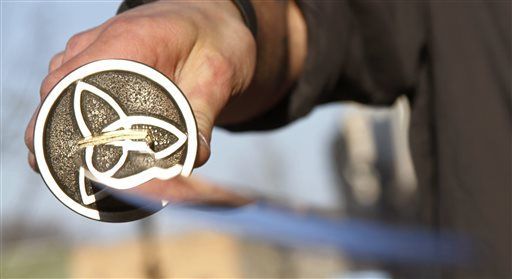
Many characteristics contribute to Michonne's persona and a large part of that identity is tied to props created by Mark Grzybowski of Slinger.
He created the blade Michonne's character uses on the show. He was responsible for every detail of the weapon, from the feel and shine of the blade to the look of the sheath that covers it.
"The propmaster called and left a voicemail message, saying there is a new character that needed a sword," Grzybowski said.
He was asked to make four swords. They provided the design and he had to make them in one month.
"It was really cool seeing my sword on television," Grzybowski said. "I didn't have cable at the time so I was driving back and forth to my parents' house." For Grzybowski, the opportunity was an amalgamation of past experience, passion and an abiding faith he could make a living from his talents. His interest in weaponry began when he was 10. He grew up watching movies like "Conan the Barbarian" and "Beastmaster," which piqued his interest in swords.
"I have a brother and we were raised without guns," Grzybowski said. "Swords were the only weapons we could pretend to play with. I think that was the early '80s." The interest petered out for a few years as he was growing up, and he was less interested with the object and more attracted to the creative process. He enjoyed the creativity and appreciated designing the finer details of the weapon.
He went to the University of Wisconsin-Milwaukee and went through several majors before settling on the arts, where he found his passion. He began in the technical areas, engineering and computer science. He then went to Spanish, but eventually found art.
"The program was interesting," Grzybowski said. "A student can major in art, but have an emphasis in different mediums. There is sculpture, ceramics and everything else." His interest became metalsmithing. He learned to mold and shape a variety of metals, both by machine and by hand. There was a class where he learned how to cut sheets of metal.
"I didn't know what I was going to do with the major," Grzybowski said. "It was something I just wanted to do." He graduated in 1999 and took a few jobs in retail, but it was not a good fit.
"I was going crazy and needed to create things again, so I worked at a higher-end woodworking store," Grzybowski said. "I applied and got a retail job there. It turns out some of people from the sword place I eventually worked at got their supplies from where I worked. One of my coworkers got their information." Grzybowski was given a chance.
"Basically I worked for Jody Samson," Grzybowski said. "Whatever he wanted me to do, I would do. I cleaned the shop. A lot of it was preparing materials for him. He had free rein with his part of the company, so he could make whatever swords he wanted. He would draw the designs on bars of metal and I would have to cut out the profile of the blades, and eventually fitting guards on the sword." In exchange, he learned from Samson?s expertise. Practically, he learned a hollow grinding technique that is aesthetically pleasing. He then found a job in Indiana, working for a swordsmith there on a project for Nintendo and learned how to make swords designed in the Far East, before his family started his own business.
"My family had a meeting and they wanted to start a business," Grzybowski said. "The deal was that I could work in the shop and they would handle everything else." He made many types of swords for customers, mainly historical pieces ordered on the Internet. He worked with the company for a few years before it closed down and he transferred out of the business.
But he built a reputation for himself in the industry, and that is why representatives from "The Walking Dead" contacted him in 2013 for a sword.
The rest is history.
"The coolest part is there is an action figure with the sword," Grzybowski said. "She has had four different figures. I bought them and gave them to everybody."
___
Information from: Daily News, http://www.gmtoday.com
This is an AP Member Exchange shared by the Daily News
- Updated
TOPEKA, Kan. (AP) — Six years before it has to be done, state and federal officials are already talking about redistricting of congressional and legislative districts in Kansas.
The new maps for political districts aren't due in Kansas until 2022. But officials from the U.S. Census Bureau met with the state Legislature's research department last week to discuss the process and get familiar with data and computer software that will be used, The Lawrence Journal-World reported (http://bit.ly/1riKLnN).
The next census will be in 2020 and states have two years after that to draw new political maps.
"It's a long process, so we want to get information out early so folks can start preparing whatever material they need — geographic information; software — so they can start thinking about how they're going to implement the program when it comes time to actually start redistricting," said Michael Ratcliffe, the Census Bureau's assistant division chief for geographic standards in Washington.
The census counts each state's residents and maps them into geographic units known as census "blocks." Legislatures use that data to draw maps that are supposed to be as equal in population as possible.
The process is often controversial. In 2012, Kansas lawmakers were unable to draw a redistricting plan of their own, leaving the job to a three-judge federal court panel.
An estimated 2.9 million people currently live in Kansas, about 2.1 percent more than the count from the 2010 census. Kansans are steadily moving from rural areas into the state's larger cities, particularly Kansas City and Lawrence, and Ratcliff said that trend is likely to continue.
"Some of the (rural) counties out here in Kansas, Nebraska and the Dakotas hit their peaks in the late 1800s, others in the early part of the 20th century," he said. "And that's happening all across the country, really, not just out here."
The shift likely means the next round of redistricting will leave Kansas City, Lawrence and Wichita metropolitan areas with more seats in the Kansas Legislature, with fewer rural legislators. That could lead to significant changes in how the state's four congressional districts are configured. It appears the First district, which covers all of western Kansas and much of central Kansas will become larger geographically, while the Second and Third Districts of eastern Kansas, and the Fourth District around Wichita will become smaller.
The state officials who met at the Statehouse won't be involved in those decisions. They will manage the data files and software programs that allow lawmakers and others to draw maps and submit their proposals for the new districts.
"We provide the data. The states then do the work. We stay out of that," Ratcliffe said.
___
Information from: Lawrence (Kan.) Journal-World, http://www.ljworld.com
- Updated
TOPEKA, Kan. (AP) — A hospital can deny unemployment benefits to a former employee who objected to receiving a flu vaccine, according to a recent ruling from the Kansas Court of Appeals.
In a unanimous decision, the three-judge appeals panel affirmed a lower court ruling dismissing the case of Debra Rhodenbaugh, who had been an emergency department clerk at McPherson Hospital. In 2013, the hospital announced employees would be required to receive a flu vaccination to limit exposure and transmission of the virus, The Topeka Capital-Journal reported (http://j.mp/1NzPCuB ).
The hospital allowed for religious and medical exceptions. Rhodenbaugh chose the second, and sent the hospital a note from her doctor stating she "prefers to defer flu shot at this time."
When the hospital said the note didn't qualify as a medical exception, Rhodenbaugh provided detailed reasons for not wanting a flu shot including relatives who she said died and suffered complications after receiving vaccinations.
She was fired two days later, and when she began receiving unemployment benefits, the hospital appealed to the Kansas Employment Security Board of Review, which ruled she wasn't eligible for unemployment benefits.
Shawnee County District Court Judge Rebecca Crotty sided with the hospital, saying the vaccination rule was fairly enforced.
"The policy applied to all employees and reasonable exceptions were made for those objecting on medical or religious grounds," Crotty ruled.
In agreeing with Crotty, the appeals panel said Rhodenbaugh had a "duty to the hospital to follow the safety rule by either receiving the flu vaccine or meeting the applicable exemptions." The ruling said Rhodenbaugh's failure to comply amounted to job-related misconduct "and thus disqualified her for unemployment benefits."
___
Information from: The Topeka (Kan.) Capital-Journal, http://www.cjonline.com
- Updated
ST. CHARLES, Mo. (AP) — A university that owned the two-century-old home in suburban St. Louis where famed frontiersman Daniel Boone once stayed and drew his last breath is donating the property to the county's park system.
Lindenwood University has run the limestone-walled house as a tourist and educational site since 1988, the St. Louis Post-Dispatch reported (http://bit.ly/1TaAqQZ ). But on Friday, St. Charles County Executive Steve Ehlmann and Lindenwood's president, Michael Shonrock, announced the school is turning over to the county the home, along with the adjoining 66-acre historic village and more than 200 surrounding acres.
All of the property, about five miles south of New Melle, will be called Lindenwood Park. After the ownership change, expected in coming weeks, the university will continue its various classes and activities at the site in field biology, archaeology, history and recreation leadership.
The house, completed in 1810, was the home of Boone's son but was where Boone spent part of his final years and where he died in 1820.
"I am thrilled that we will be part of sharing this rich history of our region with others," Ehlmann said of the donation, which also allows the county to provide additional green space for outdoor activities.
The village includes more than 20 other historic structures moved there from other sites over the years.
As part of the deal, Ehlmann said, the school will give the county a significant amount of maintenance equipment at the site, including tractors and backhoes. Lindenwood will get a $500,000 credit relieving it from paying rent for the next few years for commencement exercises held at the county-owned arena in nearby St. Charles.
Joe Brazil, a county council member whose district includes the property site, called the Boone home the county's "crown jewel."
The new Lindenwood Park will be the 12th park in the county system, which began almost from scratch in 1997.
___
Information from: St. Louis Post-Dispatch, http://www.stltoday.com
- Updated
CINCINNATI (AP) — Workers renovating Cincinnati's Music Hall have discovered human remains at the more than 100-year-old performance venue.
The Cincinnati Enquirer reports (http://cin.ci/1MZTNA1 ) workers uncovered skeletons under the orchestra pit while removing asbestos in late March.
Archeologists concluded the arm and leg bones under the orchestra pit are believed to be four adult bodies. They identified six other grave shafts in the north carriageway.
The property under Music Hall was a public burial ground in 1818. Heavy excavation hasn't yet started on the Music Hall's $135 million renovation project.
Bones have been popping up at the Music Hall since construction began for the building in 1876. Workers found a skull and other bones during a major renovation in 1969.
___
Information from: The Cincinnati Enquirer, http://www.enquirer.com
- By MEGAN RAPOSA Argus Leader
- Updated
SIOUX FALLS, S.D. (AP) — Florencia Nievas knew at a young age that she wanted to teach in another country.
The Argentina native studied English for eight years before coming to Sioux Falls to teach in the school district's Spanish immersion program, the Argus Leader (http://argusne.ws/240AKx3 ) reported.
Like Nievas, almost all of the district's 20 Spanish immersion teachers come to South Dakota from other countries, according to human resources supervisor Becky Dorman.
The district does not travel to find international teachers, Dorman said, but that has not stopped them from recruiting from a wide range of Spanish-speaking countries, including Argentina, Ecuador, Columbia, Spain and Mexico.
Spanish immersion teachers must be able to speak both English and Spanish. They are recruited primarily online, Dorman said, but the district has also been able to hire teachers based on the recommendations of current teachers.
"Now that our program has been existent for more than a handful of years, staff are reaching out to people they know in the world of teaching," Dorman said.
A number of interns have also stayed on to become full-time teachers.
Nievas first came to Sioux Falls as an intern for the district three years ago, through the Amity Institute, a program that places international teachers in American classrooms.
After a summer back in Argentina, she accepted a full-time job as a first-grade Spanish immersion teacher at Rosa Parks.
Coming to the U.S. for a job was not cheap, Nievas said. The district does not pay teachers to relocate, but a parent-led group does what it can to offer new teachers support, according to school board member and Spanish immersion parent Carly Reiter.
The Parent Advocates for Spanish Immersion set up fully-furnished apartments for teachers, so when they arrive in the U.S. they are able to walk into a home. They also help teachers find community resources, get a drivers license, open bank accounts, and meet other teachers and parents.
"It's a very large process, but our whole intent is, number one, we want our teachers to feel welcome and comfortable," Reiter said.
The international flight was expensive, Nievas said, but the support from parents and the opportunity to teach in Sioux Falls made the trip worthwhile.
"They have given us so much, the parents from the school," Nievas said.
Before coming to Sioux Falls, Nivas had never been abroad, but after two years teaching within the district, she's starting to feel at home.
"When I came, I fell in love with the (Spanish immersion) program, and I really like the way they work here," Nievas said.
This year, the district is looking to hire seven Spanish immersion teachers, including three new positions. When Sonia Sotomayor Elementary opens in the fall, most of its 23 teachers will be from other countries.
And Nievas is excited to be one of them.
___
Information from: Argus Leader, http://www.argusleader.com
This is an AP Member Exchange shared by the Argus Leader
More like this...
- By BARRY ADAMS Wisconsin State Journal
BLUE MOUNDS, Wis. (AP) — Kyle LaFond began his career as a wildlife biologist, studying bear, elk and whitetail deer for the state Department of Natural Resources.
But the motivation for LaFond's new livelihood came from the perspiration of a different type of creature, one that can be oblivious to its odor and effect on those nearby.
Two years teaching science in a pungent classroom environment populated with middle school boys turned out to be the basis of a business model for LaFond's American Provenance, the Wisconsin State Journal (http://bit.ly/231Ho0k ) reported.
The business has transformed part of his family's idle dairy farm into a production facility for deodorants, body sprays, aftershaves and other body and hair care products for men and women.
Coupled with sales experience at Capital Brewery in Middleton, LaFond has his products in over 60 retail locations around the Midwest and an online business taking orders from around the country. Sales could double this year to $500,000, and it likely won't be long before the business outgrows the 1,000-square-foot space that used to be his grandfather's machine shop.
"Everything led me to where I am now," said LaFond, 37. "The science background at both the DNR and teaching helped me come up with this whole project, and then my sales background helped me go out and pitch the product."
The name of the company comes from its roots in rural America as provenance means "the place of origin." Products are also creatively named to evoke a rugged American theme. The scents in the company's men's line include Fastballs & Fisticuffs, Brass Knuckles & Branding Irons, Horseshoes & Hand Grenades and Firepits & Flannels. For the women's line there are names like Virtues & Vices, Daggers & Diamonds and Pinups & Paramours. The proceeds from the men's line Gridiron Greats benefit former NFL players in need of assistance.
The brand is aimed at consumers looking for locally made products with all-natural ingredients. Like other craft products, whether it's be beer, soda, cheese or pasta, it comes with a higher price than those that are mass produced by international corporations.
The men's deodorant, for example, is $7.75 per stick and is made with coconut oil, beeswax, shea butter, arrowroot powder, aluminum-free baking soda and a blend of lemongrass, bergamot and marjoram oils. The aftershave, $10.50 per 100-milliliter bottle, includes aloe vera, witch hazel and vegetable glycerin while hair pomades are $18.50 for a 120-gram jar and include jojoba oil, vitamin E oil and argan oil.
The artwork on the labels of all of the lines is by Andrew Holdorf, a high school classmate of LaFond and owner of Six Roses Tattoo in Middleton.
"I've always admired his artwork and I wanted to give him a platform as a local artist to show off more of his breadth and depth," LaFond said. "To Andrew's credit, I came to him with these names and these products ... and I gave him free rein. He came back in a month with renderings and I was completely blown away."
But the collaborations go beyond names and artwork. LaFond has partnered with the Oil & Ash Soap Co. in Milwaukee to create a line of bar soaps that can include olive and coconut oils and shea butter.
A line of candles with American Provenance scents are produced with the help of Katie Doescher of NatureWorks Candle Shop in Blue Mounds. Retail display cases are made from reclaimed barn boards by Steve Acker at Born of a Barn furniture and cabinet shop in Verona.
There is virtually no automation at American Provenance. Production can include mixing ingredients in 2-quart glass Mason jars, hand-filling each container with squeeze bottles and pouring melted deodorant from a glass pitcher into plastic holders. Labeling is typically done by hand. All of this occurs 100 feet from an old chicken coop and 250 yards from where LaFond bagged a 14-point buck in 2012.
The mount hangs in the shop near vintage beer trays and a stringer of walleye caught in Canada. LaFond had converted his grandfather's shop into a hunting camp but transformed the space into a production area after launching his business last spring.
A small, homemade bar is now used as work space for labeling products, while the bunk beds have been turned into shelving to hold bulk containers of ingredients.
Greta Geiger worked with LaFond at Capital Brewery but is now one of four employees at American Provenance. Her day can include mixing products, labeling and packaging.
"I have the same outlook on the products as him," Geiger said of LaFond while filling bottles with Fastballs & Fisticuffs Aftershave. "With his sales background and his drive, I didn't have any doubts about this."
The 120-acre farm in southwestern Dane County was purchased by LaFond's great-grandfather and later farmed by LaFond's grandfather, Delmar Zentner. He quit farming in the mid-1980s and died in 2014 just a week after his 91st birthday.
LaFond's mother purchased the property about 20 years ago, and LaFond has warm and inspirational memories of his grandfather, who milked 40 cows a day. They had names like Debbie and Patsy, their name plates still affixed above the worn empty stanchions in the lower level of the classic red barn on a ridge overlooking the headwaters of the Sugar River.
"This is part of my family legacy," LaFond said. "Being out here and having a business out here is a great way for me to carry forward my grandfather's legacy."
After graduating from Middleton High School in 1996, LaFond attended UW-Madison, where he studied wildlife management. That led to a job after graduating in 2000 with the DNR in Madison. In 2007, he enrolled at UW-Platteville to become a science teacher and spent two years teaching in New Glarus and Belleville.
"Middle school boys smell awful," LaFond said. "When they come back from lunch and recess, it just wafts in the room, the stench of BO."
LaFond kept a supply of deodorant in his desk that he would pass around to his students, but after reading the labels and noticing the amount of chemicals they contained, he began making deodorant with natural ingredients in his kitchen. Six years later, after several trials and eventually positive reviews from family and friends, LaFond used $30,000 in savings, borrowed $30,000 from the Small Business Administration and had family members invest another $30,000 to help him launch his company in May 2015.
LaFond worked part time at Capital Brewery beginning in 1999 but in 2011 was named director of business development, a position that had him calling on distributors around the Upper Midwest. His sales skills have helped him quickly grow his list of retailers that include natural food stores and co-ops like Willy Street, Viroqua Food and Milwaukee based Outpost. Products are also available at Community Pharmacy, 13 Hometown Pharmacies, Metcalfe's Market and in 20 Hy-Vee stores. LaFond is working to get his products in all of Hy-Vee's 250 stores, a move that would force him to quickly expand.
"I think a lot of folks are looking for products they can have a relationship or an experience with," LaFond said. "We're going to listen to customers. We're going to let our customers dictate our business and the products we make. We solicit information and feedback at every opportunity we have."
___
Information from: Wisconsin State Journal, http://www.madison.com/wsj
This is an AP Member Exchange shared by the Wisconsin State Journal
DETROIT (AP) — A 94-year-old Detroit native has been awarded the Bronze Star Medal for heroic service and meritorious achievement during World War II.
Lt. Col. Alexander Jefferson was presented the award by U.S. Sen. Debbie Stabenow on Sunday at the 61st Annual Detroit NAACP Freedom Fund Dinner.
Stabenow says Jefferson is one of the few remaining Tuskegee Airmen still alive. It was the first African-American unit to fly combat airplanes in World War II.
In 1944, he was shot down on his 19th mission in Europe and taken prisoner by the Nazis. His prison camp was liberated in 1945, but he saw atrocities at the Dachau concentration camp.
In 2007, Jefferson and other Tuskegee Airmen received the Congressional Gold Medal — the nation's highest civilian honor.
DES MOINES, Iowa (AP) — The number of drunken driving deaths on Iowa roads has increased, but driver's license revocations are down.
The Des Moines Register reports (http://dmreg.co/1WA3XJs ) there were 123 drunken driving deaths last year. That's up from 110 the year before and 114 in 2012.
Last year, 13,938 driver's licenses were revoked for drunken driving in the state. That number has been steadily declining. In 2014, 14,515 licenses were revoked and in 2012, 17,708 licenses were taken.
The issue was highlighted by a deadly crash in March on Interstate 80 near Waukee when an intoxicated driver going the wrong way slammed into a Des Moines police vehicle at 102 miles an hour. The driver, two Des Moines police officers and a prisoner all died.
"We're hoping that (the accident) serves as a wake-up call," said Patrick Hoye, bureau chief of the Governor's Traffic Safety Bureau. "The current culture has to change. We're losing too many lives on Iowa highways to impairment."
Officials with the state Transportation Department and law enforcement say the decline is a result of having fewer officers on the road because of budget cuts. Also, more people may be getting rides home after drinking.
"We're hoping that fewer people are driving drunk," Hoye said. But, he added, "a lot of departments have told us they don't have the same amount of officers they used to. If there's less officers out there, that probably means fewer tickets are being written."
Mary Roche's husband died 23 years ago in a crash with a drunken driver. Roche said she thinks public attitudes about drunken driving need to change.
"Somehow we believe we have the right to drive if we're impaired," said Roche, of Waterloo. "People minimize the effects of their impairment — they think, 'I'm not drunk, I can handle it.' No, you can't."
Later this month, Iowa officials will meet to draft recommendations about what more should be done to deter driving intoxicated.
___
Information from: The Des Moines Register, http://www.desmoinesregister.com
WEST LAFAYETTE, Ind. (AP) — A device developed by a Purdue University team is helping boost recycling during the university's tailgating events before home football games.
The team developed small metal rings which clip onto the side of regular trash barrels and are fitted with a trash bag to encourage people to fill them with discarded cans and plastic bottles.
The device has been helping cut down on waste at Purdue tailgating and other events since the fall of 2014.
Purdue Sustainability director Michael Gulich tells WLFI-TV (http://bit.ly/1SRHzIR ) that before the recycling units were implemented, only about six percent of waste produced during tailgating events was actually recycled.
But with the units installed, he says about 45 percent of that waste is now recycled. Gulich says the metal rings can be deployed quickly.
- By MICHAEL GERSTEIN Associated Press
LANSING, Mich. (AP) — A group of 22 lawmakers backs a bill to require more rigorous medical training for police officers, borne of fear that some rural police are not properly equipped to rescue people undergoing heroin or prescription opioid overdoses.
Republican bill sponsor state Rep. Hank Vaupel, a Fowlerville Republican, said current law doesn't require police to stay up-to-date on medical procedures that can save people from a narcotics overdose. But the organization that develops training standards for the state's 20 police academies and another that represents police officers say law enforcement are already trained in practices Vaupel's bill would mandate.
Vaupel said he spoke with two police chiefs that he would not name who don't require officers in their departments to be trained to do "rescue breathing," commonly known as mouth-to-mouth resuscitation.
Medical experts say heroin overdose victims often need assisted breathing because the narcotic can shut down the respiratory system. But Vaupel said the two departments are only trained to perform chest compressions. He said he fears that puts lives at risk amid growing concern over opioid abuse.
State data show that heroin-related overdose deaths tripled since 1999. In 2014, the most recent data available, 1,745 people in Michigan died of fatal heroin or opioid painkiller overdoses.
Vaupel said he suspects other small departments also might not stay current on CPR training that includes rescue breathing, which his bill would require. State Rep. Andy Schor, D-Lansing, echoed that concern.
The Michigan Commission on Law Enforcement Standards sets training programs for police in the state, but they don't require police to renew CPR training. Neither that organization nor the Michigan Association of Chiefs of Police, which represents the state's police officers, keeps statewide data showing how many local departments require their officers to renew CPR training.
Jeff Boyd, Livingston County Emergency Medical Services director, said some officers also don't know they're supposed to accompany rescue breathing with anti-overdose drugs in some instances. He said he'd like EMS personnel to help train police to administer the drugs, and testified in a House committee on behalf of Vaupel's measure.
George Basar, legislative director for the Michigan Association of Chiefs of Police, said he sees the bill as unnecessary because recruits trained in the state's police academies are already required to learn rescue breathing as part of their basic training.
Wayne Carlson with the state commission that develops those training standards confirmed that. Carlson said police CPR training is based on programs from the American Red Cross and the American Heart Association. All state troopers learn the same techniques, said Shanon Banner, a spokeswoman for the State Police. Carlson and Basar said they suspect most departments make their officers renew training, but Carlson said it's possible some don't.
Michele Wagner of Fowlerville, a constituent in Vaupel's hometown, helped spark the legislation after her 23-year-old son, Mitchell, died of a fatal opioid overdose the night before Thanksgiving 2014. She said he still had a heartbeat when she found him on the floor of their home, but officers who arrived performed chest compressions without rescue breathing and weren't carrying Naloxone, a drug that can resuscitate people in an opioid overdose.
Wagner said she thinks her son wouldn't have died if police had been carrying the drug and helped him breathe.
"I don't know how I get through," Wagner said. "One day at a time. That's all I can do. I don't know. I go to therapy. I do community service, try to take it to the community and talk about it."
Fowlerville Police Chief Thomas Couling confirmed the date and cause of Mitchell Wagner's death, but declined to say whether officers performed rescue breathing while trying to revive him.
Couling said as a general rule, his officers don't perform rescue breathing anymore.
"The way they teach you to do CPR these days, is by compressions," he said, noting that all of his department's officers are Red Cross certified in CPR.
A spokesman from the American Red Cross said they have programs that include rescue breathing and ones that don't.
"She's a grieving mother," Couling said. "And this has been very difficult for everybody. And as much as we care for her and we do, we've done everything that can be done in this case."
___
This story has been corrected to show 22 lawmakers support the legislation, not 20.
CINCINNATI (AP) — A southwest Ohio county is at odds with Cincinnati officials over the disposal of solid human waste.
The Cincinnati Enquirer reports (http://cin.ci/1SPY77d ) that the latest spat between the city and Hamilton County centers on the Metropolitan Sewer District closing its incinerator for maintenance.
It's unclear when or if it will reopen because it no longer meets federal pollution standards.
Unless the EPA grants an extension, the sewer district must ship several truckloads a day of solid waste to a landfill. Backup incinerators aren't operating at full capacity.
City officials say they want to build a $16 million sewage digester to replace the incinerator. But county officials say they don't want to build anything until they study the issue. That could take until next year.
___
Information from: The Cincinnati Enquirer, http://www.enquirer.com
ST. ANSGAR, Iowa (AP) — An activist wants to persuade officials in northern Iowa to take down a deer crossing sign that warns about "suicidal deer."
Christy Kessens told the Waterloo-Cedar Falls Courier (http://bit.ly/1WzZMgw ) she thinks the sign makes light of mental illness.
But so far Mitchell County officials seem unlikely to change the sign.
After the sign went up along Iowa Highway 105 outside St. Ansgar in March, Mitchell County supervisors considered removing it, but the motion never advanced to a vote.
Supervisor Stan Walk in Iowa says officials wanted the sign to be an attention-getter, and it has been.
___
Information from: Waterloo-Cedar Falls Courier, http://www.wcfcourier.com
SCOTTSBLUFF, Neb. (AP) — A 55-year-old western Nebraska man has been sentenced to six months in jail for trying to take out a loan in his brother's name.
The Scottsbluff Star-Herald reports (http://bit.ly/1WA8qvB ) a judge finalized details of the sentence for Mark Cross last week. Cross will get credit for 64 days of jail time he has already served, and he will be supervised for 18 months after his release.
Prosecutors say Cross went to the Team Chevrolet car dealership in February and tried to get a loan for $70,592 in his brother Joel Cross' name to buy a 2016 Chevrolet Suburban.
Police became involved after Joel Cross started getting letters from a finance company about someone trying to purchase a vehicle.
Dealership officials told police they became suspicious of Mark Cross after he couldn't provide an accurate Social Security number.
The dealership told police that Mark Cross signed paperwork in the name of Joel Cross and said that was his legal name but he went by Mark. Then a salesman took Mark Cross to his home to pick up his Social Security card, and it had the name Mark Cross printed on it.
Mark Cross pleaded guilty in March to attempted theft as part of an agreement with prosecutors.
___
Information from: Star-Herald, http://www.starherald.com
LAWRENCE, Kan. (AP) — Lawrence school officials say it's unlikely the district will ban displays of the Confederate flag.
An advisory committee told students seeking the ban that broadening the district's existing discrimination and harassment policy to include symbols would accomplish the same goal as banning the flag.
Some students began asking for the ban after a student flew a Confederate flag from his pickup truck on school grounds in January.
The Lawrence Journal World reports (http://j.mp/1SRcXXX ) the committee members say broadening the current discrimination policy would also reduce the risk of the school district being sued by students claiming their free speech rights were being violated.
The discrimination policy currently bans written, verbal or physical discrimination and harassment.
The advisory committee will meet again Tuesday to begin drafting a new policy.
___
Information from: Lawrence (Kan.) Journal-World, http://www.ljworld.com
- By RALPH CHAPOCO Daily News
SLINGER, Wis. (AP) — Fans watching TV's "The Walking Dead" are definitely aware of Michonne, a character shrouded in mystery. She joined the show near the end of the second season as a hooded figure who saves another individual from harm by using a sword known as a katana.
Many characteristics contribute to Michonne's persona and a large part of that identity is tied to props created by Mark Grzybowski of Slinger.
He created the blade Michonne's character uses on the show. He was responsible for every detail of the weapon, from the feel and shine of the blade to the look of the sheath that covers it.
"The propmaster called and left a voicemail message, saying there is a new character that needed a sword," Grzybowski said.
He was asked to make four swords. They provided the design and he had to make them in one month.
"It was really cool seeing my sword on television," Grzybowski said. "I didn't have cable at the time so I was driving back and forth to my parents' house." For Grzybowski, the opportunity was an amalgamation of past experience, passion and an abiding faith he could make a living from his talents. His interest in weaponry began when he was 10. He grew up watching movies like "Conan the Barbarian" and "Beastmaster," which piqued his interest in swords.
"I have a brother and we were raised without guns," Grzybowski said. "Swords were the only weapons we could pretend to play with. I think that was the early '80s." The interest petered out for a few years as he was growing up, and he was less interested with the object and more attracted to the creative process. He enjoyed the creativity and appreciated designing the finer details of the weapon.
He went to the University of Wisconsin-Milwaukee and went through several majors before settling on the arts, where he found his passion. He began in the technical areas, engineering and computer science. He then went to Spanish, but eventually found art.
"The program was interesting," Grzybowski said. "A student can major in art, but have an emphasis in different mediums. There is sculpture, ceramics and everything else." His interest became metalsmithing. He learned to mold and shape a variety of metals, both by machine and by hand. There was a class where he learned how to cut sheets of metal.
"I didn't know what I was going to do with the major," Grzybowski said. "It was something I just wanted to do." He graduated in 1999 and took a few jobs in retail, but it was not a good fit.
"I was going crazy and needed to create things again, so I worked at a higher-end woodworking store," Grzybowski said. "I applied and got a retail job there. It turns out some of people from the sword place I eventually worked at got their supplies from where I worked. One of my coworkers got their information." Grzybowski was given a chance.
"Basically I worked for Jody Samson," Grzybowski said. "Whatever he wanted me to do, I would do. I cleaned the shop. A lot of it was preparing materials for him. He had free rein with his part of the company, so he could make whatever swords he wanted. He would draw the designs on bars of metal and I would have to cut out the profile of the blades, and eventually fitting guards on the sword." In exchange, he learned from Samson?s expertise. Practically, he learned a hollow grinding technique that is aesthetically pleasing. He then found a job in Indiana, working for a swordsmith there on a project for Nintendo and learned how to make swords designed in the Far East, before his family started his own business.
"My family had a meeting and they wanted to start a business," Grzybowski said. "The deal was that I could work in the shop and they would handle everything else." He made many types of swords for customers, mainly historical pieces ordered on the Internet. He worked with the company for a few years before it closed down and he transferred out of the business.
But he built a reputation for himself in the industry, and that is why representatives from "The Walking Dead" contacted him in 2013 for a sword.
The rest is history.
"The coolest part is there is an action figure with the sword," Grzybowski said. "She has had four different figures. I bought them and gave them to everybody."
___
Information from: Daily News, http://www.gmtoday.com
This is an AP Member Exchange shared by the Daily News
TOPEKA, Kan. (AP) — Six years before it has to be done, state and federal officials are already talking about redistricting of congressional and legislative districts in Kansas.
The new maps for political districts aren't due in Kansas until 2022. But officials from the U.S. Census Bureau met with the state Legislature's research department last week to discuss the process and get familiar with data and computer software that will be used, The Lawrence Journal-World reported (http://bit.ly/1riKLnN).
The next census will be in 2020 and states have two years after that to draw new political maps.
"It's a long process, so we want to get information out early so folks can start preparing whatever material they need — geographic information; software — so they can start thinking about how they're going to implement the program when it comes time to actually start redistricting," said Michael Ratcliffe, the Census Bureau's assistant division chief for geographic standards in Washington.
The census counts each state's residents and maps them into geographic units known as census "blocks." Legislatures use that data to draw maps that are supposed to be as equal in population as possible.
The process is often controversial. In 2012, Kansas lawmakers were unable to draw a redistricting plan of their own, leaving the job to a three-judge federal court panel.
An estimated 2.9 million people currently live in Kansas, about 2.1 percent more than the count from the 2010 census. Kansans are steadily moving from rural areas into the state's larger cities, particularly Kansas City and Lawrence, and Ratcliff said that trend is likely to continue.
"Some of the (rural) counties out here in Kansas, Nebraska and the Dakotas hit their peaks in the late 1800s, others in the early part of the 20th century," he said. "And that's happening all across the country, really, not just out here."
The shift likely means the next round of redistricting will leave Kansas City, Lawrence and Wichita metropolitan areas with more seats in the Kansas Legislature, with fewer rural legislators. That could lead to significant changes in how the state's four congressional districts are configured. It appears the First district, which covers all of western Kansas and much of central Kansas will become larger geographically, while the Second and Third Districts of eastern Kansas, and the Fourth District around Wichita will become smaller.
The state officials who met at the Statehouse won't be involved in those decisions. They will manage the data files and software programs that allow lawmakers and others to draw maps and submit their proposals for the new districts.
"We provide the data. The states then do the work. We stay out of that," Ratcliffe said.
___
Information from: Lawrence (Kan.) Journal-World, http://www.ljworld.com
TOPEKA, Kan. (AP) — A hospital can deny unemployment benefits to a former employee who objected to receiving a flu vaccine, according to a recent ruling from the Kansas Court of Appeals.
In a unanimous decision, the three-judge appeals panel affirmed a lower court ruling dismissing the case of Debra Rhodenbaugh, who had been an emergency department clerk at McPherson Hospital. In 2013, the hospital announced employees would be required to receive a flu vaccination to limit exposure and transmission of the virus, The Topeka Capital-Journal reported (http://j.mp/1NzPCuB ).
The hospital allowed for religious and medical exceptions. Rhodenbaugh chose the second, and sent the hospital a note from her doctor stating she "prefers to defer flu shot at this time."
When the hospital said the note didn't qualify as a medical exception, Rhodenbaugh provided detailed reasons for not wanting a flu shot including relatives who she said died and suffered complications after receiving vaccinations.
She was fired two days later, and when she began receiving unemployment benefits, the hospital appealed to the Kansas Employment Security Board of Review, which ruled she wasn't eligible for unemployment benefits.
Shawnee County District Court Judge Rebecca Crotty sided with the hospital, saying the vaccination rule was fairly enforced.
"The policy applied to all employees and reasonable exceptions were made for those objecting on medical or religious grounds," Crotty ruled.
In agreeing with Crotty, the appeals panel said Rhodenbaugh had a "duty to the hospital to follow the safety rule by either receiving the flu vaccine or meeting the applicable exemptions." The ruling said Rhodenbaugh's failure to comply amounted to job-related misconduct "and thus disqualified her for unemployment benefits."
___
Information from: The Topeka (Kan.) Capital-Journal, http://www.cjonline.com
ST. CHARLES, Mo. (AP) — A university that owned the two-century-old home in suburban St. Louis where famed frontiersman Daniel Boone once stayed and drew his last breath is donating the property to the county's park system.
Lindenwood University has run the limestone-walled house as a tourist and educational site since 1988, the St. Louis Post-Dispatch reported (http://bit.ly/1TaAqQZ ). But on Friday, St. Charles County Executive Steve Ehlmann and Lindenwood's president, Michael Shonrock, announced the school is turning over to the county the home, along with the adjoining 66-acre historic village and more than 200 surrounding acres.
All of the property, about five miles south of New Melle, will be called Lindenwood Park. After the ownership change, expected in coming weeks, the university will continue its various classes and activities at the site in field biology, archaeology, history and recreation leadership.
The house, completed in 1810, was the home of Boone's son but was where Boone spent part of his final years and where he died in 1820.
"I am thrilled that we will be part of sharing this rich history of our region with others," Ehlmann said of the donation, which also allows the county to provide additional green space for outdoor activities.
The village includes more than 20 other historic structures moved there from other sites over the years.
As part of the deal, Ehlmann said, the school will give the county a significant amount of maintenance equipment at the site, including tractors and backhoes. Lindenwood will get a $500,000 credit relieving it from paying rent for the next few years for commencement exercises held at the county-owned arena in nearby St. Charles.
Joe Brazil, a county council member whose district includes the property site, called the Boone home the county's "crown jewel."
The new Lindenwood Park will be the 12th park in the county system, which began almost from scratch in 1997.
___
Information from: St. Louis Post-Dispatch, http://www.stltoday.com
CINCINNATI (AP) — Workers renovating Cincinnati's Music Hall have discovered human remains at the more than 100-year-old performance venue.
The Cincinnati Enquirer reports (http://cin.ci/1MZTNA1 ) workers uncovered skeletons under the orchestra pit while removing asbestos in late March.
Archeologists concluded the arm and leg bones under the orchestra pit are believed to be four adult bodies. They identified six other grave shafts in the north carriageway.
The property under Music Hall was a public burial ground in 1818. Heavy excavation hasn't yet started on the Music Hall's $135 million renovation project.
Bones have been popping up at the Music Hall since construction began for the building in 1876. Workers found a skull and other bones during a major renovation in 1969.
___
Information from: The Cincinnati Enquirer, http://www.enquirer.com
- By MEGAN RAPOSA Argus Leader
SIOUX FALLS, S.D. (AP) — Florencia Nievas knew at a young age that she wanted to teach in another country.
The Argentina native studied English for eight years before coming to Sioux Falls to teach in the school district's Spanish immersion program, the Argus Leader (http://argusne.ws/240AKx3 ) reported.
Like Nievas, almost all of the district's 20 Spanish immersion teachers come to South Dakota from other countries, according to human resources supervisor Becky Dorman.
The district does not travel to find international teachers, Dorman said, but that has not stopped them from recruiting from a wide range of Spanish-speaking countries, including Argentina, Ecuador, Columbia, Spain and Mexico.
Spanish immersion teachers must be able to speak both English and Spanish. They are recruited primarily online, Dorman said, but the district has also been able to hire teachers based on the recommendations of current teachers.
"Now that our program has been existent for more than a handful of years, staff are reaching out to people they know in the world of teaching," Dorman said.
A number of interns have also stayed on to become full-time teachers.
Nievas first came to Sioux Falls as an intern for the district three years ago, through the Amity Institute, a program that places international teachers in American classrooms.
After a summer back in Argentina, she accepted a full-time job as a first-grade Spanish immersion teacher at Rosa Parks.
Coming to the U.S. for a job was not cheap, Nievas said. The district does not pay teachers to relocate, but a parent-led group does what it can to offer new teachers support, according to school board member and Spanish immersion parent Carly Reiter.
The Parent Advocates for Spanish Immersion set up fully-furnished apartments for teachers, so when they arrive in the U.S. they are able to walk into a home. They also help teachers find community resources, get a drivers license, open bank accounts, and meet other teachers and parents.
"It's a very large process, but our whole intent is, number one, we want our teachers to feel welcome and comfortable," Reiter said.
The international flight was expensive, Nievas said, but the support from parents and the opportunity to teach in Sioux Falls made the trip worthwhile.
"They have given us so much, the parents from the school," Nievas said.
Before coming to Sioux Falls, Nivas had never been abroad, but after two years teaching within the district, she's starting to feel at home.
"When I came, I fell in love with the (Spanish immersion) program, and I really like the way they work here," Nievas said.
This year, the district is looking to hire seven Spanish immersion teachers, including three new positions. When Sonia Sotomayor Elementary opens in the fall, most of its 23 teachers will be from other countries.
And Nievas is excited to be one of them.
___
Information from: Argus Leader, http://www.argusleader.com
This is an AP Member Exchange shared by the Argus Leader
More like this...
More information
Most Popular
-
Arizona's Medicaid, AHCCCS, undergoes huge changes
-
 Vacant Tucson stores could transform into new housing
 -
Arizona’s landscapes become star of new TV show filming here
-
Pima County official: Nanos angry she gave FBI info in Guthrie case
-
This mother-daughter duo is taking on Tucson one breakfast burrito at a time

