

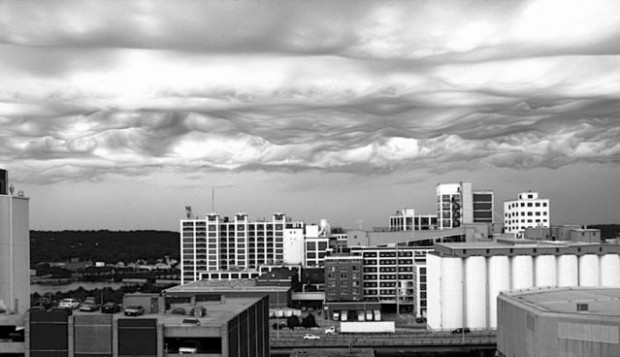
DES MOINES, Iowa — Looking out the 11th floor window of her law office, Jane Wiggins did a double take and grabbed her camera. The dark, undulating clouds outside were unlike anything she'd seen before.
"It looked like Armageddon," said Wiggins, a paralegal and amateur photographer in Cedar Rapids, Iowa. "The shadows of the clouds, the lights and the darks, and the greenish-yellow backdrop. They seemed to change."
They dissipated within 15 minutes, but the photo Wiggins captured in June 2006 intrigued — and stumped — a group of dedicated weather watchers who now are pushing weather authorities to create a new cloud category, something that hasn't been done since 1951.
Breaking into the cloud family would require surviving layers of skeptical international review. Still, Gavin Pretor-Pinney and his England-based Cloud Appreciation Society are determined to establish a new variety. They've given the photo and similar pictures taken in different parts of the world to experts in England and are discussing the subject fervently online.
People are also reading…
"They were the first ones that I noted of this type and I was unsure which category to put them under," said Pretor-Pinney, author of "The Cloudspotter's Guide."
Some scientists are skeptical. They say researchers with years' experience haven't seen anything distinctly new for decades.
There are three main groups of clouds: cumulous, cirrus and stratus. Each has various sub-classifications built on other details of the formation.
Brant Foote, a scientist at the National Center for Atmospheric Research in Boulder, Colo., said the clouds photographed by Wiggins already fit into the existing cumulous classification.
But Pretor-Pinney, who never studied meteorology, believes the clouds merit their own cumulus subclassification. He proposes they be called altocumulus undulatus asperatus. The last word — Latin for roughen or agitate — is a reference to the clouds' undulating surface.
"Not necessarily gentle or steady, but quite violent-looking, turbulent, almost twisted in its appearance," he said.
The group has compiled several photographs documenting the formations from the billowy, rolling clouds shot by Wiggins in Iowa to ones from New Zealand that were much more menacing.
Foote said it would be "very unusual" for such a formation to be recognized as a new variety.
"People have been looking at clouds for hundreds of years, and the general cloud classification is well defined," Foote said. "It's not as if someone discovered a new plant in the Amazon. It's what you've seen every day. There was no atmospheric condition that caused a new kind of cloud to form."
Pretor-Pinney is working with the Royal Meteorological Society in Reading, England, to prepare his case. If that group signs off, the proposal will go to the United Nation's World Meteorological Organization in Geneva.
On StarNet: Find more science and technology stories at


