

Longtime union leader Debbie Hayes remembers the day about three months ago when Gov. Kathy Hochul came to bargaining between the Communications Workers of America and Catholic Health, hearing of challenges inside Mercy Hospital in South Buffalo and also of larger health care industry staffing issues as the two sides labored toward a new contract.
Hayes thought of that day again Jan. 5 when she heard Hochul make big spending promises aimed at bolstering New York's health care workforce in her State of the State address – proof, she said, that the Democratic governor was paying attention that day in October.
"I'm not sure if we could have asked for a better proposal from her in terms of the investment in the health care workforce," said Hayes, the CWA's area director. "As always, the devil is going to be in the details, and I'm anxious to get more detailed information on the plan."
People are also reading…
That's exactly how many health care executives feel, as well.
They see Hochul's multiyear pledge to spend $10 billion in health care, including more than $4 billion to boost wages and bonuses for workers, as an optimistic sign, but so far they have more questions than answers. They wonder where exactly that money would come from, how long it would take to spend and how much would go to hospitals, or nursing homes, or other health care facilities.
Gov. Kathy Hochul, in her first State of the State address, sets an ambitious agenda for her administration and lawmakers in the coming six months.
That fine print will be revealed in Hochul's budget proposal, due Tuesday. That will kick off a couple of months of progressively more tense discussions as state legislators negotiate with the governor in advance of the state budget deadline of April 1.
That process will make clear just how much of Hochul's health care plan will have the chance to come to fruition.
What we know
Hochul's plan to spend $10 billion in health care initiatives grabbed the headlines, a multiyear pledge geared toward growing the state's health care workforce by 20% over the next five years.
Here are five details:
1. Improve the pipeline of new health care employees
Within that $10 billion: $2 billion to support health care wages and another $2 billion for health care and mental hygiene worker retention bonuses, with up to $3,000 bonuses for full-time workers who stay in their jobs for a year. In addition, she pitched $500 million in cost-of-living adjustments to boost wages for human services workers, $2 billion for health care capital infrastructure and the remainder toward spending on other workforce initiatives as well as health care access and delivery.
Broadly, the proposals aim to improve the pipeline of new health care employees, expand training and education and recruit more workers to underserved areas.
"The fact that she's thinking short term and long term is very encouraging," said Bea Grause, president of the Healthcare Association of New York State, which represents nonprofit and public hospitals as well as other health care facilities.
2. Telehealth reimbursements could rise
In addition to funding for health care infrastructure, Grause took note of a proposal that would require private insurers to reimburse appropriate telehealth services at the same rate as equivalent traditional services.
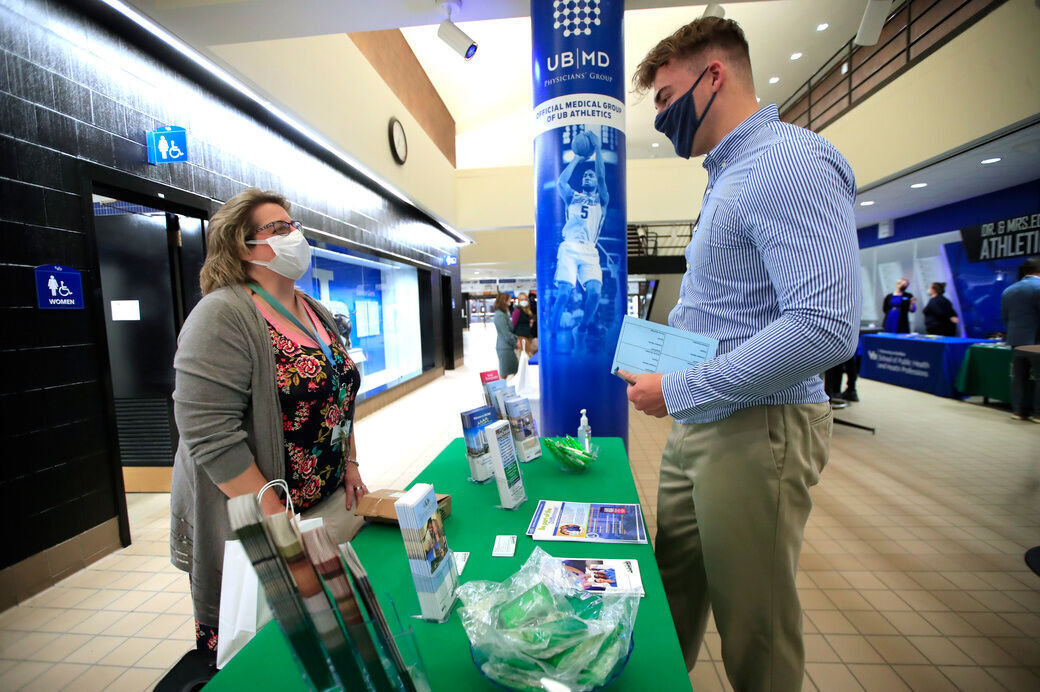
Health care employment across the country is down by 524,000 since February 2020, with nursing and residential care facilities making up about 80% of the loss, according to the U.S. Bureau of Labor Statistics.
3. More support for health care workers
Given the ongoing staffing challenges, Grause also was glad to see Hochul's plan would create an Office of Healthcare Workforce Innovation. That office, according to a 237-page State of the State document released by Hochul's office, would regularly gather input from health care providers, educational institutions and labor unions to, among other goals, build an online portal that matches candidates with training, support and job services. The office would also recommend policies to boost the supply of health care personnel to meet the demands of an aging New York population.
4. A plan for more aging New Yorkers
Similarly, LeadingAge New York, which represents 400 nursing homes, senior housing, adult care facilities and other providers across the state, was glad to see a proposal for a State Master Plan for Aging. That plan, billed as "first step toward building a comprehensive roadmap for meeting the needs of aging New Yorkers," aims to address challenges related to coordination, caregiving, long-term financing and innovative care models.
5. Longer postpartum Medicaid coverage for mothers
Hochul's proposals also mention advancing health equity in communities. For example, New York will look to extend Medicaid postpartum coverage for mothers from 60 days to a full year, something states were given the option to do via last year's American Rescue Plan Act.
"We really need to strengthen Medicaid," said Sheila Kee, executive vice president and chief operating officer at Niagara Falls Memorial Medical Center. "Enhancing it is a good thing. We haven't seen a lot of Medicaid enhancements in recent years, so her proposals to enhance Medicaid are right on and, in my view, most needed."
What we don't know
While Hochul made her priorities clear, many of the critical details behind the proposals remain unknown.
Here are four questions flagged by those following the proposals:
1. Who will qualify for bonuses?
For example, it's unclear over how many years that $10 billion will be spent. While Hochul said she wanted to grow the workforce over the next five years, she only referred to the $10 billion in spending as a "multi-year investment." And questions remain over which health care workers will qualify for wage support and bonuses.
"Is she going to focus on people at the low end of the income spectrum, or is a brain surgeon in Manhattan going to qualify as well?" wondered Bill Hammond, senior fellow for health policy at the Empire Center for Public Policy, a fiscally conservative think tank in Albany. "Does it only apply to people who actually provide care or does it include administrators and support staff?"
2. Where will the money come from?
Another key question is about how much of the money will come from the federal and state governments. Hammond presumed at least some would flow through the state's Medicaid system, pointing out that the federal government matches every dollar the state spends on Medicaid.
"There's a lot of unknowns here," Hammond said. "And given the unknowns, it's really hard for anybody to analyze what she's proposing and to say whether it's a good idea or not."
3. Will Medicaid reimburse rates increase?
It's also not yet clear whether Hochul's proposals will increase Medicaid reimbursement rates for health care facilities. Nursing homes, which largely rely on Medicaid reimbursements, have said stagnant financial support from the state has made it difficult to cover rising costs, including the recruitment and retention of workers.
LeadingAge New York said it will be looking for details in Hochul's budget proposal for additional clarity.

Orchard Park resident Connor Kolb has been trying to get his grandparents in the same Western New York nursing home for more than six months. But that has proven difficult, if not nearly impossible, amid severe staffing issues at the region's nursing homes.
But legislators seem to be understanding the worsening situation at nursing homes as of late, noted Christopher Koenig, president and CEO of Niagara Lutheran Health System in Lancaster.
"The key now is to not slow down because the conversation started, and that's what I think we see a lot," he said. "Now the pressure has to keep going until we have action, until actual reform is made. So I think you know, my optimism is going to be tied to how much people keep moving the ball forward and not backing off."
4. What about home health care?
Assemblyman Richard N. Gottfried, a Manhattan Democrat who has served in the Assembly since 1970 and chaired the Health Committee since 1987, said he's never been so optimistic about the health part of the budget as he is this year.
But that doesn't mean some things aren't missing from Hochul's proposal.
"What I did not see was a commitment to substantially increase the pay for home health care workers," he said. "That is a grave crisis that has been developing for several years, and I think substantially increasing home care wages is urgently needed."
Of the 150,000 health care openings anticipated annually in New York, about 60% are for personal care aides, home health aides and nursing assistants, according to a report released this month by the Senate Committees on Aging, Health and Labor.
Despite that growth, a home health care worker's median annual salary is only $22,000, lower than wages for fast food employees, the report notes. Further, the report points out, more than one in seven low-wage workers in New York City are home care workers.
Some are calling for Hochul to pass the Fair Pay for Home Care in her executive budget, a bill that would lift home care wages and has reached a Democratic majority in the State Senate and is gaining support in the Assembly, with 71 Democratic Assembly sponsors as of Friday.
What New York has done, according to the State of the State book released by Hochul, is appeal to the federal government to spend $2.2 billion on 14 initiatives to bolster the home health care workforce.
But overall, Gottfried said Hochul pitched a "dramatic set of proposals" aimed at health care, which he thinks many of his colleagues will support.
"I would be very surprised if there is opposition," he said. "The question is whether we can build on what she's proposed."


