

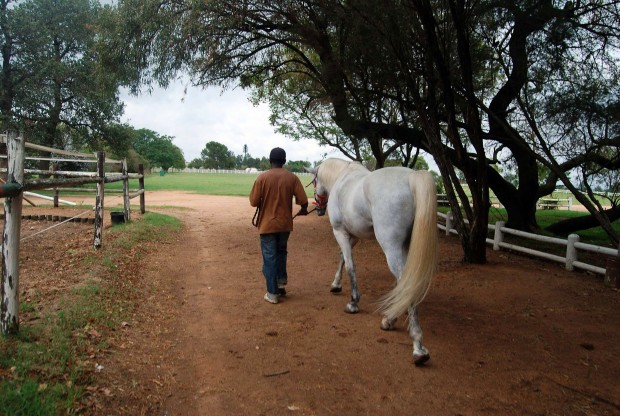
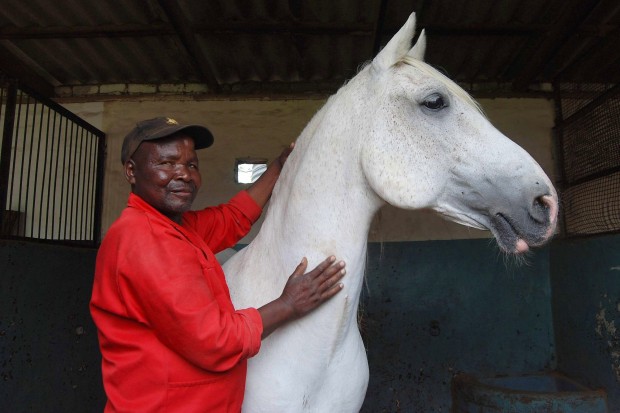
KYALAMI, South Africa - When they retired the small, impossibly beautiful stallion named Favory Merlin, he went off his food. He grew thin, and his glossy white coat became dull.
He was one of the great Lipizzaner stallions, the famous dancing white horses trained in the ballet of equestrianship known as Haute Ecole dressage.
In his heyday as a soloist, Merlin was the most photographed stallion in the riding academy here, the one who was taken to formal ballrooms to perform, who went on television.
In the arena, his specialty was the levade, raising his forelegs and standing with his hind legs at a 30-degree angle to the ground, a position requiring the strength of an equine Nureyev.
Merlin is 26 now, and too old for demanding acrobatics. But head groom Story Banela, 63, remembers the days more than two decades ago when the stallion first came to the Lipizzaner center here north of Johannesburg, the only foreign school to win affiliation with the prestigious Spanish Riding School in Vienna.
People are also reading…
It often took three grooms to take Merlin to his paddock, but still he regularly broke free and ran off.
"Merlin's too old now," Banela said. "He was a cheeky one before. Always when you took him out, he'd run away, but my heart was not sore because I like him. … He's strong. Other people didn't like that, but me, I liked it, because he was something like a child. I'd say, 'Oh my boy, my horse.' "
SYMBOLISM ON DISPLAY
In one sense, Merlin is a relic of a past age and a distant culture, the refined art of Renaissance dressage.
Yet the Lipizzaners' story in South Africa - and their struggle for financial survival in recent years - is also symbolic of the country's cultural history: "White" culture, post-apartheid, has often fallen on hard times and the Lipizzaners are kept afloat by the ardor of a tiny group of enthusiasts.
When they perform, the dazzling white stallions and their straight-backed riders transcend any questions of cultural relevance, however, like a beautiful Ming vase found in a dusty corner.
Merlin is descended from a line of Lipizzaners owned by a noble Hungarian family that escaped the advance of the Soviets in World War II and arrived, improbably, in a sleepy corner of South Africa in 1948.
The breed, known for its loyalty, intelligence, courage and beautiful physique, dates to the 16th century, when Maximilian II, archduke of Austria and Holy Roman Emperor, began breeding Spanish horses.
Gill Meyer, a young horse enthusiast, went to see the Lipizzaners when they first came to South Africa.
"They were thin. Their coats were long. They looked so weary," she said. "When I got back home, I cried and cried. I thought, they can't be these beautiful Lipizzaners."
She didn't know what they'd been through.
escaping the nazis
As the Soviet Union's Red Army swept toward Hungary, one of the Axis powers, the horses' owner, Count Jankovich-Besan, hitched them to carts and fled in the night, before managing to get them on a train to Bavaria. To stop them from being requisitioned as meat by the Nazis in Germany, he painted the stallions so they looked too dreadful to eat.
They escaped first to England and then in 1948 came to South Africa. Money was a problem from the start.
At a chance encounter at a rural agricultural show, the count met a former cavalry officer from Poland named Maj. George Iwanowski, to whom he gave a stallion named Maestoso Erdem to train. Then, when the count ran out of money, he gave six of his stallions to Iwanowski.
Iwanowski decided the only way to save the horses was to train them and a group of riders in Haute Ecole dressage to garner public support and raise money. He gradually built up the horses and riders, and they gave performances around the country using a record player attached to a car battery.
The horses are bred on the Lipizzaner stud farm and raised in a herd of about four to eight.
They will stay together as a herd all their lives - training, working, performing and riding out into the country.
"Even when the horse is too old, I'm crying because you know, I love him, the same like a child," Banela said.


