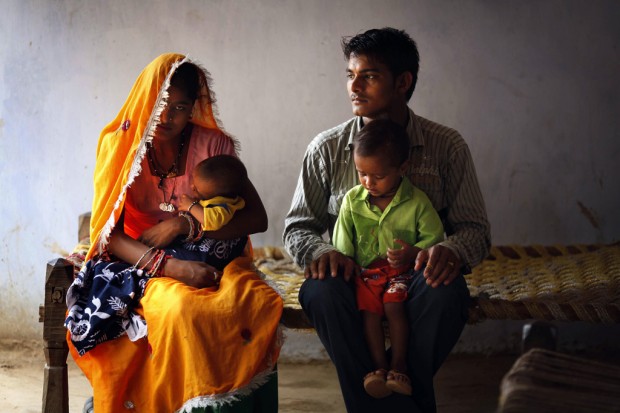
JAIPUR, India - Ramjee Lal Kumhar and his bride, Mamta, first laid eyes on each other inside a billowing wedding tent festooned with garlands of marigolds.
He was 11 years old. She was 10.
Their families had arranged the marriage. The couple delighted their parents by producing a son when they were both 13. They had a daughter 2 1/2 years later. To support the family, Ramjee gave up his dream of finishing school and opened a cramped shop that sells snacks, tea and tobacco on the muddy road through his village.
At 15 and finally able to grow a mustache, Ramjee made a startling announcement: He was done having children.
"We cannot afford it," he said, standing with arms crossed in the dirt courtyard of the compound he shares with 12 relatives, a cow, several goats and some chickens in the northern state of Rajasthan.
People are also reading…
Horrified, his mother and grandmother pleaded with him to reconsider.
"Having one son is like having one eye," his grandmother said. "You need two eyes."
major repercussions
How many children to have is an intensely personal matter, often a source of family debate. But the decisions made by Ramjee, Mamta and others their age will have repercussions far beyond their own families and villages.
They are members of the largest generation in history - more than 3 billion people worldwide under the age of 25. About 1.2 billion of them are adolescents just entering their reproductive years.
If they choose, collectively, to have smaller families than their elders did, the world's population - now 7 billion - will continue to grow, but more slowly.
According to United Nations projections, the number will rise to 9.3 billion by 2050 - the equivalent of adding another India and China to the world.
That's an optimistic scenario, one that assumes the worldwide average birthrate, now 2.5 children per woman, will decline to 2.2.
If birthrates stay where they are, the population is expected to reach 11 billion by midcentury - akin to adding three Chinas.
Under either forecast, scientists say, living conditions are likely to be bleak for much of humanity. Water, food and arable land will be more scarce, cities more crowded and hunger more widespread.
On a planet with 11 billion people, however, all those problems will be worse. The outcome hinges on the cumulative decisions of hundreds of millions of young people around the globe.
70 million per year
So many people are now in their prime reproductive years - the result of unchecked fertility in decades past coupled with reduced child mortality - that even modest rates of childbearing yield huge increases.
"We're still adding more than 70 million people to the planet every year - which we have been doing since the 1970s," said John Bongaarts, a leading demographer and vice president of the nonprofit Population Council in New York. "We're still in the steep part of the curve."
Think of population growth as a speeding train. When the engineer applies the brakes, the train doesn't stop immediately. Momentum propels it forward a considerable distance before it finally comes to a halt.
U.N. demographers once believed the train would stop around 2075. Now they say world population will continue growing into the next century.
In India, a country of 1.2 billion people, women have an average of 2.5 children each, and the birthrate is projected to fall to 2.1 by 2030. At that point, parents will merely be replacing themselves.
But even then, India's population will continue to grow because of momentum. It is on track to surpass China's and is not expected to peak until 2060, at 1.7 billion people.
various factors at work
Momentum isn't the only factor in population growth. In some of the poorest parts of the world, fertility rates remain high, driven by tradition, religion, the inferior status of women and limited access to contraception.
Population will rise most rapidly in places least able to handle it: developing nations where hunger, political instability and environmental degradation are already pervasive.
The African continent is expected to double in population by the middle of this century, adding 1 billion people despite the ravages of AIDS and malnutrition.
Even under optimistic assumptions, the toll on people and the planet will be severe.
Today, about 1 in 8 people in the world lives in a slum. By midcentury, with the population at more than 9 billion, the ratio would be 1 in 3, assuming poverty and migration to cities continue at their current rates.
Now nearly 1 billion people are chronically hungry, according to the U.N. Food and Agriculture Organization, and at least 8 million die every year of hunger-related illnesses.
demand for food
It's not just that the population will be larger. It's that hundreds of millions of newly affluent people, mostly in Asia, will want to add dairy products and grain-fed beef and pork to their diets.
To meet the projected demand, the world's farmers will have to double their crop production, according to calculations by a team of scientists led by David Tilman, a University of Minnesota expert on global agriculture.
William G. Lesher, a former chief economist for the U.S. Department of Agriculture, said the brightest minds in the field haven't figured out the solution.
"We're going to have to produce more food in the next 40 years than we have the last 10,000," he said. "Some people say we'll just add more land or more water. But we're not going to do much of either."
Most of Earth's best farmland has already come under hoof or plow, and farmers are losing ground to expanding cities and deserts. Soil erosion, chemical contamination and salt buildup from irrigation are despoiling prime acreage.
Climate change will make all of these challenges more daunting. Higher temperatures and violent weather will stunt or destroy crops. Increased flooding will imperil millions living in low-lying regions. More severe droughts could displace masses of people, leading to conflict.
By 2050, the United Nations predicts, there could be as many as 200 million "climate refugees."
Despite these trends, population growth has all but vanished from public discourse.
In Europe, Japan and North America, leaders are worried about having too few young people to care for aging populations and to fund benefits for the elderly.
family planning
In developing countries, leaders often consider large youthful populations a source of economic vitality and political strength.
In the U.S., contraception has become entangled in acrimonious battles over abortion, causing some environmental and humanitarian groups to retreat from family-planning initiatives.
Under the best conditions, it's hard to get contraceptives into the hands of impoverished women who want them. In developing nations, family planning programs open and close at the whim of autocrats. Aid from wealthy nations rises and falls with political currents.
The result: Nearly 20 years after 179 nations signed a pledge to provide universal access to family planning, supplies of contraceptives remain erratic in much of the developing world.
Population growth gets less attention than it did in the late 1960s, when there were half as many people on the planet.
Although India's population growth has slowed among the urban middle class, birthrates remain high among the rural poor.
The result, especially in northern states like Uttar Pradesh, is a scramble to fill each bowl.
"We are doing the best we can," said Anup Murari Rajan, an officer with CARE India, which provides free meals at 32,000 community centers in Uttar Pradesh. "These slums are increasing day by day."
A decade ago, the state had 166 million people. Today it has 200 million - more than Brazil. If Uttar Pradesh were a country, it would be the fifth-most populous in the world.
Fertility has been declining slowly, but women in the state still have 3.5 children each on average. At this pace, Uttar Pradesh's population will double by midcentury.
birthrates once low
Reducing population growth in India's poor northern regions would require an extensive push to make contraceptives widely available in scattered villages and rural areas, many of which lack paved roads or clinics.
Government efforts have been haphazard and limited, reflecting an ambivalence about family planning. A national law restricts women under 18 from marrying, but the tradition is so strong and enforcement so lax that nearly half do so anyway, all but guaranteeing an early start to childbearing.
For most of human history, the world's population grew very slowly. Short life spans and high child mortality offset high birthrates.
Advances in agriculture, followed by the Industrial Revolution, pushed humanity to the 1 billion mark around 1810. From there, the numbers began a steep ascent.
With improved sanitation, more reliable food supplies, vaccines and other medical advances, the population doubled to 2 billion by 1930 and doubled again by 1974.
Last year, the global population passed 7 billion. It took just a dozen years to add the last billion.
The precipitous rise has not resulted in famine, disease and other catastrophes on the scale famously forecast by Thomas Robert Malthus in 1798 and by Paul Ehrlich in the 1968 bestseller "The Population Bomb."
Malthus did not foresee that mass migration to the New World would relieve population pressures. Ehrlich didn't anticipate the success of the Green Revolution - modern, intensive farming methods that boosted crop yields.
Still, the warnings of Ehrlich and others helped inspire a population control movement. As the pill and other modern contraceptives cut birthrates in industrialized countries, environmental groups, the World Bank and a succession of U.S. presidential administrations joined in a robust campaign to bring family planning to the developing world.
The effort soon ran into a powerful counterforce: the anti-abortion movement. Its activists sought to halt U.S. aid to family planning programs abroad, pointing to abuses such as forced abortions and sterilizations in India and China.
u.s. aid reduced
In a notable success, lobbyist Steven W. Mosher helped persuade the administration of President George W. Bush to withhold $34 million to $40 million a year over seven years from the U.N. Population Fund, the largest international donor to family planning programs.
U.S. foreign health aid should be spent saving lives, "not preventing them coming into being," Mosher said in an interview. Like some others in the anti-abortion movement, he considers many forms of contraception "chemical abortion" because they prevent embryos from implanting in the womb.
The funding was later restored, but many advocates of family planning have retreated, recast their missions or reduced their profiles.
The Rockefeller Foundation, once a leading philanthropic supporter of international family planning, sharply cut back its funding in the late 1990s.
Other donors have stepped forward, including the Susan Thompson Buffett Foundation, named for the late wife of investor Warren Buffett, and the Bill & Melinda Gates Foundation.
U.S. funding for family planning overseas has been flat in inflation-adjusted terms for two decades. Such aid to poor countries from all sources, measured per-capita, has been declining since 1999.
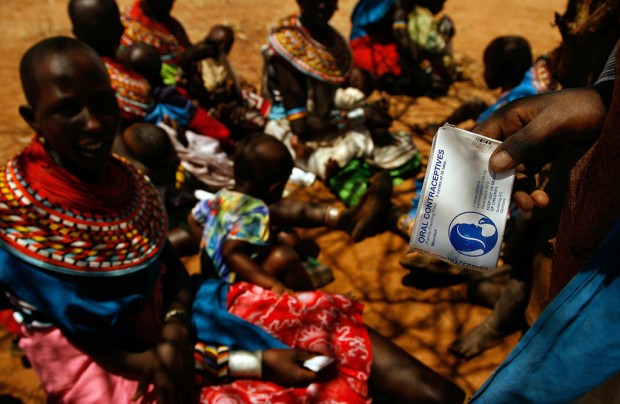
The result: Although use of contraceptives worldwide has climbed steadily in the last 40 years, led by the industrialized West and China, it remains extraordinarily low in the least developed parts of Africa and South Asia.
A muddy road in Kibera, Kenya's largest slum, overflows with humanity. Women tote buckets of water on their heads and bundles of firewood on their backs. Young men splash through open sewers in bare feet.
A century ago, this was grazing land and acacia forest. Now it is a hive of mud huts with rusting metal roofs. Hundreds of thousands of people, mostly migrants from the countryside, are packed into a 500-acre area of Nairobi that reeks of sweat, human waste and rotting garbage.
With no running water or plumbing, the area is notorious for "flying toilets" - plastic bags of feces tossed into muddy alleyways. There are regular outbreaks of cholera, typhoid and dysentery.
Tucked behind mud walls is a family-planning clinic operated by Marie Stopes International, a British nonprofit.
Inside, a row of chairs sits empty beneath a single bare light bulb."We ran out of stock some time ago," said Esther Omariba, a clinic nurse. "When we have adequate supplies, word gets around really fast and many, many women come."
Across Africa, clinics in impoverished or remote areas run out of contraceptives so often they have a term for it: "stockouts."