

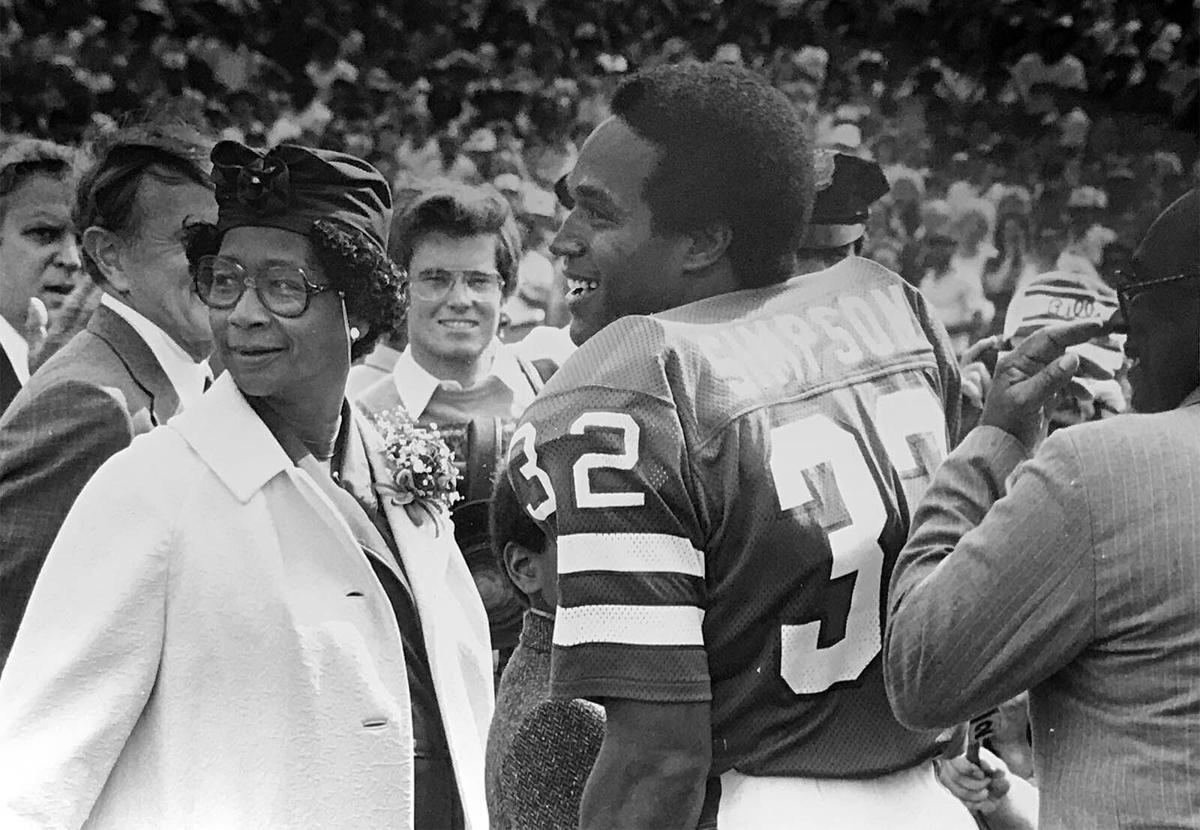
When fans from other cities visit Highmark Stadium, they are often surprised to see one particular name on the Buffalo Bills Wall of Fame:
O.J. SIMPSON.
It appears in all caps on the façade, along with his familiar No. 32. “Gee,” some visitors surely think, “I thought maybe they would have taken that down by now.”
Local fans generally don’t have similar thoughts, mainly because they don’t really notice Simpson’s name anymore. It is just there, part of the scenery, like a road sign that has been there for as long as anyone can remember.
The Bills Wall of Fame went up in 1980. Simpson was in the inaugural class. No, wait: He was the inaugural class. At the time, he was a singular talent in Bills history. He ran for 2,003 yards in 1973, the first season at Rich Stadium, as it was then known, though it might as well have been called the House That O.J. Built. Now, we are told, the arena is about ready to fall down. Even so, it’s fair to say that Simpson’s legend wore out long before his stadium did.
People are also reading…
The facts surrounding all this are well-known. Simpson was accused, and acquitted, of double murder in the so-called "trial of the century," and was later found civilly liable. Years later, he was convicted on robbery charges for breaking into a Las Vegas hotel room to steal memorabilia that had once belonged to him, much of it from his time with the Bills.
Some Buffalo fans have argued over the years that Simpson’s name should come down. Such discussions took place in bars and backyards and on talk radio, but not seriously within the Bills organization. Bills owner Ralph C. Wilson Jr. decided to take his cue from the Pro Football Hall of Fame, which honors players for what they do on the field, and does not expunge members after the fact for conduct off the field.
All this comes up again because the Tampa Bay Buccaneers recently removed Jon Gruden’s name from the team’s Ring of Honor. The move came one day after old emails surfaced in which their ex-coach had used racist, homophobic and misogynistic language. That erasure came in less than 24 hours; the Bills’ inaction spans more than 25 years.
As it happens, the Bills hope to be playing in a new stadium in a few years. If and when a new one opens, will Simpson’s name still be on the wall? Or might the Bills take that opportunity to dispose of his name quietly? That way they wouldn’t have to take it down so much as just not put it back up.
Joe Horrigan is a son of South Buffalo who retired a couple of years ago as executive director of the Pro Football Hall of Fame. He remembers the calls that came from the Bills years ago for advice on what to do about Simpson’s name on their Wall of Fame.
“What we told them was what we told everybody,” Horrigan said. “There is no provision to remove anybody from the Pro Football Hall of Fame. They gain entrance based on what they did as a player, coach or contributor. There is no way for us to go back and say, ‘O.J. Simpson didn’t run for 2,003 yards in 1973.’ ”
Simpson averaged 143.1 yards per game that year; it is the NFL record by an astonishing 10 yards per game.
“That’s a remarkable record,” Horrigan said. “Our sole focus at the Hall of Fame is on the game – what happens on the field, not off of it.”
When Pat Tillman, the Arizona Cardinals safety, joined the Army Rangers and died in Afghanistan, in 2004, some argued that he should be enshrined in the Pro Football Hall of Fame.
“People would tell us, ‘He was a great American who paid the ultimate sacrifice,’ ” Horrigan says. “And they are exactly right about that. But we only consider what a player does in his pro football career.”
Ah, but this is where the Wall of Fame differs from the Hall of Fame. Tillman was the first pro football player to die in combat since Bob Kalsu, who was killed in Vietnam in 1970. Kalsu played one season for the Bills, in 1968. He is on their Wall of Fame, as he should be.
The Hall of Fame does not take into account what happens off the field, but the Bills Wall of Fame clearly does. Kalsu’s inclusion proves that. And if Wall of Fame selectors factor in how honorably Kalsu acted, then they should do the same for how dishonorably Simpson did.
Take Simpson’s name off the wall. Or, at a new arena, don’t put it back up.
And let’s name the new place Bob Kalsu Stadium.


