

The citizens of the world celebrated V-J Day (Victory over Japan) on September 2, 1945, marking the official end of World War II—and of Japan's 15-year military rampage across Asia. 400,000 Americans died, and an estimated 65 million people worldwide perished in the conflict.
At sunrise on Thursday morning, September 2, 1945, the seas in Tokyo Bay were nearly calm, casting a steely silver sheen across a sky filled with billowing pearl-gray clouds—an ever-so-slight waft of balmy air tousled the colorful array of the nation's flags on warships dotting the bay. More than 300 Allied combat vessels from around the globe lay at anchor around the "Mighty MO." The 58,000-ton battleship USS Missouri was anchored in the bay, with its starboard gray teak-planked deck polished and buffed.
The flagship of the 3rd Fleet was christened for service in January 1944 by Margaret, President Harry Truman's daughter. "Give 'em Hell, Harry" hailed from "The Show Me State." Truman chose the vessel for this distinguished occasion as the site of the formal surrender of the Empire of Japan.
The battleship USS West Virginia was the only ship damaged at Pearl Harbor that was present in Tokyo Bay that morning when the Japanese surrendered. The Japanese sank the battlewagon at Pearl Harbor with six torpedoes and two bombs. The ship was salvaged and repaired, and it played a pivotal role in many battles in the Pacific. It was a ship the Japanese would take note of.
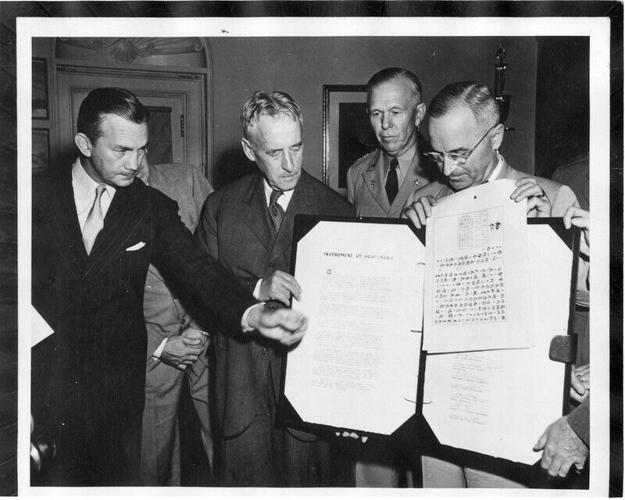
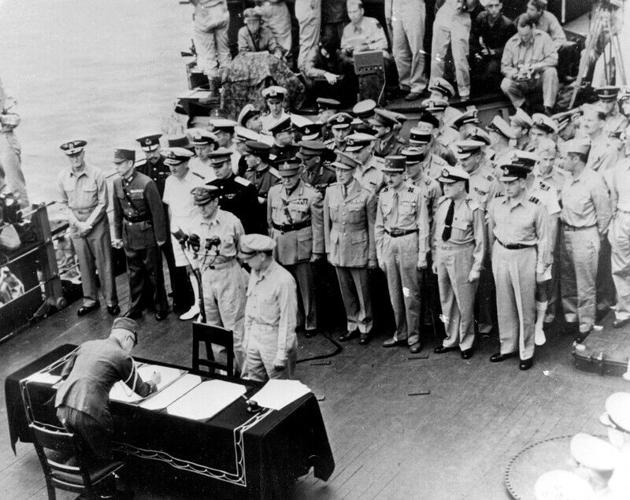
On board the Missouri, a standard folding table from the ship's mess hall was set in the center of the deck. The table was covered with a coffee-stained green baize tablecloth with yellow scrollwork trim, hastily procured from the ship's laundry wardroom. Fortunately, the stains were obscured by the substantial size of the Instrument of Surrender folders. The Allied document was bound in a formal, ceremonial gilded-leather binder printed on aged parchment. Gen. MacArthur's staff found the rare paper in a monastery basement in ravaged Manila. The Japanese document was bound in rough, drab canvas on commonplace paper. Losers signed first.
Allied Supreme Commander Douglas MacArthur ordered that the day's uniform be khaki, with daily service clothes, open shirts, no ties and minimal rank insignia. He said, "We fought them in our khakis, and we will accept their surrender in our khaki uniforms."
At 8:56 a.m., a Navy band played The Star-Spangled Banner as clouds obscured the sun. The solemn, glum, and formally attired 11 Japanese emissaries were granted permission to board the ship. At the top of the gangway, eight U.S. seamen, all over 6 feet tall and in starched white uniforms, lined the entrance. The Japanese imperial envoys passed between the lines of lanky sailors, specifically chosen to demonstrate U.S. size superiority and intimidate the delegation. Not one of the principals, allied military officers, saluted the Japanese.
MacArthur avoided any direct or implied humiliation of the Japanese participants in his remarks. He spoke not of surrender or defeat but of restoring peace marked by freedom, tolerance, and justice. MacArthur declared, "Let us pray that peace now be restored and that God will preserve it always." Facing the Japanese delegation, he solemnly intoned, "These proceedings are closed." The formal ratification process took 23 minutes.
As the Japanese Imperial government representatives were escorted off the ship, the sun broke through the leaden clouds, as if on divine cue. With the warming sunlight, 450 Navy carrier planes from the 3rd Fleet and 462 Army Air Force B-29 bombers swarmed low and loud over the bay, producing a thunderous final benediction. There were more U.S. aircraft in the sky over Tokyo than the total number of Japanese planes that had attacked Pearl Harbor four years and nine months earlier.
According to Lieutenant General Leslie Groves, director of the 'Manhattan Project,' which managed the creation of the first A-bomb, "The atomic bombings of Hiroshima and Nagasaki ended World War II. There can be no doubt about that. While they brought death and destruction on a horrifying scale, they averted even greater losses—American, English, and Japanese."
But it was J. Robert Oppenheimer, "the father of the atomic bomb," who helped end the war when his second bomb, a plutonium-based nuclear explosive, was dropped on Nagasaki on August 9, 1945. An official Japanese military broadcast claimed the Hiroshima explosion was the result of a "new type [of] bomb with special equipment, but its content is unknown." The report did not describe the city's extraordinary destruction and omitted the word "atomic."
36 hours after the Hiroshima raid, a Japanese government broadcast said the power of the new weapon "cannot be slighted," adding that the Japanese military was working on countermeasures, including its own bomb, to continue the war. There was no doubt that the Royal Japanese Army had no intention of surrendering. That was a day before "Fat Man," AKA Mark III, an implosion-type nuclear weapon with a solid plutonium core, fell on Nagasaki.
Let us be infinitely grateful to the men and women who, to this day, answer the call to military service in America as they protect and preserve our democracy.
Award-winning writer Jerry Wilkerson lives in SaddleBrooke. He is a former press secretary for two U.S. congressmen and a former correspondent for CBS NewsRadio Chicago and the Chicago Daily News. He is a retired police commissioner and Navy veteran. Email: franchise@att.net.
 U of A acceptance rate rises to 90% as applications plunge


