



The early-morning New Mexico desert sky was cast in Robin 's-Egg blue, salted with feathery, see-through, lacy clouds drifting south in a nomadic weave, with little encouragement from a faint airstream. A sweet early-spring scent drifted among us. Flecks of wildflowers gently opened to the sun’s warmth, creating a spectrum of hues as the April morning temperature reached 60 degrees by 9 o’clock.
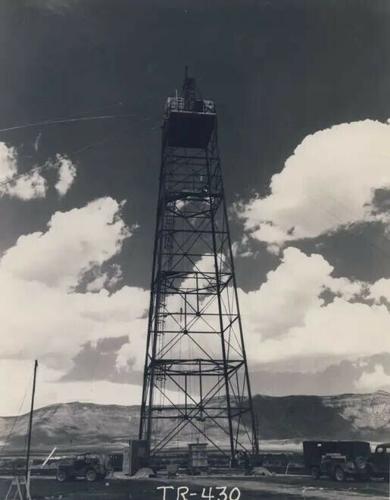
I stood at Trinity, ground zero, where the first atomic bomb exploded on July 16, 1945, at 5:30 a.m. The test bomb, known as the Gadget, would have hung from a steel tower about 96 feet above my head. Upon detonation, it released enough energy to compress the ground beneath me by ten feet into the earth’s crust. The steel tower was vaporized. The blast triggered seismographs in Tucson, which recorded an earthquake wave generated by seismic energy radiating from the northeast. Scientific equipment at the University of Arizona recorded the atomic explosion 280 miles away at the Trinity site in southwestern New Mexico.
The Albuquerque Museum of Nuclear Science has access to the Army-operated White Sands Missile Range on the first Saturday in April. The only other day the base is open to the public is the first Saturday in October. My wife and I traveled to the site on a museum-provided tour bus. The outing was led by extraordinary guides who were well-versed in the data surrounding the location and development of the Gadget. That was the cover name scientists at the secret Los Alamos laboratories, about 175 miles north of this test site, had given it.
During a discussion with one of the senior guides, he asked me who I thought was the single individual most responsible for the U.S. producing the atomic bomb. Prominent names were mentioned. Then he stated: Hitler, adding that before the war, Hitler’s manic aggression forced the most brilliant scientific minds from the German Jewish community to flee the country, saving their lives. The boundless mental aptitude and cooperative competence of this group were used in the U.S. almost immediately, and they fully developed into the Manhattan Project.
“Most experiences in life can be comprehended by prior experiences,” Norris Bradbury has said, “but the atom bomb did not fit into any preconceptions posed by anybody.” Bradbury was an American physicist who served as Director of the Los Alamos National Laboratory for 25 years, from 1945 to 1970. He succeeded Robert Oppenheimer. The Bradbury Science Museum in Los Alamos is named after him.
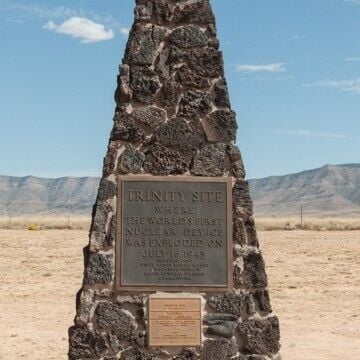
As we were walking out of Ground Zero, past a fenced-and-gated sector containing the Trinity memorial marker, I heard a faint ticking sound behind us. It came from a fellow carrying a Geiger counter. A grave reminder of what man created at this very site, which, to my vexation, is still ticking.
Award-winning writer Jerry Wilkerson lives in SaddleBrooke. He is a former press secretary for two U.S. Congressmen and a prior CBS NewsRadio Chicago and Chicago Daily News correspondent. He is a retired police commissioner and Navy veteran. Email: franchise@att.net.


