Lakes Mead and Powell are storing barely more water today than Lake Mead alone did in 1957 — at a time when construction on the dam that would create Lake Powell had barely started.
This very low storage in the two reservoirs — the lowest on record for both — drives home the need for Colorado River water users to start cutting their use, several water researchers and other outside water experts say.
The reservoirs have been steadily declining for years. But the decline has accelerated in the past few months, due to record-setting warm temperatures in the spring across the Colorado River Basin and record low snowpack in the river’s Upper Basin states where most of the river’s flows originate. The Upper Basin states are Colorado, New Mexico, Utah and Wyoming.
People are also reading…
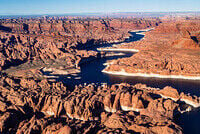
An aerial view of the Colorado River in Lake Powell, in April, just west of the river's confluence with the San Juan River. The white streak at the bottom of the canyon walls alongside the river is the familiar bathtub ring, colored white because this section of rock was previously submerged.
Several water researchers said the record low storage in these reservoirs is alarming, and comes on top of a flock of other bad news about the lakes due to the long-term drought, and the heat that has enveloped the Colorado River Basin this year.
The fact that the two big reservoirs now hold no more than one of them did two generations ago “represents a teaching moment to communicate to the general public how dire is the situation and how little remaining water we have in the reservoir system,” said water researcher Jack Schmidt, lead author of a new report on the record low storage. He is director of Utah State University’s Center for Colorado River Studies.
Schmidt used a bathtub analogy to explain what he thinks the water users must do to extract Mead and Powell from their current plight.
“The amount of water we have left in the bathtub can be fixed by increasing flow out of the faucet or closing down the drain,” Schmidt said. “We can’t increase what’s coming out of the faucet. We have to decrease the flow out of the drain.”
The news comes just as the U.S. Bureau of Reclamation prepares to release a final environmental impact statement showing how it proposes to cut Colorado River water use in an attempt to lower its supply-demand gap.
For decades, these reservoirs have been an insurance policy, guaranteeing the river’s ability to deliver drinking water to major cities including Tucson, Phoenix and Los Angeles, along with huge farming operations in the Yuma area and in Southern California. They stored enough water for decades to provide a buffer for the states to keep water supplies from disappearing during droughts.
But now, this record low storage, combined with two very dry years on the river, have put the reservoirs in a depleted enough state that their ability to offset short-term drought conditions is “almost nonexistent,” said Anne Castle, an assistant Interior secretary of water and science during the Obama Administration.
This report “points out the fact that we are in a very difficult water crisis situation right now,” said David Wegner, a Natoinal Academy of Sciences board member who lives in Tucson and has been very active on river issues for many decades. “Now is the time we need to start doing something;”
As weather conditions look now in the river basin, that loss of storage will continue every day until late next winter or early spring, when melting snows would be expected to boost the reservoirs’ water levels, the new paper said.
The reservoirs first hit their near-record-setting low storage on July 12. The last time the total reservoir storage was that low was in May 1957, less than a year after construction started on Glen Canyon Dam and six years before Lake Powell at the dam site started filling. The previous record low storage level for both Mead and Powell was set in March 2023.
In the paper and in an interview, Schmidt emphasized that while the two big reservoirs lie in separate sections of the Colorado River Basin, “Lake Powell and Lake Mead essentially comprise one gigantic reservoir, separated into two parts by the Grand Canyon.”
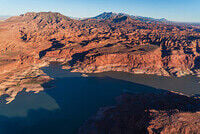
The main section of Lake Powell, photographed from the air in April. As the water level in the lake keeps falling, more sandbars and sediment are being revealed.
The low storage level in Mead and Powell comes on top of an almost endless stream of bad news for the river and its reservoirs this year.
Most recently, the latest monthly federal forecast for the reservoirs, in mid-July, projected that Lake Powell could still fall below the minimum level at which Glen Canyon Dam’s turbines can generate electricity by next spring — even though the U.S. Bureau of Reclamation released lots of extra water into Powell from an upstream reservoir and cut back releases from Powell to Mead.
The amount of river water flowing into Powell from upstream from April through July is likely to be the second lowest on record, says the federal Colorado Basin River Forecast Center.
In addition, river flows have been so low that the no additional water was stored not just in Mead and Powell, but in the entire, 46-reservoir system on the river, during the late winter and early spring snowmelt season. That’s when the reservoirs usually accumulate more water from melted snowpack.
What Schmidt calls “zero accumulation” last occurred in Mead and Powell in 2002, another very dry year, and in the entire reservoir system in 2002 and 2012.
In their new paper, the researchers said the two big reservoirs have been losing 15,000 to 16,000 acre-feet of water daily for four of the past five months, including most of July.
“Every day going forward, until runoff from the 2026-2027 winter snowpack begins next spring, a new record low will likely be set,” the paper said. “This is a significant moment in the evolving Colorado River water supply crisis.”
Contact Tony Davis at 520-349-0350 or tdavis@tucson.com. Follow Davis on Twitter@tonydavis987.

Tony Davis
Reporter

 Colorado River reckoning: Not enough water