

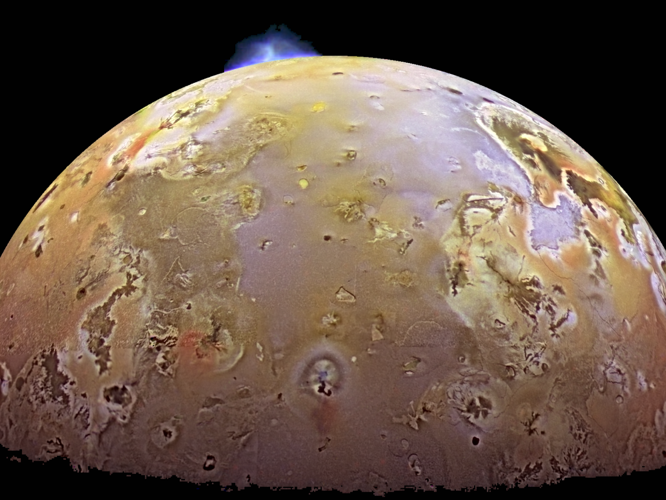

The SaddleBrooke Skygazers Astronomy Club is pleased to host Dr Al Conrad, an Astronomer and data scientist at the Univ of Arizona’s Steward Observatory’s Large Binocular Telescope, Sunday, April 12th at the Desert View Theater, 39900 S Clubhouse Dr. at 7:00 pm. Through the use of the latest visible light imaging technology, multiple observations of Jupiter’s volcanic moon Io have delivered results with the highest scientific impact. Dr Conrad will provide details of these observations and plans for the future.
SHARK-VIS is a visible light imager positioned behind the recently upgraded, SOUL adaptiveoptics (AO) system at the Large Binocular Telescope (LBT). Since SHARK-VIS first light in November 2023, the higher angular resolution of Io revealed a resurfacing event in which Pele’s persistent red ring was paved over by an eruption from nearby Pilan Patera. Observations during the following opposition (fall/winter 2024/2025) resulted in more surface change detections identifying the location of new lava flows and changes in plume and pyroclastic deposits, and areas where volcanic activity had decreased.
Looking to the future, an instrument capable of visible light interferometry, the LBT interferometer visible extension (LIVE), is being developed for LBT, with installation on the telescope planned for summer 2027. LIVE will be capable of resolution below 20 km on Io. Images from LIVE can be combined to provide a single image with the resolution of a 23 m filled aperture telescope.
Dr Conrad received his PhD in Computer Science from the University of California at Santa Cruz in 1994. Before joining the Large Binocular Telescope (LBT) in 2014, he worked as software engineer and support astronomer at both Lick and Keck Observatories before moving to the Max Planck Institute for Astronomy to lead the development of the ground layer adaptive optics (AO) system for the LINC-NIRVANA instrument. At LBT, Al serves as the point of contact for new instruments, including a visible light AO camera capable of 80 km resolution on the surface of Io, which was commissioned in 2024, and a visible light Fizeau interferometry camera capable of 20 km resolution on the surface of Io, which is planned for installation on LBT in 2027. His research interests include asteroid systems and developing novel techniques to study comets, planets, and the moons of planets, particularly Jupiter’s moon Io.
The SaddleBrooke Skygazers Astronomy Club meets monthly (and typically) on the second Sunday evening (7:00 p.m.) at the Desert View Theater. The Spring/Summer star parties are scheduled on Wednesday April 15th, Thursday May 14th and Tuesday June 16th at the Softball Field parking lot. The public is welcome to both meetings and star parties. Club and Star Party information can be obtained by reviewing our website (https://sbazsky.xakt.me/) or emailing Sam Miller at twoyosemite@gmail.com.


