

No one would have blamed Ryan Johnson if he allowed the disappointment to linger for days, if not weeks.
Johnson impressed at the World Junior Summer Showcase in 2019 and represented himself well at the United States’ camp to determine its roster for the annual top international tournament, only to hear that December that he would not be joining the team in the Czech Republic.
“It’s obviously not a good response to be angry or mad at yourself,” recalled Johnson, a 20-year-old left-shot defenseman drafted in the first round, 31st overall, by the Buffalo Sabres in 2019. “I think the right response is to see how you can learn from it, how you can grow. And it's kind of a wakeup call to start working again.”
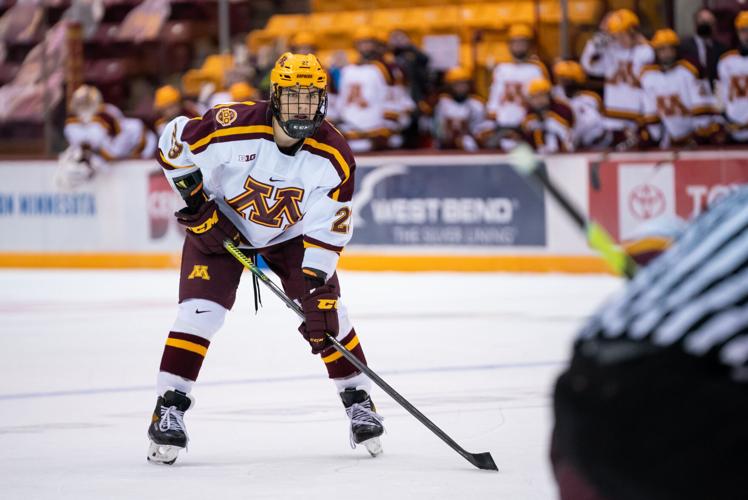
Johnson's response has him likely on the cusp of joining the Sabres' youth movement in Buffalo. Now a junior at the University of Minnesota, Johnson is coming off a season in which he totaled two goals and 14 points in 27 games to help the Golden Gophers reach the NCAA Frozen Four.
People are also reading…
And Johnson finally realized his dream of representing the U.S. on the international stage, as he was a key cog on the blue line for its gold-medal run at the IIHF World Junior Championship in January, logging 16:17 of ice time in a 2-0 championship victory over heavily-favored Canada. Johnson had one goal and four points in seven tournament games, showcasing his remarkable skating stride, responsible play away from the puck and blossoming offensive skills.
In a year when many prospects’ development was stalled because of the Covid-19 pandemic, Johnson showed why he was selected by former Sabres General Manager Jason Botterill with the draft choice acquired in the Ryan O’Reilly trade.
Johnson didn’t post otherworldly offensive numbers in his pre-draft years and he was only 17 years old when he officially joined the organization in June 2019, but a methodical approach to improving his weaknesses, and another fine season at Minnesota, could earn him an entry-level contract with the Sabres following this season.
“I think a lot of it is just kind of see how this year goes and obviously, keep in contact with Buffalo,” said Johnson about his timeline to turn pro. “But that's the main thing, is focusing on this season, and then hopefully, we'll see. We'll see what happens.”
Johnson entered his first collegiate offseason in 2020 with a list of skills to improve but few places to train. Covid-19 prevented Johnson from following his typical offseason routine, which centered around working with his father, Craig, an assistant coach with the American Hockey League’s Ontario Reign. Craig Johnson was a forward in the NHL for 10 seasons (1994-2004) and was part of the 1996 trade that sent Wayne Gretzky to the St. Louis Blues.
Craig, like his son, represented the United States at world juniors, albeit in 1991, before competing on the international stage at the IIHF World Championship and the 1994 Winter Olympics.
The easing of restrictions across North America allowed Ryan and Craig to continue their on-ice skill work this summer, but it only spanned a few weeks. Ryan opted to spend most of his offseason in Minnesota, where he skated with some of the Golden Gophers' alumni – including NHLers Nate Schmidt and Erik Haula – and continued off-ice work to emphasize gaining more strength. Johnson also competed against NHL players in Da Beauty League, a four-on-four summer league whose list of professionals included Sabres center Casey Mittelstadt.
According to Johnson, he currently weighs around 190 pounds – the 6-foot native of Irvine, Calif., was listed at 175 pounds in the spring of 2019 by NHL Central Scouting – but did so in a way that hasn't impacted his speed. Yet, the one area of Johnson’s game that’s improved the most over the past two years can’t necessarily be learned during summer workouts.
Two seasons of NCAA hockey taught Johnson when to take risks in the offensive zone. Weighing risk versus reward can be difficult for even the most talented defensemen, and Johnson learned to contribute in a way that doesn’t leave his defense partner on an island. Watching his own film helped. Johnson also studied New York Rangers defenseman Adam Fox, a 23-year-old who won the Norris Trophy for 2020-21. But the most important teaching tool is playing in games and learning from his own mistakes.
“I think that's a big part of it is just knowing when (to join the play) and that can be through experience and then also just being more comfortable on the ice where you're trying to help on offense,” said Johnson. “I think my offensive side, ever since I was young, it's been something I've been focusing on. … It’s definitely grown. A lot of it's just through learning and picking up habits within the offensive zone. I always thought I had a good offensive ability.”
Some talent evaluators and fans questioned the Sabres’ decision to draft Johnson with the final pick of the first round in 2019. The organization needed more goal-scorers and there were some notable forwards on the board at the time, including Shane Pinto, Arthur Kaliyev and Nick Robertson.
Johnson, meanwhile, was a 17-year-old prospect who was expected to need years in college to develop into an NHLer. Thin on patience following another disappointing season, many Sabres fans only looked at Johnson’s statistics from the prior season: six goals and 25 points in 54 games for Sioux Falls of the USHL.
But that stat line didn’t tell the full story. Johnson developed a strong defensive foundation during his junior career, playing a more conservative style that led to a responsible approach away from the puck but also led to fewer plays in the offensive end. When Johnson was given the green light by Minnesota coaches, he started to show his outstanding vision with the puck. That also led him to the United States’ roster for world juniors.
Johnson is currently on campus at Minnesota preparing for another pivotal season. While he and his teammates have national title aspirations, the entire hockey world doesn’t view the Golden Gophers as the top team in the Big Ten, let alone the NCAA. Everyone is fawning over the University of Michigan, a team led by Sabres No. 1 draft choice, defenseman Owen Power.
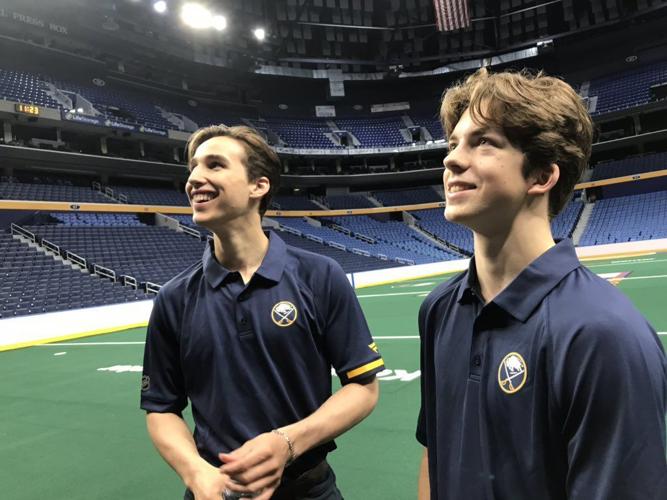
Neither Johnson nor Power could attend Buffalo’s Prospects Challenge ahead of NHL training camp, but the two will face off four times during the regular season, beginning Dec. 3. Johnson and Power also may see each other at the next world juniors. It will be mandatory viewing for Sabres scouts and development coaches, as the two young defensemen could be part of the club’s young core in 2022-23.
“He’s a really good skater,” said Johnson, who also faced Power in the USHL. “When I played against him in Chicago, I didn’t even know he’s an ’02. I thought he was a 2000 or ’99 because he was so big and strong.
“He’s a really, really talented player, even watching him at the world championship (this spring). Happy for him and hopefully we can get going.”


