


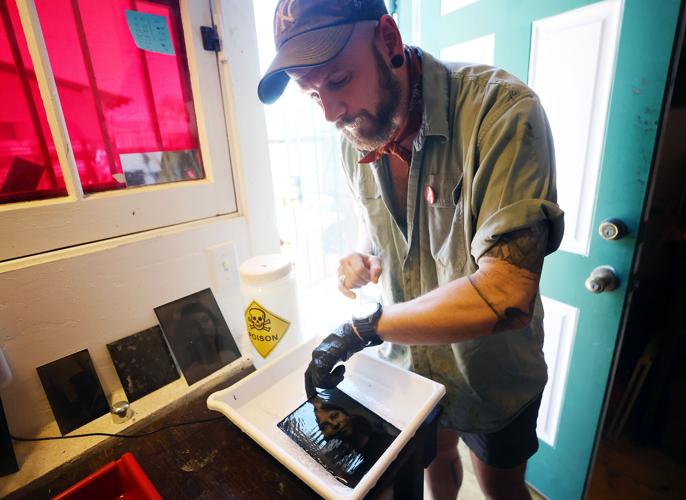

Jono Melamed goes through the process of developing a tintype at his studio in Tucson, Ariz. on June 17, 2026. Melamed is a local artist who works in photography, video, writing and design.
Long before smartphones could capture thousands of photos in a pocket, photographers made images on metal plates by hand. In Tucson’s Presidio Historic District, Jono Melamed is keeping that tradition alive, creating tintype portraits that blend 19th-century chemistry, painstaking craftsmanship and a distinctly modern desire for something real.
What he loves about tintype photography, Melamed said, is the connection to history, the human influence on the medium, and the unedited honesty of the photos.

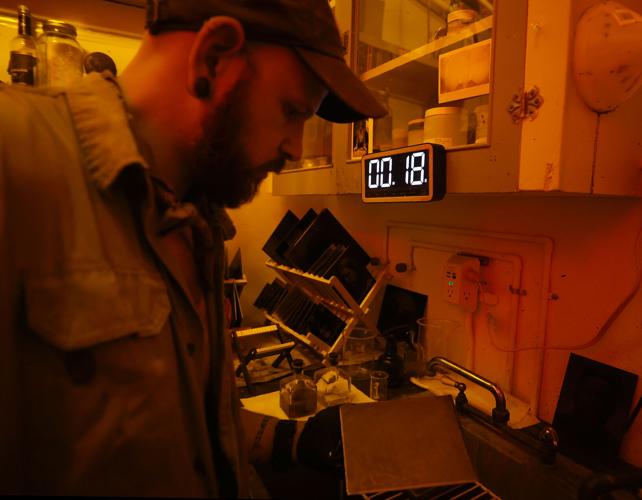
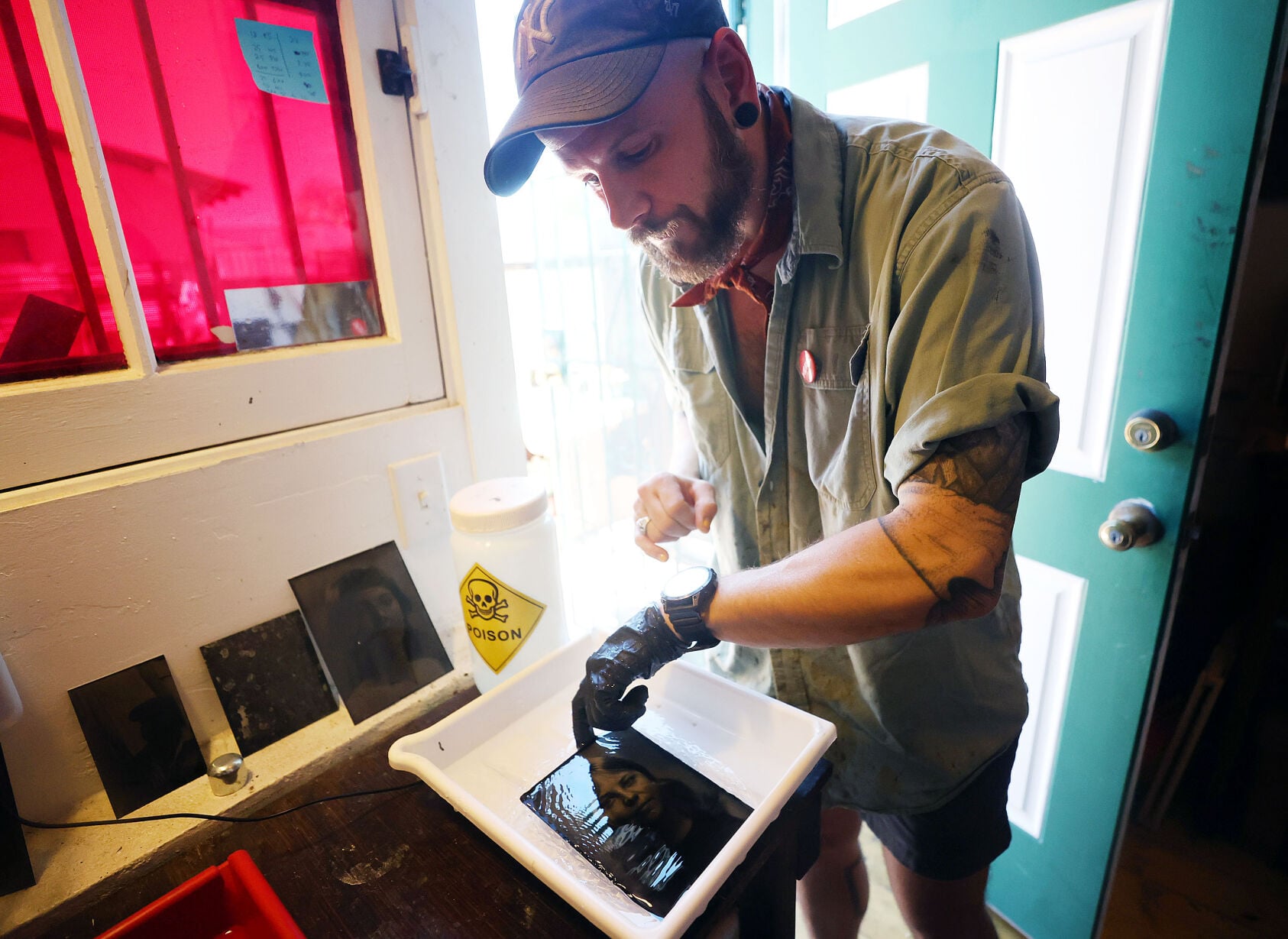
After exposing the tin type plate in the camera, Jono Melamed uses a timer in his darkroom to keep track of how long the developer has been on the plate at his studio in Tucson, Ariz. on June 17, 2026. Melamed is a local artist who works in photography, video, writing and design.
“It's a pretty archaic medium, but it's also really honest. I think, when it comes to photography, especially now, everything is pretty saturated, and hyper digital,” he said. “This is really raw.”
Part of the draw for his clients, Melamed said, is being able to take home a physical art piece that commemorates a moment in a way that digital photographs can’t.
“In a world where we have so many pictures in our phones, and we have so many digital pictures of us, this is a physical, tangible thing,” he said. “People really love getting pictures made with their partners, or with their kids.”
“Many people that I've interacted with, they've only ever seen a tintype in a museum, or they have some old tintypes from their great great grandparents,” he said. “They see that and they're like, ‘I want that, I want to be able to hand down this image to somebody that matters in the future to me,’ and that feels really special to me. That's a service that I'm super grateful I get to provide for people.”
For Melamed, the beauty of tintype comes from the physical process of creating the images.
“The process itself – because it's very physical – the images get pretty imbued with the physicality of what I'm doing,” he said.
Photography has been a longtime passion for Melamed.
“My father was an artist, so I grew up with him encouraging me to do creative things. He gave me a camera when I was really small, 10 or 12, and I just messed around doing that for a little while,” Melamed said. “I picked a camera up more seriously when I was 17, and I was just photographing my life.”
He later studied photography at the School of Visual Arts in New York City, and discovered tintypes during an elective class senior year.
“I took an alternative process class, and it was (about) all of the historic photographic printing methods,” Melamed said.
The process of creating a tintype photograph is intricate and highly technical, and involves working with several finicky chemical mixtures. Any misstep or small change in the process, can impact the final quality of the picture.

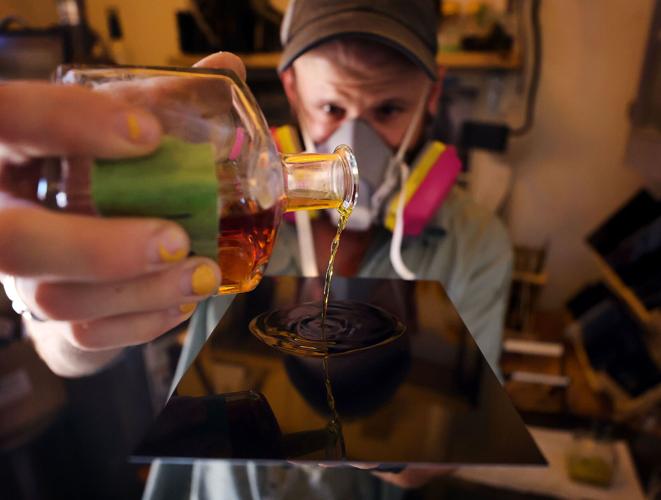
Jono Melamed prepares a plate before taking a tintype photo at his studio in Tucson, Ariz. on June 17, 2026. Melamed is a local artist who works in photography, video, writing and design.
Before the photo is even taken, the metal plate is carefully prepared with collodion, which Melamed makes himself.
“There's a handful of different ways to do that, different types of film, I guess, and they have their own recipes, have their own benefits and pros and cons. This is one that is pretty historically accurate and I like it, because it has good tonal range,” he said. “The contrast really shines outside.”
The collodion-coated plate is then dipped in silver nitrate. Neither component is light-sensitive, but the combination of the two becomes light-sensitive and allows the photo to be exposed on the metal.
“When photography happens, it gets shot like a piece of film,” Melamed said. “The plate gets exposed to light.”
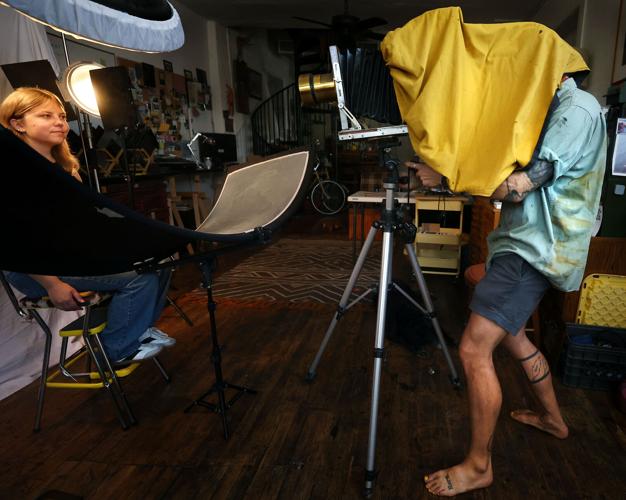
The prepared plate is then loaded into Melamed’s Deardorff V8 camera. With its accordion shape and fabric cover, Melamed disappears beneath it, it looks like something straight out of a period piece or archived photos.

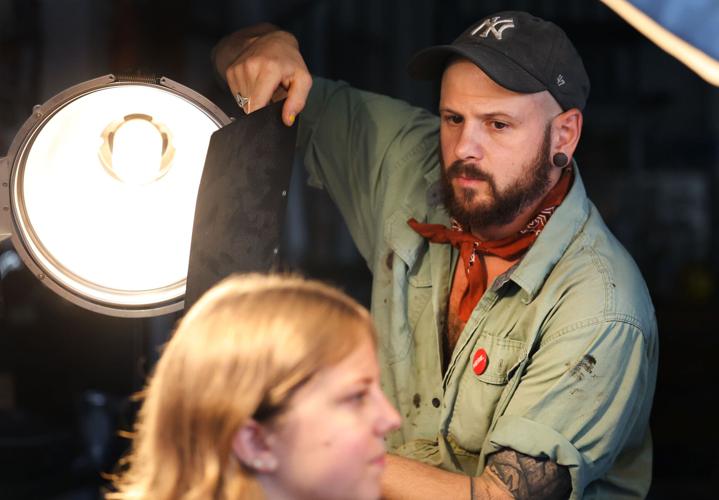
Jono Melamed adjusts the lighting on Analeise Mayor before taking a tintype photo of her at his studio in Tucson, Ariz. on June 17, 2026. Melamed is a local artist who works in photography, video, writing and design.
“When people come in, they typically sit and we have a conversation for a little bit, figure out who they are, what they're trying to do. Often I have couples, and there's a moment they're trying to commemorate,” Melamed said. “People often think that they have to sit very, very, very still, and you do. If we're not using natural light, it's not as still, because the exposure itself is instant, but you do need to sit still for the camera to focus, because it is so not sensitive to light. I have to open up the lens quite a bit, so the f-stop is very low, which means the aperture is very wide, and lets in a lot of light. It makes the depth of field really, really shallow, razor thin, especially because this is a large amount of camera, so, because of that, if somebody moves a smidge, they go out of focus.”
His favorite portraits, Melamed said, are the more natural, up-close and moody pictures.
“I live in a world of many, many pictures, and I appreciate the honest ones, and honest portraiture is, I think, the most interesting,” he said. “People ask me a lot about if they should smile, if they can smile, which I always say, ‘you can do whatever you want, it’s your picture,’ but people look the best when they look like themselves, and people look the most like themselves when they are gentle.”

Jono Melamed, right, focuses the camera on Analeise Mayor before taking a tintype photo at his studio in Tucson, Ariz. on June 17, 2026. Melamed is a local artist who works in photography, video, writing and design.
Once the subject is framed in the camera, and the bright explosion of the flash exposes the image, the race is on and Melamed has only minutes to complete the process of developing the photo.
The key is the acidic, heat-reactive developer, which must remain cold, and is chilled in the freezer for an hour before the session.
“The developing process is what gets exacerbated by the heat. What happens is the developer gets hyperactive, and then my development times get very short,” Melamed said. “You're going to see things come up, it starts with the highlights, then it hits the mid tones, and then the shadows pop in, and so the trick is to catch it like right when the shadows pop in, as soon as you see shadow detail. And depending on how much time there is, every second matters more or less.”
On average, Melamed said he only has 12 seconds to stop the developer with water and place the tintype into a fixer of potassium cyanide.
“There's a handful of reasons why people use (potassium cyanide), there's people who need it to be historically accurate and they won't settle for anything that's not what they did in the 1800s, and there's people who say that there is an esthetic benefit because there's more lights, and the lights are brighter,” Melamed said. “Then there's people like me, where I do a lot of work outside, and the cyanide, for chemical reasons that I don't fully understand, takes significantly less time and water to wash.”
The first plate usually is like the first pancake in a batch, Melamed said, with some imperfection or another.
“Sometimes clients love it,” he said. “Usually the second one is the one that people end up walking away with.”
Some weeks Melamed said he can produce a portrait every day, or more. His five-by-seven plates are priced on a sliding scale from $95 to $125.
“Some weeks it's two a day,” he said. “I try not to do more than two a day.”

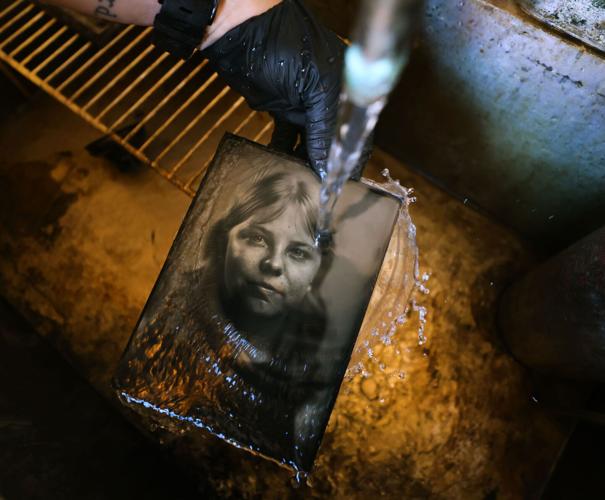
After developing the plate, Jono Melamed runs the tintype under water to wash off the chemicals at his studio in Tucson, Ariz. on June 17, 2026. Melamed is a local artist who works in photography, video, writing and design.
When he’s not creating portraits, Melamed takes his photo lab on the road in his truck that he’s converted into a portable darkroom, to photograph the landscape of the desert.
“I've got the camera and then I've got the case of my lenses, and a tripod, and then two milk crates, and the Pelican case, and a roll of paper towels, and then as much water as I can carry,” he said. “Right now I'm working on a project about endangered public land. A lot of that land happens to be in the desert.”
Some of the places he’s photographed include Bears Ears and Grand Staircase-Escalante national monuments.
“I've gone out to Big Bend, where they're trying to build a wall on the Rio Grande in the national park,” Melamed said. “I think the conversation is really important around public land, because I think it's the biggest asset we have as a nation, and I also think that this process (of tintype photography) is important to the conversation, because there's a historical context and a precedent for the use of it. The original photographers that made it out west as part of the US Geological Survey teams, basically all of the imagery that we have of the West and the United States in general, was all created using this process.”
The project is slow-going but deeply impactful for Melamed.
“For me, connecting the dots between those two things feels important,” he said.
This summer, you can find prints of Melamed’s work around Tucson at your favorite local breweries and after-work hangout spots, from Crooked Tooth Brewing to Tap & Bottle North, and Tucson Hop Shop, as part of Bun Bun Vending’s “Smol Worx” art show, which runs through July.




