



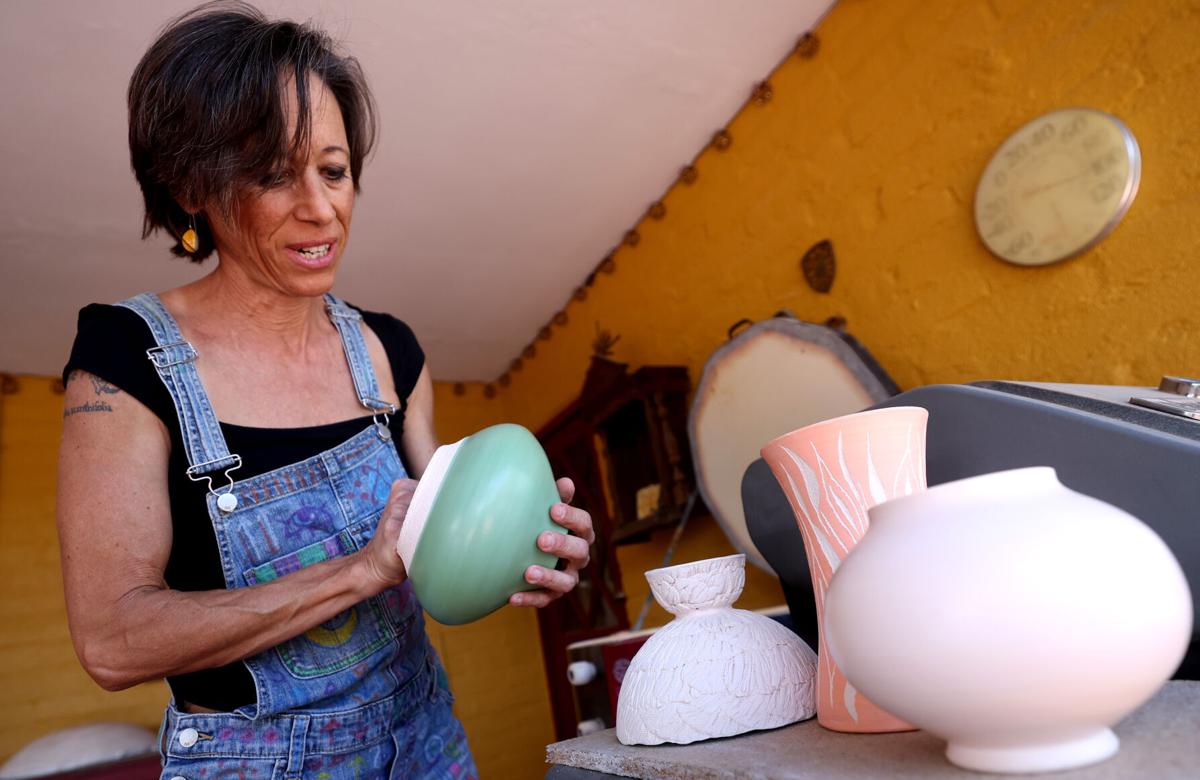
For Tucson ceramicist Anne Neuenschwander, the wonder of pottery is in the happy accidents.
Using traditional raku ceramic techniques, her work incorporates natural elements like horsehair and desert flora, as well as shimmering metallic glazes and earthy charcoals to create deep, smoky black pottery pieces.
“What I really love is the unpredictability. Sometimes it takes me a little while. Sometimes I need to sleep the night to embrace the piece and to deal with my expectations if it didn't come out the way expected, and then those pieces wind up to be pieces I love,” Neuenschwander said. “The raku gods keep teaching me valuable lessons – how to manage expectations, embrace patience, and slow down, whether I’m unloading the kiln or navigating everyday life.”
She has called many places home from Greece to Switzerland, France, West Africa and now Tucson, and said each place has shaped her journey and influenced her pottery style. Her home near the base of the Catalinas is filled with ceramics from her life around the world, including dark pots and vases from Africa that sit on her fireplace mantle.
Neuenschwander said she started pottery more than 20 years ago, after her children were born, as a fun hobby and a way to meet people.
“I immediately fell in love,” she said. “I bought the wheel, and within six months, I had my own studio.”
She moved to Tucson in 2013 and has been teaching ceramics classes at Tucson Parks and Recreation for five years now.
“One is hand building, and the other one is advanced pottery,” Neuenschwander said. “A lot of people come, they just work on their own projects. If they work on the wheel, I can help them there, but most people right now do hand building, so I come up with hand-building projects.”
She also teaches occasional raku workshops out of her house, and recently started doing raku workshops for non-potters.
“You don't need to have done pottery, you don't need to have any artistic fiber in you. It could just be a getaway as a family or work colleagues or friends, sit on my back porch and drink coffee or wine, depending on the time, and I take care of the kiln,” she said. “Just come and put the horsehair on the pots that I previously made.”

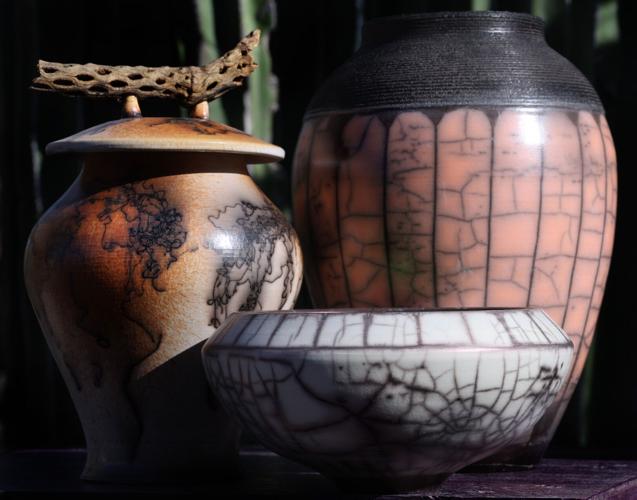
A horsehair raku urn with a cholla bone for a handle, left, a naked raku bowl and raku vessel with smoke infused upper section from the finished work of Anne Neuenschwander, Tucson, Ariz., June 11, 2026.
In keeping with the raku style, her pieces are mostly decorative, and range from vases and trinket dishes to bowls, tealight holders and sculptures.
Her inspiration, she said, comes largely from the nature of the Sonoran Desert, and the shapes and plants she would see on her trail runs.
“Every (Tucson) potter, sooner or later, faces a question: will I carve or paint or make those cacti or not? And for me, I totally embrace it,I love it.,” Neuenschwander said. “When I do not raku, I do carving of cacti, and with raku, I use the saguaro ribs, I use the cholla skeletons where I can ... on the lids or as handles.”
She also draws from ceramics and pottery from the cultures she has experienced, and utilizes horsehair to bring a Southwestern flair to some of her pieces.
Each of her works takes hours or days to complete, with numerous, painstaking steps needed to achieve the desired cracked raku look.

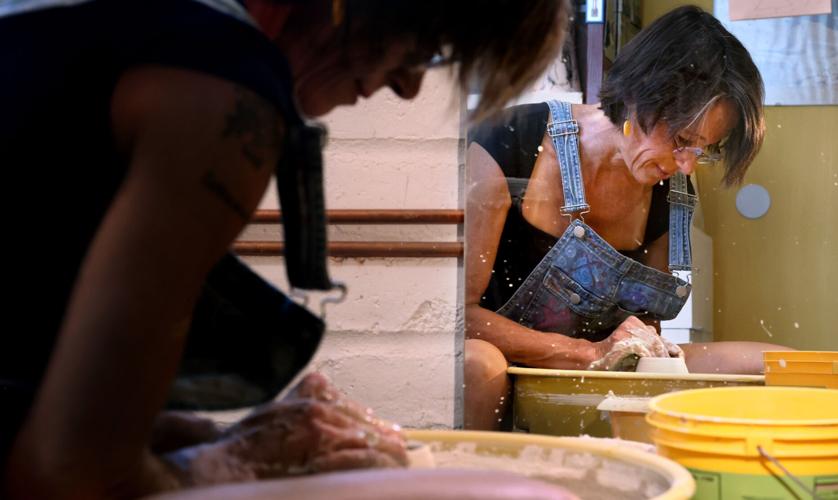
Anne Neuenschwander throws some salt shakers while working in her home ceramics studio, Tucson, Ariz., June 11, 2026.
“I fire it first in the electric kiln, then, when glazing, I apply a coat of sacrificial slip, and then the glaze wherever I want the glaze,” Neuenschwander said.” “Wherever I don't glaze will be completely black.”
When the kiln is brought to temperature, around 1,600 degrees, Neuenschwander opens the lid.
“That creates a thermal shock that cracks the glaze,” she said. “I put it in a metal bin with combustibles, and then I extinguish the flame with the lid, I close it, and it has a thick smoke, and the carbon of that smoke enters into the bare clay.”
When the piece is ready, Neuenschwander takes it out, cools it with water and scrubs the glaze off, creating the classic contrasting raku designs.
The final step is polishing.
“There's a lot of polishing involved,” Neuenschwander said. “I polished it beforehand, sometimes I added a layer that's called Terra sigillata that's very fine liquid clay, so it's super, super smooth, and at the end I wax it and polish it.”

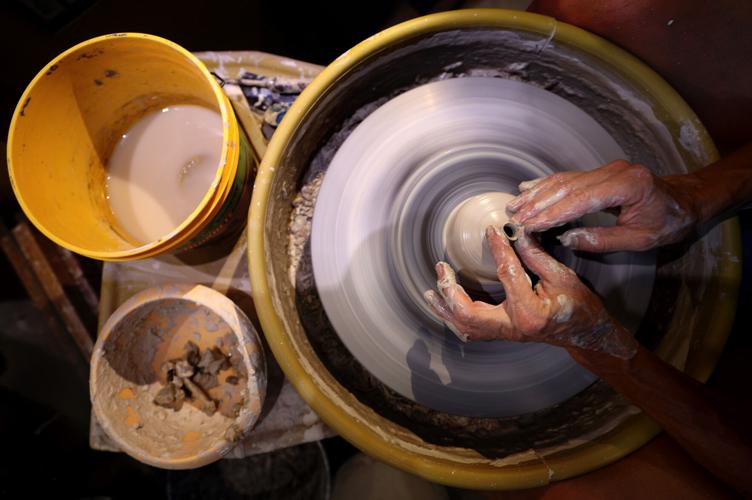
Anne Neuenschwander gets to the delicate part, throwing clay on her in her home ceramics studio, Tucson, Ariz., June 11, 2026.
For her horsehair designs, once the kiln reaches the same 1,600 degrees, the pottery is removed and the horsehair is applied, leaving behind curling, linear threads.
“What you see left behind are the carbon markings,” Neuenschwander said.
Some of her favorite pieces are a large sculptural piece titled Ariadne’s thread, which is set to be displayed at the upcoming Silver City CLAY Festival, and the Light Art Space Gallery in Silver City. The work depicts a line unspooling like a ball of thread, and pays homage to the Greek myth of Ariadne, as well as Neuenschwander’s childhood in Crete.
She is also proud of her new three-piece sculptures that symbolize the three continents she has lived on.
The next evolution for Neuenschwander as an artist, she said, is exhibiting her work in more shows and galleries, and testing the limits of raku, and her sculptural technique.
“I want to make crazier pieces, throw something and then see where that goes. What I want to try, really, is bigger pieces.” she said. “I'd like to explore that a bit more.”




