


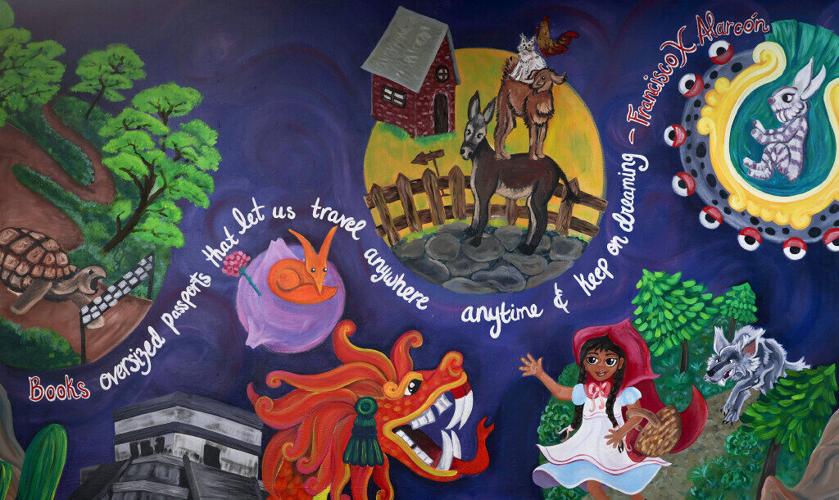
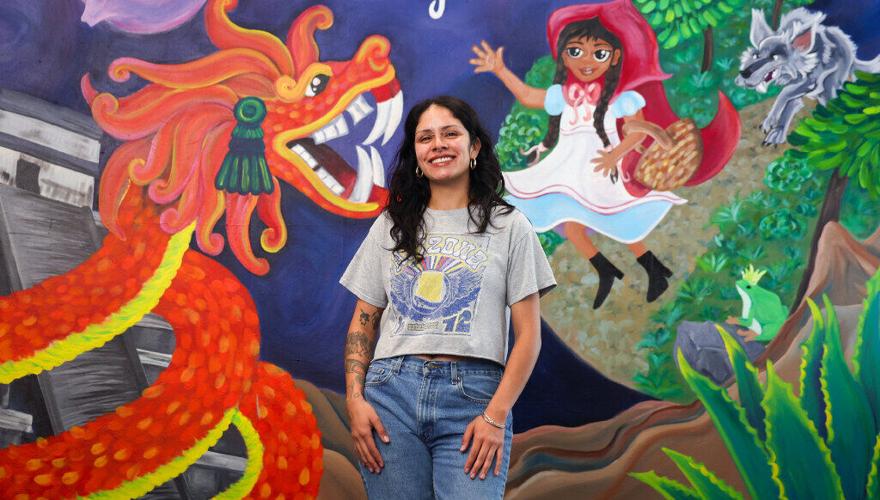

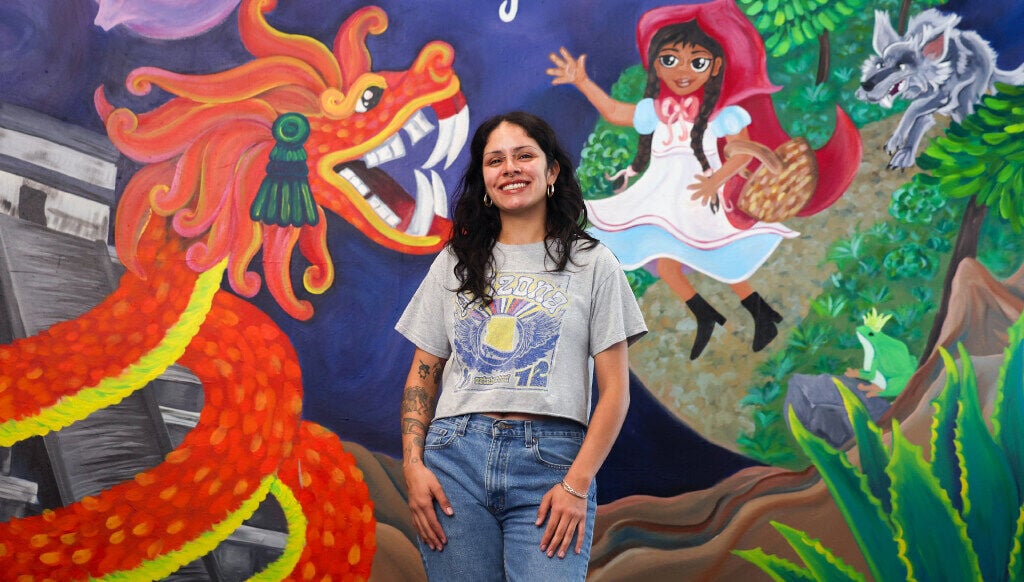
An orange feathered serpent winds around a pyramid, its body stretching across the center of a mural inside the University of Arizona Poetry Center.
Inspired by the Aztec deity Quetzalcoatl, the serpent is surrounded by desert plants, mountains, trees and characters drawn from stories around the world. A girl carrying a basket appears to leap across the landscape, while a wolf emerges from the trunk of a tree and a rabbit sits beside a glowing moon near the mural’s upper corner.
Created by Tucson artist Adelynn Olea of Alleycat Murals, the mural transforms the Poetry Center’s children’s area into a vibrant meeting place between stories, cultures, and imagined worlds.
The mural is the centerpiece of Brave Books: ¡Cuentos del Mundo!, a new exhibit centered on Mexican literature and folklore.
The exhibit was introduced in August and is expected to remain in the children’s area for about five years.
Brave Books is the Poetry Center’s celebration of independent bookstores and libraries around the world. Previous exhibits have featured Shakespeare and Company in Paris, the African National Memorial Bookstore in Harlem, libraries in Egypt and Iraq, and Casa Camino Real in New Mexico. The most recent theme, which ran from 2021 to 2026, centered on zines and zine libraries.
This time, the program is highlighting Biblioteca de México in Mexico City while exploring the connections between stories read in Mexico and those shared by children in other parts of the world.
“We’re thinking about both what our neighbors in Mexico are reading,” said Eva Sierra, the Poetry Center’s K-12 programs assistant. “But also just recognizing there’s this broader literature in Mexico, and then also thinking about the stories that we all grew up reading, like fables and fairy tales, and how those are common to children all over the world.”

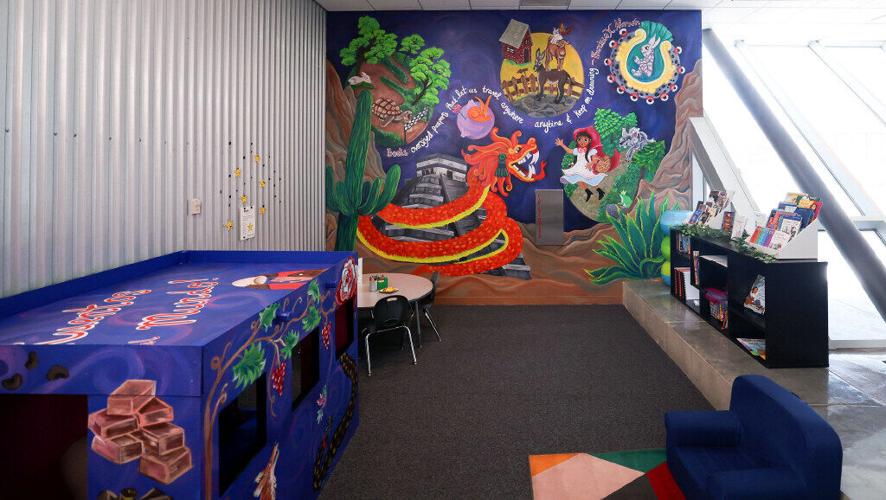
¡Cuentos del Mundo! theme mixes Mexican literature with classic stories like fables, fairy tales, folktales and legends, Helen South Schaefer Building, 1508 East Helen Street, Tucson, Ariz., Aug. 21, 2026.
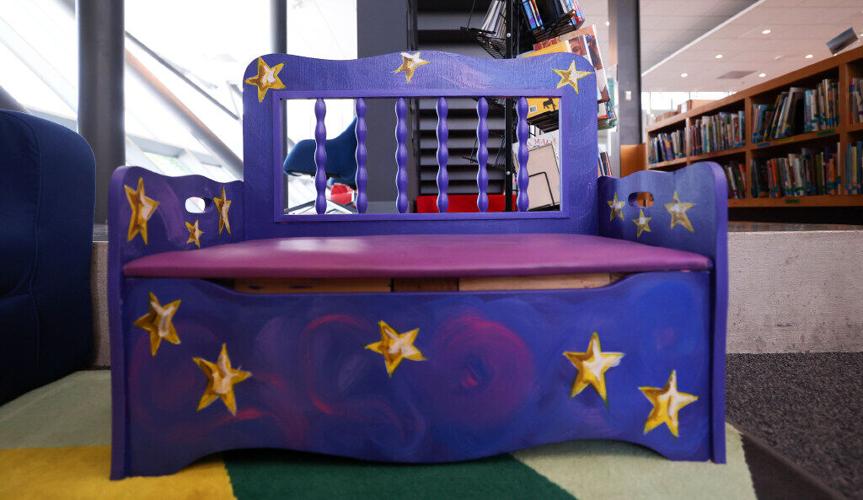
The exhibit includes a themed reading shelf, a playhouse, Unified English Braille books and a rotating interactive display. The featured books, available in English and Spanish, can be read in the Poetry Center’s children’s area.
Its most noticeable feature is Olea’s mural, which blends a Sonoran Desert landscape with characters and imagery from traditional stories and Mexican culture.
Olea created the original composition in collaboration with Sierra and other members of the Poetry Center’s K-12 education team. The group started with a theme, a collection of images and the idea that each story could be its own planet.
The concept complemented a line from poet Francisco X. Alarcón that now appears across the mural: “Books are oversized passports that let us travel anywhere anytime and keep on dreaming.”
Olea said the mural took about four or five weeks of active work to complete, or nearly six weeks when including a break. Its combination of characters was partly inspired by the bright, story-filled murals often seen at elementary schools in Mexico.
Some of the details Olea painted on the mural and playhouse were also chosen with local children in mind. Rapunzel, for example, has brown hair because many of the children who play in the playhouse will most likely have brown hair, Sierra said.
For Olea, the mural was an opportunity to create something that could do more than decorate a wall.
“It starts a whole conversation,” Olea said. “That’s what I try to do with my murals. All my murals, I try to have them as conversation points.”
The mural gives children and their families plenty of those starting points. Visitors can identify familiar characters, ask about the Mexican imagery or consider why certain stories and landscapes have been brought together.

A new mural inside the University of Arizona Poetry Center children’s area corresponds with the theme "¡Cuentos del Mundo!" (Stories of the World).
Olea, whose work is rooted in Chicana art and storytelling, said the project also reflects a change in her artistic style.
Her earlier murals featured crisp lines, careful structure and less movement, she said. At the time, creating orderly paintings gave her a sense of stability while the rest of her life felt chaotic.
Since becoming a mother, that relationship has shifted.
“The chaos shows up on a wall instead of in my life,” Olea said. “It was very reflective. It was like looking into a mirror of how my life has changed.”
The result is a mural filled with loose lines, layered colors and movement. Olea said some of its details emerged naturally as she painted rather than from a rigid plan.
“If I would have had a plan, I don’t think the background would have looked like this,” she said. “I like the movement, and I like that it’s very dynamic. You could look at things for a very long time and see something different every single time.”
Olea said the project was one of her most challenging murals because it required her to take the Poetry Center’s broad theme and transform it into one cohesive composition.
She begins that process with language.
“All my murals start off as sentences,” Olea said. “They start off as words. Once I have the idea in writing, literal paragraph form, that’s when it starts taking form as a mural.”
She said she is proud to have her work displayed at the university, particularly as a Chicana artist.
“This is a huge deal for me,” Olea said. “It’s just sick to have Chicano art here at the U of A.”
The Poetry Center plans to incorporate ¡Cuentos del Mundo! into its programming throughout the exhibit’s run.
Field trips for students in fourth through 12th grades will include activities connected to the exhibit, such as reading its featured poems and thinking about translation. The center also plans to offer related professional development opportunities for K-12 educators.
Kids Create events, which are held twice a year, will encourage visiting teaching artists to use the exhibit in their lessons and activities.
For younger children, the Poetry Center has launched a monthly Bilingual Storytime. Children from infancy through third grade and their families are invited to hear stories in English and Spanish from 10 to 11 a.m. on the second Saturday of each month through December.
The remaining fall dates are Oct. 10, Nov. 14 and Dec. 12. The events are free, and registration is not required.

A new mural inside University of Arizona Poetry Center children’s area corresponds with the theme,¡Cuentos del Mundo!, Helen South Schaefer Building, 1508 East Helen Street, Tucson, Ariz., Aug. 21, 2026.
The exhibit also pays tribute to Biblioteca de México’s accessibility work. Sierra said the Mexico City library offers Braille books, reading technology and accessible spaces for people who are blind or visually impaired.
The Poetry Center’s children’s area currently includes a small selection of Braille books. Sierra hopes the center can eventually expand that collection and acquire additional accessible technology inspired by Biblioteca de México’s work.
The exhibit and its accompanying programs are part of a larger effort to help more Tucson families feel comfortable visiting the Poetry Center and the UA campus, Sierra said.
“How do we get the community more into the university space?” she said. “Sometimes it’s a hard place to visit if you’re not familiar.”
For Sierra, that work includes offering bilingual programs and sharing practical information that might make a campus visit feel less intimidating.
The Poetry Center and its library are free and open to the public. The center is open from 9 a.m. to 5 p.m. Tuesdays through Fridays and from 9 a.m. to 3 p.m. Saturdays.
Street parking and parking in uncovered campus surface lots are free on Saturdays. The Highland Avenue garage, located across from the Poetry Center, charges $2.25 per hour.
The Poetry Center is located at 1508 E. Helen St., at the corner of Helen Street and Vine Avenue.
“Anybody could just come in, grab a book and read,” Sierra said.

