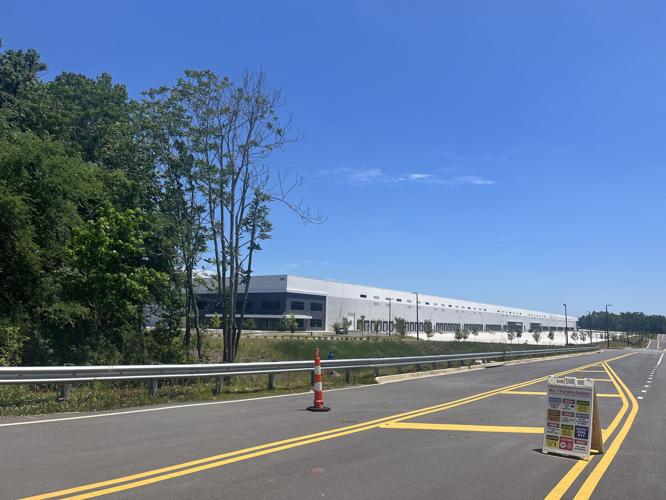
SOCIAL CIRCLE, Ga. — Until recently, this rural city was best known for its Blue Willow Inn cookbooks featuring recipes for Southern dishes such as baked pineapple casserole and kudzu blossom jelly.
Lately, the community tried to stave off a new identity of "prison town" as it fights the opening of what could become the nation's largest immigration detention center, which could hold up to 10,000 people.
Walton County, home to this city of about 5,500, voted overwhelmingly for Republican President Donald Trump in 2024. But, as the administration's mass deportation strategy hits closer to home — with plans moving forward to transform a more than 1 million-square-foot warehouse into a holding pen — residents say the city's infrastructure can't handle such an influx of people.
This month, Social Circle filed a lawsuit in federal court against U.S. Immigration and Customs Enforcement. The city's complaint argues that the operation of a detention facility, what it calls a "mega center," would harm public health, strain the fresh water and sewage treatment systems, and overburden emergency medical services.
People are also reading…
"The community is very unified," City Manager Eric Taylor said. "We want them to go away."
Social Circle is among communities across the country thrust into a national debate about the administration's mass deportation strategy. On the campaign trail, Trump said migrants occupy American towns. But municipal leaders, state attorneys general, advocacy groups and others in Arizona, Maryland, New Jersey, Pennsylvania and Texas claim the administration is doing the same thing by plopping detention centers into communities without the capacity to handle them.
ICE puts every person the administration seeks to deport in detention — including those with no criminal records — without the possibility of release on bond. In January, the agency held almost twice as many people as it had that same month in 2024 under Democratic President Joe Biden.
However, while many supporters remain aligned with Trump's immigration stance, some residents fear their city's stability will be jeopardized. "Social Circle is not exactly flourishing, but it's making it," said Gareth Fenley, a retired social worker who ran for state Senate in 2024 as a Democrat and was not among those who voted for Trump.
"If Social Circle becomes a prison town," she said, "we're gonna lose what we have."

Social Circle, a Georgia city of 5,500 residents, filed a lawsuit against U.S. Immigration and Customs Enforcement, claiming plans to open a massive ICE detention center could threaten the city's public health and overburden its emergency medical services.
Water supply and other challenges
In February, the Department of Homeland Security, ICE's parent agency, purchased the 235-acre site in Social Circle for almost $129 million — nearly five times its assessed value. It plans to house nearly triple the number of people housed at the current biggest U.S. immigration detention facility, in El Paso, Texas.
DHS estimates the facility would require about 1 million gallons of water daily, according to the city's suit, which alleges that volume would bleed residents' taps dry and contaminate streams with sewage. Emergency medical calls from the detention center, the lawsuit claims, would overwhelm the city's first responders, which Taylor said clock in at 14 firefighters, 15 police officers and two school resource officers. The city relies on Walton County for ambulance services.
Additionally, Social Circle would live under an ever-present threat of a major disease outbreak, the lawsuit said, adding the federal government didn't conduct the needed environmental reviews or solicit community input beforehand.
Taylor said federal officials had only one meeting with city leaders and brushed off concerns about water, sewage and emergency care, which administration officials said the site wouldn't need to use. "I don't buy that," he said.

This industrial property in Social Circle, Ga., is being developed into a U.S. Immigration and Customs Enforcement detention center expected to hold up to 10,000 detainees.
Supercharging health concerns
DHS Secretary Markwayne Mullin said he is reviewing plans made by his predecessor, Kristi Noem, to transform warehouses into detention facilities. The department's inspector general is investigating whether the federal government overpaid for some buildings. Mullin also said officials are reviewing agency policies and working with community leaders. "We want to be good partners," said Lauren Bis, a DHS spokesperson.
Still, the administration's swift escalation of immigrant detention exacerbated long-standing allegations of medical neglect for those in custody across the country and led to the highest number of detainee deaths in at least two decades.
Three detention facilities in Folkston, Ga., issued 130 emergency calls from Feb. 4, 2025, to Feb. 3, 2026, according to dispatch reports obtained by KFF Health News through a public records request. The calls from the facilities, which hold about 2,000 people, were for wide-ranging reasons, including anaphylaxis, assaults, suicide attempts, overdoses, seizures, strokes, head injuries from falls and other health issues.
GEO Group, ICE's largest contractor, which runs the Folkston facility, provides "around-the-clock access to medical care" and relies on emergency medical services as needed, said Christopher Ferreira, director of corporate relations.

ERO El Paso Camp East Montana, built on a Texas military base, is the nation's largest detention center and holds about 2,500 people. In the five months from Aug. 17, 2025, to Jan. 20, 2026, about 130 emergency medical calls were made from the site, according to city records. Several detainees died at the facility; several others tested positive for tuberculosis, measles, or COVID-19.
Amentum Services, which recently took over management of the facility, did not respond to questions about emergency calls.
Social Circle may face an uphill battle. Taylor said Walton County leaders and the state of Georgia were silent about the center.
"They say it's federal issues, that they have no jurisdiction," he said. "They don't have any interest in helping us."
KFF Health News is a national newsroom that produces in-depth journalism about health issues and is one of the core operating programs of KFF — the independent source for health policy research, polling and journalism.


 Tucson official: Air Force won't pay for D-M groundwater cleanup now