

Creative Machines is a mixture of three seemingly incongruous ingredients — art, science and business.
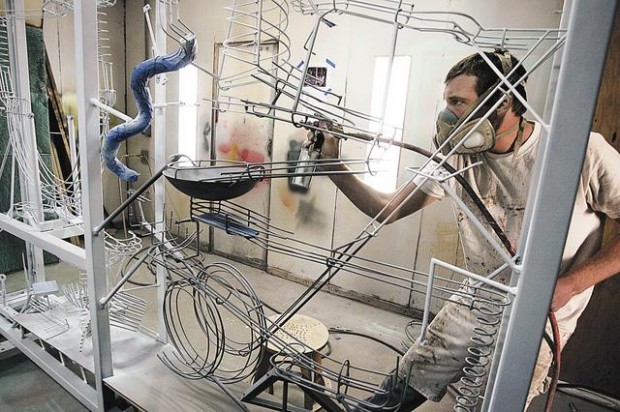
Owner Joe O'Connell is the chef who has blended art and science profitably, for most of the company's 11 years — mainly selling exhibits to children's museums that artfully, playfully and physically demonstrate scientific concepts. The company has also branched into interactive public art and making "ball machines," miniature roller- coasterlike mazes of tracks on which steel balls ride, tripping devices along the way.
The Tucson company's generic-looking steel building in an industrial neighborhood near East Ajo Way and South Country Club Road conceals a veritable toy store for a small crew of hybrid artist-craftsmen-scientists.
The company has slowly grown to about five full-time employees and four part-timers and annual sales of $600,000, O'Connell said.
People are also reading…
To grow further, he's diversifying, ramping up the public art section of the company. One of Creative Machines' interactive public art projects was installed last year in Tucson's Ochoa Park — an internally-lit, conga-style drum with electric drum-sound triggers on the top.
O'Connell said he hopes to sell different versions of the drum to other parks around the country, with different shells — the art part — but using the same electronic "guts."
Creative was paid $10,000 for the park drum, O'Connell said. Since it took a lot of design work and extreme-condition-testing, it wasn't exactly a high-profit project. But if he can sell essentially the same piece several times, it could become a profitable project, spreading the development cost out over many units.
Selling variations of the same package with the same technology is one of the keys to the company's success, O'Connell said.
"It used to be 90 percent original (pieces) and 10 percent copies, and that was just killing us," he of the company's earlier days.
Artists need to eat, too
The company's evolution "is not that unusual," said Roberto Bedoya, executive director of the Tucson-Pima Arts Council.
"I think sometimes there's a false dichotomy," between making art and making money, Bedoya said. "Every artist has to make a living."
"Andy Warhol did illustrations for fashion magazines. Salvador Dali did movie sets.
"Artists have always worked in a commercial medium and done their art as well."
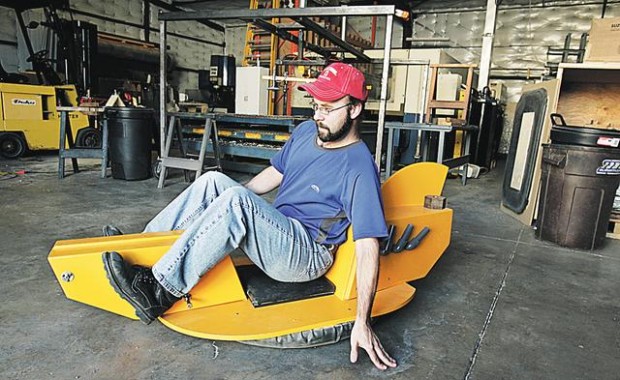
As O'Connell leads a Cook's tour of the business, one of Creative Machines' artistic science guys is scooting around the warehouse on a Hovercraft prototype they built. They're working the bugs out.
O'Connell said museum exhibits that are going to be tortured hundreds or even thousands of times a day by eager kids have to be safe and durable.
Strange noises are the norm here. Some of the exhibits are set up to operate themselves, repeating their operations thousands, even hundreds of thousands of times to simulate the beating they'll get from wired-up kids in a museum across the country, and sometimes across the globe.
There are a dozen or more exhibits sitting around, burbling, growling, popping and humming. Some are waiting to be perfected and delivered to hands-on museums. Others were never sold, but have become permanent exhibits because O'Connell likes them.
There's a fun house mirror that changes its distortions, the thin surface distorted from behind by servo-controlled rams.
There's an exhibit that projects an ever-changing image of water running across a reflective surface on a wall.
There's a huge booming kettle drum that is activated by the user's heartbeat, picked up by handgrips.
"Wouldn't it be cool if ...?"
Many of the devices, probably most of them, were built not because somebody asked for them, but because one of crew said, "Wouldn't it be cool if . . . ?" or "I wonder what would happen if . . . ?"
One of the latest devices is a would-be children's museum exhibit, a horizontal glass screen on a tabletop. It has buttons, each of which produces a different sound when depressed.
O'Connell said the Beat Sequencer is actually an Apple iMac computer, screen facing upward and running some customized software he contracted.
That kind of practicality, using off-the-rack components, helps keep these projects affordable.
Bedoya said artists are increasingly turning to technology in their day jobs.
"I think where it becomes a little more blurry is in these new economies associated with the art — Web design, architecture to a certain extent, Internet gaming all ask that an artist have visual competency.
"They may be going home and painting and then going to a media lab to create a new game for GameBoy."
On the Net
See a YouTube video on Creative Machines' Drum Project piece in Ochoa Park.