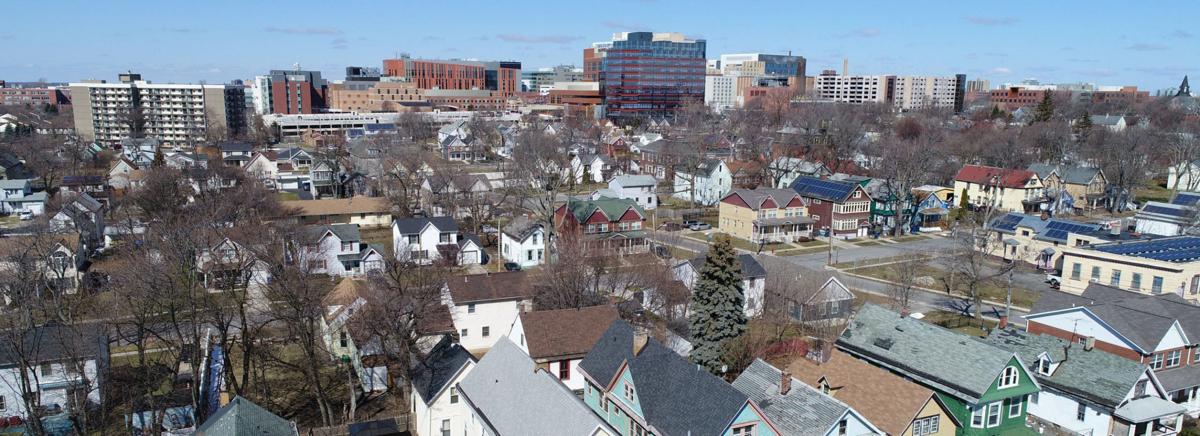
Eight months ago, a Dunkirk nonprofit agency and the Fruit Belt Community Land Trust unveiled plans to bring 50 affordable housing units to the East Side neighborhood, adjacent to the Buffalo Niagara Medical Campus.
The goal of the deal, signed by Buffalo mayoral candidate India Walton when she led the land trust in 2020, was to create more lower-priced options for residents, while offering a path to ownership. The plan was to use low-income housing tax credits to finance the venture, which would be co-owned by the land trust and Southern Tier Environments for Living, or STEL.
The partners have struggled to gain consensus in the community, even after two years of behind-the-scenes discussions. And now the $20 million development proposal appears to be barely on life support.
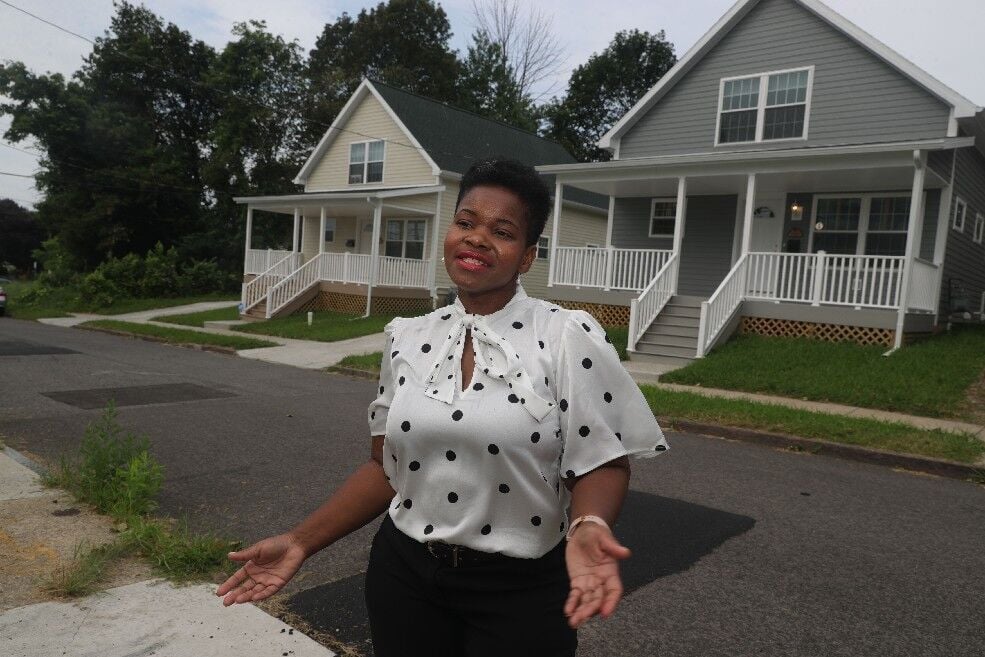
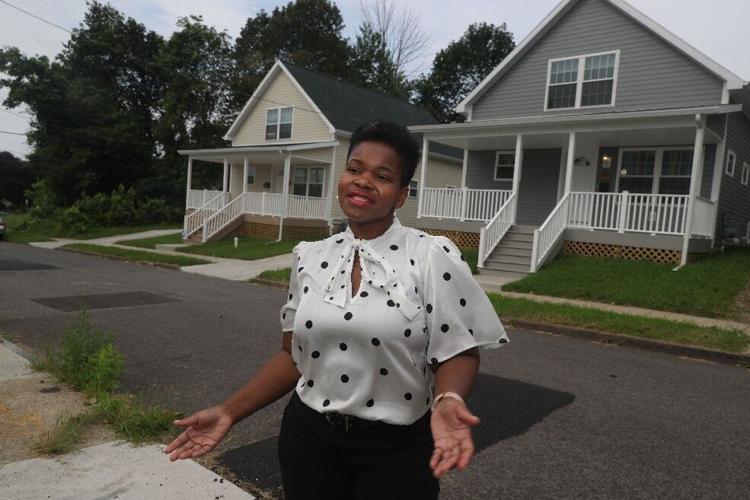
Mayoral candidate India Walton on Rose Street in front of a pair of Habitat for Humanity houses constructed under a partnership with the Fruit Belt Community Land Trust. Walton spent several years as the founding executive director of the Fruit Belt Community Land Trust, a nonprofit community organization formed to give the Fruit Belt neighborhood more control and input over development in the neighborhood.
The land trust's interim leader abruptly backed out of the project over the summer, blaming Walton, its founding executive director, who stepped down last November to run for mayor.
People are also reading…
In a July 19 email from interim Executive Director Stephanie Simeon to STEL Executive Director Thomas Whitney, Simeon asked to cancel their contract, saying the 4-year-old land trust lacked the resources for the project. She also cited the inexperience of the group's previous leaders: Walton and former board chair Zaid B. Islam.
"I believe it's clear that the agreement signed by then Executive Director: India Walton and President Zaid Islam was premature due [to] their inexperience with complex housing projects of this scale," Simeon wrote in the email, which was recently obtained by The Buffalo News. "Therefore we are asking to dissolve our agreement."
The venture's failure comes at a time when Walton has been citing the project among her successes as "an accomplished executive director" in the Fruit Belt, as she campaigns for mayor against incumbent Byron W. Brown.

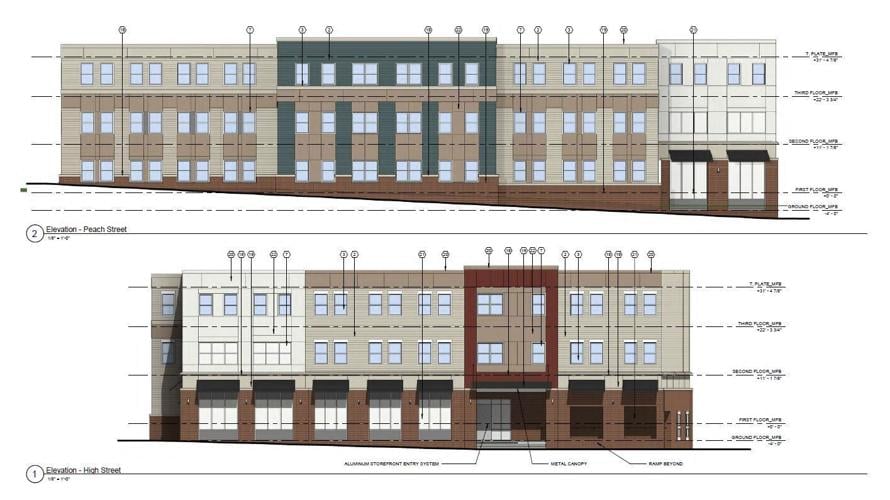
Schematic elevations of the proposed new apartment complex in the Fruit Belt neighborhood, by Southern Tier Environments for Living and the Fruit Belt Community Land Trust.
The collapse of the plan demonstrates the challenge of working in a neighborhood like the Fruit Belt, with its divergent viewpoints. It also illustrates the shortcomings of a nonprofit organization with novice leadership that has plans but few financial resources or expertise. And it could potentially reinforce those like Brown who say Walton lacks the experience to run a complex city government.
Simeon insisted on Friday that the land trust "never terminated its agreement with STEL," but that's what STEL and the city understood. The designated-developer agreement for 27 properties expired in late July. STEL won't work with the land trust again. And the city is ready to start all over.
Walton spokesman Jesse Myerson said Walton had "no insight to offer" about the change in direction by the land trust.
"Stephanie Simeon has decades of experience in this field and that, if she feels the deal wasn't prudent at the time, or is no longer in line with the organization's approach, India trusts her judgment," Myerson said.
From an interview with The Buffalo News Editorial Board on June 3, 2021.
But the land trust's pullback doesn't sit well with Walton's critics.
"STEL invested a whole lot of resources," said Divitta M. Alexander, an attorney and financial consultant who had been working with STEL. "It's significant for an organization of that size, and to be wasted for those reasons flies in the face of this project being an accomplishment."
Whitney, STEL's executive director, declined to comment, citing a need for his organization to remain apolitical because it needs "the support of a myriad of governmental and funding agencies."
New board members shifted aspirations
From the start, the project was ambitious. It would have built one of the few large-scale housing projects in the Fruit Belt, which is largely comprised of single-family homes. To pay for it, the project's backers planned to rely on a complicated financing package built around tax credits.
It would have built a 42,000-square-foot apartment building at the northeast corner of High and Peach streets, with 33 units. It also included five three-bedroom duplexes, one two-bedroom duplex and five single-family homes on 21 other nearby Fruit Belt properties. The below-market rents would be affordable to those earning less than 50% or 60% of the area median income.
The deal was signed last year by Walton and Islam, as a means of quickly advancing their affordable housing goals for the neighborhood.
But it butted up against the more cautious aspirations of newer board members. And it conflicted with the philosophy that Simeon brought – that the land trust should focus on its core mission of preserving affordability and neighborhood control of the land, rather than become an affordable housing developer.
The first signs of trouble came in February, when community members complained to the Buffalo Planning Board they were left out of the planning, and had not been consulted on the project. Questions were also raised about how much the board members of the land trust knew about the project – and when – even after Walton signed the agreement on the organization's behalf.
Then, during a public meeting in late April that Whitney and Alexander attended, STEL and the land trust leadership were peppered with questions about how the agreement came about, and whether the land trust's by-laws had been followed.
Simeon said STEL was also unable to respond to questions about the project budget and the makeup of the design and construction team, while the land trust's leaders did not explain how STEL was chosen for the project.
Simeon took the next few months to evaluate the project, before announcing the decision to pull out in the July email. She said the land trust was "fully transparent" with STEL throughout the process.
But the email still caught STEL officials off guard.
Five days later, in an interview with The Buffalo News at the land trust's July 24 annual meeting, Simeon said she was trying to renegotiate the relationship, but did not say she had already asked to end it, nor did she say the project was not continuing.
"I stand behind my statement made on July 24 during the annual meeting," Simeon told The News last week.
She said the land trust wanted to amend the agreement to focus the project on larger, higher quality apartments, to target low- to moderate-income, single-parent households with children. Simeon wanted to ensure that some of the town houses could be converted from rentals to ownership, to have the buildings match the architectural design in the neighborhood, and to have the land owned solely by the trust.
In her email to Whitney, Simeon said the land trust can't keep paying the $1,000 monthly lease fee to the city from its own funds to maintain the designated-developer agreement. STEL did not contribute toward those fees.
"We have exhausted our unrestricted revenue," Simeon wrote. "We are paid up to date but can not expend additional resources until we have completed our strategic plan, which will give us the structure and leadership direction for the coming fiscal year."
She also said in the July email to Whitney that the organization's "current staff that would have played in the co-developer role was inexperienced," and that community land trusts nationwide have rarely been successful with low-income housing tax credit deals.
It "didn't make sense," Simeon repeated on Friday. The land trust lacked the experience and cash flow needed to undertake such a project, she said.. "The [land trust] just simply wasn't there as yet, nor would anyone expect an agency at its infancy stage to be able to do anything like what this project proposed."
Simeon said Friday that Walton, Islam and former board secretary Robert Knoer were present for "a lot of development meetings" with STEL, but "they didn't properly document the action items and summarize the meeting so that the entire board remained thoroughly informed."
While the land trust's "entire board was aware of the agreement," she added, they "didn't seem to be aware of all the nuances that a project at that scale would involve."
"I do deeply apologize that the board liaison that you originally worked with didn't make you fully aware that the board wasn't properly informed about the scale of the project," Simeon had written to Whitney in July.
Future of properties uncertain
Walton, through Myerson, said the board "was intimately involved in every decision during her tenure," and said both she and Islam had been authorized to sign the contract with STEL.
For his part, Islam – who stepped down as board chair this summer – said he and Walton had kept board members "fully abreast of what was going on."
"We kept them informed of the scale and all the information they needed," he said. "On that point she’s very wrong."
Instead, he suggested that Simeon and a handful of new board members feared the scope of a project that they were not originally involved with.
“It was the magnitude of the work that some of them were afraid of, the responsibility,” he said. “For them to torpedo the whole thing and now say other things, I’m very disappointed. I thought this new board could move forward, but they can’t. They’re stuck in their particular silos.”
Now the future of the vacant Fruit Belt properties and any development project on them is uncertain. STEL told the city in August that it was interested in salvaging the plan, although without the land trust, said Brendan Mehaffy, executive director of the city's Office of Strategic Planning. But STEL officials have not been in contact with city officials since then.
Another option would be to put the properties out for public bid, Mehaffy said.
But before the city agrees to any proposal or process, he added, officials plan to meet with Common Council President Darius Pridgen and the Fruit Belt community to discuss how to move forward with neighborhood support.