

Global survey of 12,000 consumers reveals that personalization and
convenience are universal desires shared by all shoppers
SCOTTSDALE, Ariz.--(BUSINESS WIRE)--Today’s retail environment is more complex than ever, given the rise of
e-commerce and a rediscovery of the age-old truth that “the customer is
king.” As retailers across the globe struggle with demands for both
personalization and convenience, balanced with consumer skepticism on
data privacy, JDA
People are also reading…
Software, Inc., and Centiro
explored consumer trends in key markets in its 2018
Global Consumer Survey, released today.

Shopping in-store remains the most popular experience overall (preferred
by 38 percent) (tweet
this), although online options were preferred in some of the
surveyed countries, such as China where online shopping via
mobile/tablet (34 percent) was the preferred option. Regarding in-store
shopping, global respondents said that having the right product in stock
is the most important aspect of their shopping experience (34 percent) (tweet
this), followed by having a variety of products to choose from (29
percent).
Regardless of where transactions ultimately occur, according to the
survey, online is the first stop on the shopper journey for clothes (46
percent), home goods (48 percent) and electronics (63 percent). Younger
consumers (ages 18-34) are more likely than average to begin their
shopping journeys for each of the categories with recommendations from
friends or family; the proportion of those who start their purchase
journeys with input from friends or family decreases among older
consumers.
“This notion that stores are dying or there is a ‘retail apocalypse’ is
exaggerated. Instead, this is a time for a retail rebirth,” said Lee
Gill, group vice president, global retail strategy, JDA (tweet
this). “While the industry may refer to it as ‘omni-channel’
retailing, consumers across the globe no longer strongly distinguish
between online and in-store channels. All retailers are struggling with
balancing the personalization traditionally offered through e-commerce
shopping with the convenience of an in-store experience. We see this
time and again as more e-commerce retailers are opening brick-and-mortar
shops, and traditional retailers are looking to strengthen their digital
and direct-to-home fulfillment.”
Balancing Personalization with Privacy
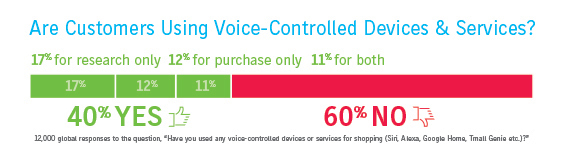
According to the global survey, 40 percent of respondents have used
voice-controlled devices or services for some aspect of their shopping
journey (ex: Siri, Alexa, Google Home, Tmall Genie, etc.), with 23
percent of those using them to make purchases.
(Refer to Image 1 for details on customers using voice-controlled
devices and services)
While global consumers continue to embrace new technology for both
research and transactions, they are somewhat hesitant about how their
personal data is being used. Overall, 75 percent of respondents said
they’re concerned about their online and in-store shopping history, such
as transaction history and online searches, being used to provide
better, more-personalized service (tweet
this).
“While consumers are looking for personalization from retailers in
theory, there are still concerns about how their data is being used for
the execution,” said Gill. “Both consumers and retailers are trying out
emerging technologies to determine what will work to provide the
increased level of personalization, while staying within consumers’
current comfort level.”
(Refer to Image 2 for details on shopper and privacy concerns)
Globally, the majority of respondents who shop in physical retail stores
have used some form of emerging technology while shopping, whether it’s
mobile coupons or discounts (49 percent) or individual recognition and
personalized service based on loyalty programs (26 percent). However, UK
consumers who shop in-store were least likely to have tried new
technology in their shopper journey, with 70 percent of UK respondents
claiming they have not used any emerging technology in stores, while
over 90 percent of Chinese in-store shoppers said they have used
emerging technology in-store (tweet
this).
When asked about the potential of augmented reality (AR), 60 percent of
global respondents said they would be more likely to make a purchase if
they could use AR to preview products. However, China continues to be
more progressive when it comes to advances in retail technology for
consumer experience. Ninety percent of Chinese respondents said they
would be more likely to purchase items based on AR, as compared to only
32 percent of UK respondents.
Returns and Store Fulfillment Seen as Convenient,
Time-Saving
The convenience factor of returning items to the store continues to be
the primary driver for consumers. Forty-nine percent of global
respondents have used Buy Online Return In-store (BORIS) service (tweet
this), with half (50 percent) saying they’ve returned items bought
online to stores because it was easier or faster, or because they would
get a refund or store credit faster than by mail. Thirty-six percent of
those who have used BORIS in the past 12 months chose this option
because the item purchased online was not what they expected, while 27
percent said that they bought multiple sizes or options for convenience
and returned what they didn’t want or need.
“The volume of returns is increasing for a variety of reasons. As well
as customers ordering multiple sizes, more than a third said they
returned items in-store in the past 12 months because an item they
purchased online was not what they expected,” said Gill. “This reverse
logistics trend continues to cause problems for retailers, who are
seeing repeat, serial returners. However, tangible rewards come from a
good returns process: The survey showed that 71 percent of respondents
claimed that they frequently or sometimes buy additional items when
returning things to stores (tweet
this), meaning returns can actually provide an opportunity to secure
a sale by offering alternative items.”
However, the ease of returns doesn’t just apply to retailers that offer
brick-and-mortar return services. According to the survey, 81 percent of
those who shop for products online said that following a poor returns
service from an online retailer, they were likely to switch to a
different vendor for future purchases.
“We’ve now reached the point where people would choose a retailer based
on the quality of delivery and returns it offers,” said Niklas Hedin,
CEO of Centiro. “Almost nine in 10 (87 percent) of those in the U.S. or
EMEA who shop for products online said the ability to track orders from
checkout to front door would influence who they would shop with.
Retailers need to keep pace with evolving consumer habits and provide
greater delivery transparency to shoppers, otherwise they risk losing
future customers.”
Sixty-nine percent of those who shop for products online have used a Buy
Online Pick-up In-store (BOPIS) option (tweet
this). Respondents used BOPIS in the last 12 months to avoid home
delivery charges (42 percent), get the product sooner than it would be
shipped (36 percent) and for added convenience over home delivery (33
percent). In addition, 66 percent of those who used a BOPIS service said
they either frequently or sometimes make additional purchases while
picking up items in-store, underscoring an opportunity for add-on sales.
Methodology
This global survey was conducted by Opinium, a strategic insight agency,
between late May to early June 2018. The findings are based on 12,000
online interviews with respondents in Asia (2,000 in China, 1,000 in
India), Europe (2,000 in the UK, 1,000 in France, 1,000 in Germany,
1,000 in Italy, 1,000 in Sweden), North America (2,000 in the US) and
Oceania (500 in Australia and 500 in New Zealand).
Additional Resources:
Check out the 2018
JDA Global Consumer Survey here for details including an
infographic and executive summary of the results
Read our blog
on today’s survey details here
Tweet this: The
age-old truth stands: “the customer is king.” If you haven’t accepted
that yet, you’re behind the times. Learn more from our 2018 JDA Global
Consumer Survey here: http://bit.ly/2oY63YF #JDASurvey
About Centiro
Centiro believes in empowering logistics for successful companies. Our
cloud-based solution for delivery management is used by finer supply
chains in more than 125 countries. With us a retailer can think global,
yet offer customers a consistent and personalized experience for first-
and last mile delivery and returns to take a brand and shopping
experience full circle. It’s a plug-and-play setup offering a
world-class portfolio of carrier networks. From straightforward shipping
labelling solutions and carrier management, through harmonized tracking,
event management and cost control – we offer functional features that
extend your existing IT-landscape. | www.centiro.com
About JDA Software, Inc.
JDA Software is the leading supply chain software provider powering
today’s digital transformations. We help companies optimize delivery to
customers by enabling them to predict and shape demand, fulfill faster
and more intelligently, and improve customer experiences and loyalty.
More than 4,000 global customers use our unmatched end-to-end software
and SaaS solutions to unify and shorten their supply chains, increase
speed of execution, and profitably deliver to their customers. Our
world-class client roster includes 75 of the top 100 retailers, 77 of
the top 100 consumer goods companies, and 8 of the top 10 global 3PLs.
Running JDA, you can plan to deliver. www.jda.com
Social Networks:
Twitter:
YouTube:
“JDA” is a trademark or registered trademark of JDA Software Group, Inc.
Any trade, product or service name referenced in this document using the
name “JDA” is a trademark and/or property of JDA Software Group, Inc.
Contacts
JDA Public Relations Contact:
Jolene Peixoto, Senior
Director, Corporate Communications