Newly-reviewed books by Southern Arizona authors:
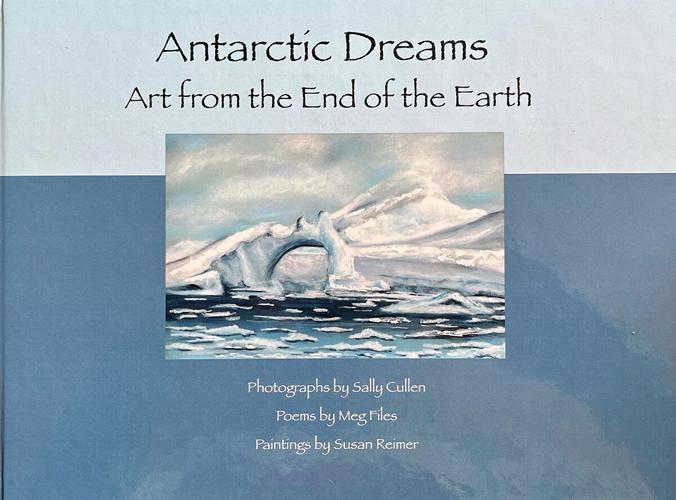
- “Antarctic Dreams: Art from the End of the Earth” by Sally Cullen, Meg Files and Susan Reimer. Moon Pony Press. $20.

So, three artists go to the end of the earth, and what do they bring us back? A little work of art, naturally.
Twin sisters Sally Cullen and Susan Reimer and older sister Meg Files offer a graceful, smart, slender volume of photographs, poems and paintings of an end-of-the-earth trip they took together in “Antarctic Dreams.” It contains photos by retired pediatrician/wildlife photographer Cullen, paintings by retired pediatrician Reimer, and poems by Tucson creative writing luminary Files (writer, instructor, and Festival of Books Literary Awards director). Cullen’s two dozen shots are sharp images of the region’s fantastic land- and ice-formations, seascapes and fauna; Reimer’s dozen paintings are softened, impressionistic versions of the same; and Files’s poems frame and shape our perceptions.
People are also reading…
The book’s five sections — “Rookeries,” “Origins,” “Passages,” “Dreamscapes,” and Endings” — each introduced by a Files poem — reflect on sights and trace the sisters’ journey. There’s no resisting the images of penguin families in the opening section, “Rookeries”; Files’s poem has the women reflecting on their own children, at home in their "green world": “… Here, away/ in the pelagic world,” she writes, “we ponder the pebble-/ ringed nests we have tried to make, our/ rookeries: may I say of love?”
Antarctica’s majestic white, black and cerulean blue presence and its history give rise to Files’s meditations — on its grandeur, its threats, impermanence; on the nature of a continent with no indigenous peoples, one without a creation mythology or naming tradition: “How we savor those explorers,/ the dogs, those rivalries…./ " Files writes in “Cosmogony,” “I was first! No I was! Listen; naming is not possessing. Nor is/ discovery, for all was here….”
And then she concludes:
“Forgive me.
I want to say, but am reduced to language and invocation:
The chaos of the original white is its own unmapped cosmos.
Amen.”
Amen indeed.
- “Fidida, Fidida (This and That): Growing up Garifuna and Belizean” by Harriet Arzu Scarborough. Vanguard Press. 143 pp. $12.99.
This volume of poetry, by retired Tucson Unified School District administrator and University of Arizona lecturer Harriet Arzu Scarborough, offers extraordinary access to the Garifuna, a little-known Central American people with a remarkable history and tradition.
Once called Black Caribs by anthropologists, this Afro-Indigenous people descend from inhabitants of the Caribbean Island of St Vincent (“the first people,” Scarborough writes, “that Columbus met when he came to our part of the world in 1492”) — who were subsequently exiled to the Central American coast, to settle in Belize, Guatemala and Honduras.
Tucson resident Scarborough was born and raised Garifuna in Barranco, a tiny Garifuna settlement at the southern tip of Belize.
While Scarborough’s identified audience in compiling these poems was “the Garifuna people who have never grown up in a Garifuna community” — many of whom live in such diverse areas as Los Angeles, New York and Chicago — she expands beyond that to introduce her people to a wider world.
In addition to cultural insights, what she shares also constitutes an affecting early-life memoir.
Scarborough’s poetry, accessible and candid, is at times pointed. “Origins” depicts a ritual, drum-led dance to an ancestor: “…du-dum, du-dum, du-dum…, We offer the Malí in the setting tropical sun/.” “His/herstory” presents competing cultural attitudes: “With so many talking, is anyone listening? /Shouldn’t we spare no effort to march in unison/ Or is friction the fate we are doomed to follow?” “I remember before Garifunadüo became fashionable/,” she writes, "The lengths we took to hide who we were/ …. Even though we should have known that we / were enough.”
Striking in the collection is how protected, untouched, and idyllic Scarborough’s childhood in Barranco was. Her father, the school principal, was also a fisherman who maintained a farm. There was initially no highway access to the village; Barranco’s only access from outside was by boat. Scarborough celebrates her mother, whose face was actually featured on a National Geographic Magazine cover; she honors traditional deities along with Catholic and Garifuna holiday traditions; and a formidable aunt who risked being a lone Black trader in Guatemalan markets.

To preserve the spirit and history of Barranco and Garifuna tradition through diaspora, Scarborough memorializes salient village moments. The philosophy of “nuguya bün buguya nün/ aü bün amürü” (“I for you/ you for me”), for example, is seen in communal sharing — women preparing cassava bread together; fisherman sharing their catches, village gossip the children overhear. But she’s realistic, not blindly romantic about that period. “…We scatter far and off, not the unit we once were./” she writes. “We resort to studying, not living, the culture.”
The collection’s narrative follows 11-year-old Harriet leaving the village for convent school in Belize City, and then graduating four years later: “six girls, immaculate in their conformity,” she writes, “White mortarboards, white gowns, white shoes … with a dawning awareness of the vastness of our ignorance … A study in white against the stark black night.”
Vivid, honest, complex, this book is a fascinating personal story and a creative, cultural tribute.
- “The Incredible Adventures of Daisy Good Dog: 23 Bedtime Stories with illustrations for Coloring” by L.J Garrod. Independently published. 151 pp. $12.95.
The back cover of this picture book promises to “bring a smile to young and old alike.” Trust it.

When a dirty yellow puppy appears in Liliana and Al Martinizes’ driveway, they name it Daisy. When Daisy turns out to be a boy, they decide to keep the name. Just like a Boy Named Sue, Al says, it’ll make him tougher. Fortunately, Daisy doesn’t need to be tough; things just happen around him, and Good Dog Daisy (and occasionally Bad Dog Daisy) goes along for the ride — a hawk snatch into a pile of chickens, unmoored Albuquerque hot air balloon, imaginary climb into butterfly heaven.
L. J. Garrod clearly loves her central dog, with all his doggy tendencies. She also manages to teach a few facts (about dogs’ limited color vision, for example) to model good human behavior without preaching (the Martiniz family pulls buffelgrass), and she exhibits a bit of a sense of humor, bringing “a smile to young and old alike.”
- “Italy’s Renaissance in Buildings and Gardens: A Personal Journal” by Frederick Kiefer. First Hill Books. 301 pp. $24.95.
Reading this collection of essays on Renaissance buildings and gardens isn’t unlike attending a lecture from your favorite humanities professor: You’ve got your Doric, Ionic and Corinthian columns and golden section, but you also have the story of the archbishop of Pisa thrown from a window of the Palazzo de Popolo,” and they’re all enlivened by the radiance of the professor’s love for his topic.
UA Distinguished Professor of English Frederick Kiefer introduces “Italy’s Renaissance in Buildings and Gardens” by telling us what this book will not be, by alerting us that he’s not someone who travels to shop, or a tourist to be whipped through sites by tour guides on timetables, so don’t expect those. Guidebooks have got those. What he is interested in presenting to us is the book he wishes he’d had when he first visited Italian Renaissance (1400 -1600) sites: Context. What is distinctive about them. How they were constructed. What connects them to their world. And his purpose? To entertain.

After a brief historical recap of the rise of interest in Antiquity in the early Renaissance, Kiefer organizes his work geographically and chronologically: first Florence, then Rome; followed by the North, the Venice region, and then separate gardens. Focusing on a building or garden site per essay/chapter, he provides a photo image, and then weaves political, ecclesiastic, and financial (wealthy bankers, after all, commissioned art and architecture) histories, and aesthetic trends, as he walks us through sites. In meticulous detail, Keifer describes features of the buildings, commission demands, architect selection processes, and the manner in which the artists’/ architects’ aesthetic history and current practices are borne out in finished products. Throughout, Keifer draws from his personal journals, in which we see transformative experiences — or ones that fell short. He invites the reader to share those places and those moments.
It's a lovely book, richly informative and suitably academic, but written in the casual, warm voice of a scholar who has beauty to offer students and readers still open to learn. And in it resonates, for this reviewer, the voice of a beloved humanities professor uncle who introduced her to Florence.
- “When Dragonflies Breathed Fire.” 80 pp. $12.95 and “Our Wonderous Sky” by John Stuart Watkins. Independently published. 102 pp. $20.

Prolific Tucson scribbler John Stuart Watkins — along with friends — has two recent publications we’ll briefly note this month: One, an illustrated children’s book; the other, a themed collaboration in photographs and poems.
“When Dragonflies Breathed Fire” is a children’s story, a coloring book and a study of dragonflies. Queen Anya, puzzled by the annual outbreaks of wildfires in her kingdom, directs her subject animals to solve their mystery. Its AI illustrations are Disney-worthy. Watkins’s friends Anya King and Jon Sebba contributed line drawings for coloring and photographs.

Along with a smattering of poems, “Our Wonderous Sky” contains a hundred pages of images of Western skies. Ranging from snapshots to studied photographs, they’re scenes captured by two dozen Arizona residents of "clouds, thunderstorms, lightning, sunsets, sunrises, snow, mist, and raindrops falling.”
The top stories from Sunday's Home+Life section in the Arizona Daily Star.
Former high school and college English instructor Christine Wald-Hopkins is an essayist and longtime regional and local book critic.
If you are a Southern Arizona author and would like your book to be considered for this column, send a copy to: Elaine Encinas, P.O. Box 26887, Tucson, AZ, 85726-6887. Give the price and contact name. Books must have been published within a year. Authors may submit no more than one per calendar year.