

Any Bad Bunny fan worth their salt knows there's always more beneath the música.
Aside from suave showmanship and feel-good Latin rhythms, the Grammy-winning reggaeton superstar, who headlined the Super Bowl halftime show on Sunday, Feb. 8, gave viewers an assortment of easter eggs alluding to his Latino heritage and Puerto Rico's fraught political history.
The singer, who was born in Bayamón, transported fans to his native Puerto Rico from the moment he stepped out onstage, walking against a backdrop that resembled the island's sugar cane fields. A series of dancers, dressed in pava straw hats, flanked him as he delivered the medley's opening number, "Titi Me Preguntó."
From heartfelt homages to Puerto Rican culture to poignant political undertones, here are all the details you may have missed from El Conejo Malo's halftime performance.
People are also reading…
Bad Bunny brings back pava hat
During the opening of Bad Bunny's Super Bowl medley, several of the singer's backup dancers — dressed as sugar cane field workers — wore pavas, brimmed straw hats traditionally made from leaves of the Puerto Rican hat palm.
At the 2025 Met Gala, the singer wore a revamped pava, which he paired with his espresso brown Prada suit.
Bad Bunny spotlights Puerto Rican cuisine
As Bad Bunny strutted down the Super Bowl stage, the singer highlighted the hallmarks of Puerto Rican cuisine.
While performing "Titi Me Preguntó," the singer passed a group of dancers, cosplaying as customers, surrounding a coco frio cart. Coco frio, also known as fresh coconut water, is a refreshment commonly sold by street vendors on the island.
Similarly, Bad Bunny also stopped at a piraguas cart recreation and briefly grabbed a frozen dessert. A Puerto Rican version of the snow cone, a piragua is a cone-shaped, shaved ice dessert that is often garnished with fruit-flavored syrup.
Bad Bunny pays tribute to reggaeton icons Daddy Yankee and Tego Calderón
Bad Bunny took a break from his hit-heavy discography to give a shout-out to the King of Reggaeton.
Following the singer's lively mashup of "Yo Perreo Sola" and "Voy a Llevarte Pa' PR," he performed a snippet of Puerto Rican rapper Daddy Yankee's iconic 2004 hit "Gasolina."
"You're listening to music from Puerto Rico," Bad Bunny said in Spanish. "From the barrios and the projects."
The reggaeton track, inducted into the Library of Congress' National Recording Registry in 2023, is widely credited with popularizing the Latin urban genre in the 2000s.
Bad Bunny and Daddy Yankee previously collaborated on the singer's 2020 hit "La Santa."
Aside from Daddy Yankee, Bad Bunny paid tribute to reggaeton heavyweights Tego Calderón and Don Omar with samples of their genre classics "Pa' Que Retozen" and "Dale Don Dale," respectively.
Who is Concho frog in Bad Bunny Super Bowl performance?
Before Bad Bunny launched into the hip-hop banger "Monaco," the camera panned to a screen projection featuring Concho.
Concho is an amphibious character that has become an unofficial mascot for the singer's latest album, "Debí Tirar Más Fotos."
Concho, who is featured in the "Debí Tirar Más Fotos" short film and "Ketu Tecré" music video, serves as a representation of the Puerto Rican crested toad, an endangered species on the island.
Bad Bunny Super Bowl guest Lady Gaga's fashion nod to Puerto Rico
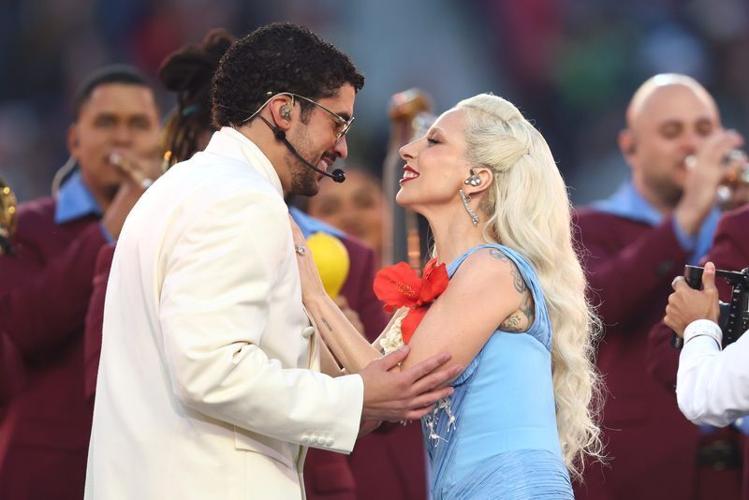
Pop superstar Lady Gaga, who made a surprise cameo during Bad Bunny's Super Bowl performance, paid tribute to Puerto Rico with her stage attire.
Gaga, who was dressed in a baby blue dress, completed the ensemble with a red floral brooch resembling the maga flower, the national flower of Puerto Rico.
Bad Bunny gives shout-out to iconic New York business
Bad Bunny may have been on the West Coast, but he brought a little of "Nuevayol" with him.
The singer, while performing the dembow-influenced opener of "Debí Tirar Más Fotos," walked in front of a New York-inspired street set that included a storefront reading "La Marqueta."
Now an open-air market in East Harlem, La Marqueta was originally an informal network of pushcart vendors and merchants that became an economic and social hub for the area's Latino immigrant community from the 1930s to 1950s. The marketplace helped transform the New York enclave into Spanish Harlem.
Bad Bunny highlights historic Grammy win
Following his performance of "Nuevayol," Bad Bunny tipped his hat to his historic Grammy Awards victory.
The singer walked in on a vignette of a couple watching Bad Bunny at the awards ceremony with their young son. At the 68th annual Grammy Awards on Feb. 1, Bad Bunny made history with the first Spanish-language album to win album of the year.
Bad Bunny later pulls out a Grammy statuette and hands it to the couple's son and tells him, "Gracias, papi," or "Thank you, baby."
Bad Bunny shines light on Puerto Rico's colonial history
Bad Bunny also alluded to Puerto Rico's turbulent political history during his halftime show performance.
The singer's Super Bowl guest performer, fellow Puerto Rican singer Ricky Martin, sang Bad Bunny's jibaro ballad "Lo Que Le Pasó a Hawaii" ("What Happened to Hawaii"), which lyrically captures the singer's concerns about the island's gentrification and potential U.S. statehood.
"Thеy want to take my river and my beach, too. They want my neighborhood and grandma to leave," Martin sang in Spanish. "No, don't let go of the flag, nor forget the lelolai. 'Cause I don't want them to do to you what happened to Hawaii."
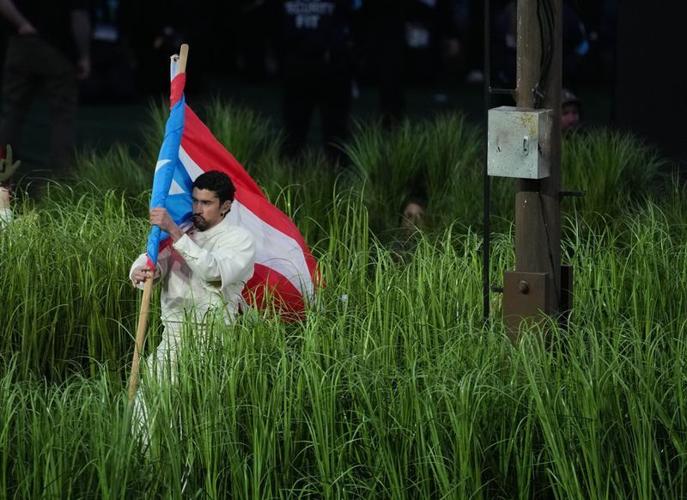
Which Puerto Rican flag did Bad Bunny use at Super Bowl?
Bad Bunny turned up the energy, but kept the political consciousness going, with the next song "El Apagón," a club banger that references Puerto Rico's economic issues with the island's electrical system.
The singer stood next to a set of faux power lines onstage, which quickly exploded to illustrate the island's frequent power outages.
The "Acho PR" singer also paid tribute to his Boricua roots during the fiery number, carrying a Puerto Rican flag as he made his way through the grassy set to the power lines.
The flag's light blue triangle is often associated with sovereignty and political independence, in contrast with variations of the flag containing dark or medium blue triangles (the darker tones have been said to symbolize Puerto Rico's status as a U.S. territory.) Although, an official shade of blue has not been established for the flag.
Bad Bunny's Super Bowl performance continues singer's political advocacy
Bad Bunny's political stance on issues affecting Puerto Rico has been firm since the start of his musical career.
During President Donald Trump's first term, two back-to-back hurricanes, including Hurricane Maria, ravaged the island in 2017, and the "Turista" singer criticized the president for his response and lack of aid to Puerto Rico. He's spoken up against transphobia and opposed colonialism and gentrification in Puerto Rico, and in 2019, he stopped his European tour to return home to protest when Puerto Ricans were demanding Governor Ricardo Rosselló's resignation.
On his latest album, 2025's "Debí Tirar Más Fotos," the outspoken singer continued his political advocacy with lyrics and music video imagery that addressed the island's uncertain future amid its evolving relationship with the U.S. and cultural assimilation.
The album's "visualizer" song videos featured a series of facts about Puerto Rican history, while a 12-minute short film — cowritten and codirected by Bad Bunny himself — tackled the impact of gentrification on the U.S. territory's local economy and islanders' way of life.
Despite the controversy that may follow Bad Bunny's halftime show performance, the singer's commitment is "always to Puerto Rico, " Petra Rivera-Rideau, a professor at Wellesley College and academic expert on reggaetón, previously told USA TODAY.
"He speaks up about those things because he's a concerned citizen, not because he feels, as a celebrity, that he has an obligation to do so," Rideau said.
Contributing: Pamela Avila, USA TODAY
