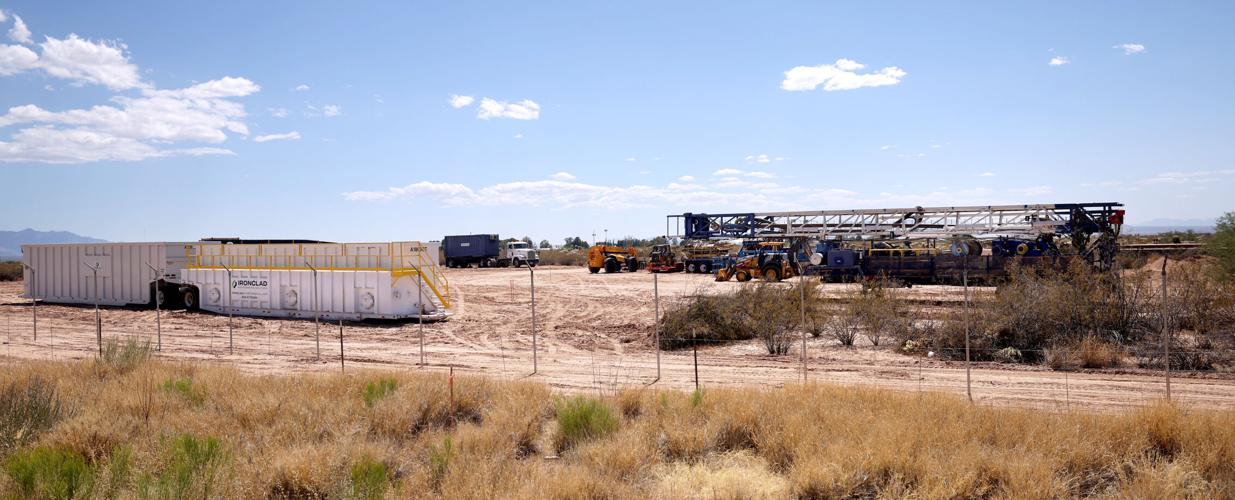
The Project Blue data center will use groundwater from two new wells being drilled on the property.
Beale Infrastructure confirmed in a statement to the Star that a contractor will begin drilling two wells at the site on South Houghton Road near the Pima County Fairgrounds.
The news of an indefinite water source for the data center follows a history of water-related issues at the construction site.
Following backlash to the data center’s potential draw on water and energy in the desert, Beale and Pima County reached a renewed agreement in December that included requiring water rights to be secured through the Arizona Department of Water Resources.
The Tucson City Council voted unanimously against any involvement with the project in August 2025, which removed the possibility the data center could use water from the city, which officials said would have been treated wastewater for the long term rather than groundwater.
People are also reading…
Documents from the Arizona Department of Water Resources showed a company named Bobcat Tucson Water LLC applied and was approved for permits in January to drill on the parcel of land that contains the data center site currently under construction.
Bobcat Tucson Water LLC proved they met all the necessary requirements and made a valid claim of entitlement for groundwater, said ADWR spokesperson Doug Maceachern. One of those requirements includes showing any new well will not impact any existing wells in the area. Both Well Impact memos written by ADWR do not indicate any surrounding well impacts and recommend approval of the company’s application.

Equipment at the Project Blue construction site near Houghton and Brekke roads.
The permits issued by the ADWR allow Beale to draw up to 96.5 acre-feet per year between the two wells. Beale said they estimate the facility will use between 15,000 to 20,000 gallons per day, “roughly equivalent to two or three sit-down restaurants.”
That daily usage estimate would bring the facility’s annual water use to between 17 and 22 acre-feet per year. An acre-foot is the amount of water it takes to cover an acre of land with water one foot deep.
In their renewed agreement with Pima County, Beale agreed to cool the data center facility with a closed-loop air-cooled system.
The company maintains that this method is more water-conscious because it only requires filling the closed-loop system once. Water is then continuously recirculated.
“After the initial closed-loop fill up, water is only used for “domestic purposes,” such as employee kitchens, bathrooms, hand washing, and health and safety requirements like any other office building, retail space, or restaurant,” Beale’s statement to the Star says.
The ADWR applications state the water will be used for fire suppression and potable water uses. Beale confirmed the well water will also be used to fill the cooling system when the design is finalized.
"The initial fill for the air-cooled, closed-loop system could require one to three million gallons, depending on the final design, which is still in development. Cooling equipment manufacturers recommend replacing the closed loop water every five to 10 years to maximize efficiency. In practice, these loops have sometimes gone up to 15 years without replacement," Beale said.
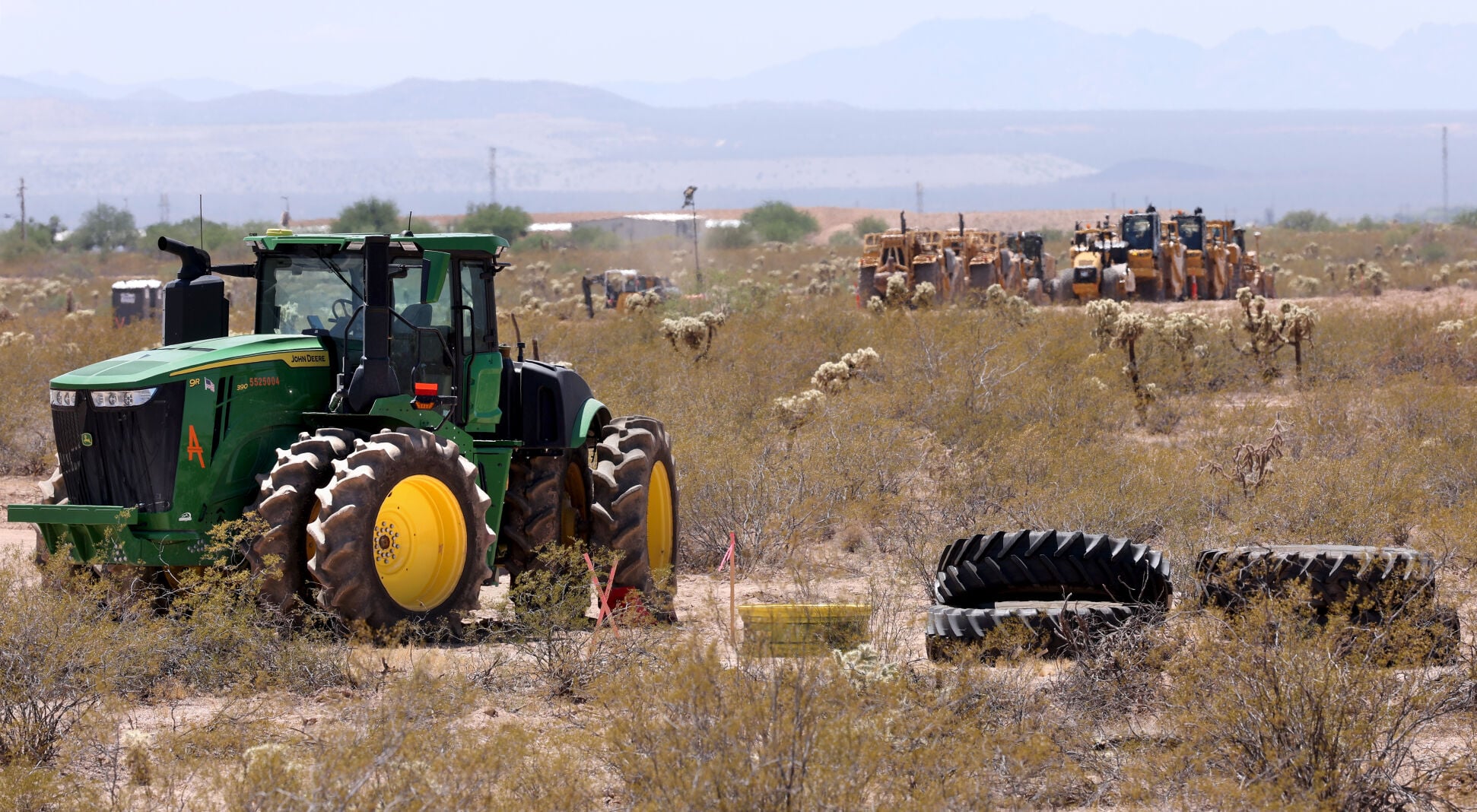
Equipment at the Project Blue construction site on the metro area's southeast side near the Pima County Fairgrounds.
On May 4, Tucson City Manager Tim Thomure wrote Project Blue contractor AMES Construction a strongly-worded letter after the city discovered it had obtained a construction water meter from Tucson Water and used trucks to haul water to the site for dust control in late April. Thomure demanded that Beale transfer two acre-feet of water credits back to Tucson Water.
A few days later, the Pima County Department of Environmental Quality said the contractor had failed proper dust mitigation practices on May 8 and May 11 and threatened a fine of up to $10,000 per day.
After their contractor was cited, Beale said they have cooperated with "numerous" inspections at the Houghton Road site and were working to bring dust control measures up to requirement. "Current site work has been temporarily paused while the contractor formalizes a non-potable water source," Beale said.
In their response to the county, AMES Construction wrote that the violations occurred because of Tucson’s decision to revoke the construction water meter. According to AMES, major machine operations were halted, but the company continued harvesting native plants. That generated enough dust to result in violations, the report reads.
AMES Construction wrote that as of May 14, the company has deployed seven 4,000-gallon water trucks with the goal of “constant water coverage” for any work to move dirt on the site. The project manager for the Pima County site did not immediately respond to the Star’s question about where they would get the water to fill those trucks.