You sometimes hear or read comments about Tucson that sting.
"Tucson is a cesspool" is one I've heard a few times.
It bothers me. Tucson certainly has ugly stretches of streetscape, disheveled and weedy. And it has persistent social problems that need solving.
But "a cesspool"? That strikes me as extreme. So sometimes I've asked people what they mean when they say things like this, online or in person, and I've started to understand better a key problem of Tucson in the 2020s.
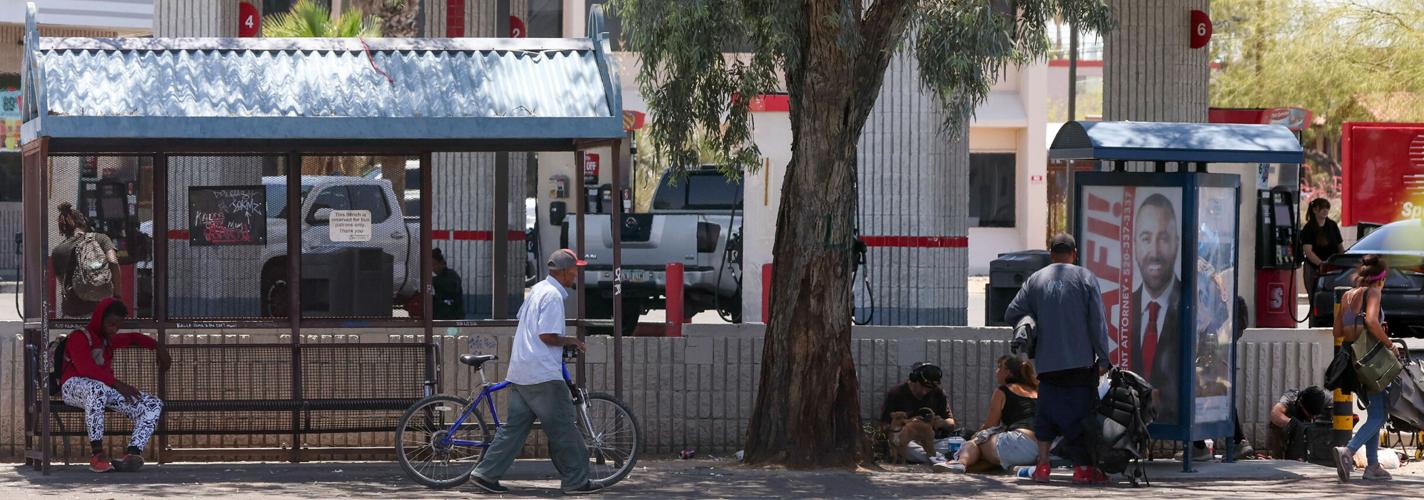
People who say this sort of thing are often talking about the view through the windshield as they drive Tucson's main arteries. What they notice, other than construction everywhere, is homeless or addicted people walking the long stretches of busy road, panhandling curbside or on medians, or congregating at bus stops.
People are also reading…
Street people used to be visible only in certain parts of town, but now may be anywhere. Importantly, these are often the only people visible along Tucson's main roads as the unrelenting sun beats down. Otherwise, all the people are in cars or buses.
Arizona Daily Star columnist Tim Steller
That, I believe, is a key to Tucson's perception problem, why some people who drive the city judge it so negatively. The little street life on our busiest arteries belongs to people who are homeless, addicted or seriously mentally ill.
Most of us who walk or ride our bikes in Tucson stay away from harsh and dangerous streets like Speedway and Oracle. We walk in our neighborhoods or parks, or we bike on paths, not in places where most drivers see us as they shoot from place to place.
Many people who live on the streets spend more time on the busy arteries. It's where the buses travel. It's more profitable for panhandling. In some cases, it's where friends gather or fellow addicts do drugs.
Visitors notice, as do locals. Jay Desai, who owns two hotels in town, one by the airport and one just north of downtown, said his businesses have had to work and spend money just to secure their properties, but guests notice the problems, nearby and around town.
"Their perception of Tucson is going down," Desai said. They say, he added, "There’s all this natural beauty, all these attractions, but the homelessness has gotten worse all over town."
A city of drivers, not walkers
This isn't to say that Tucson's homelessness and addiction problem is just an image problem. It is a tangled complex of real-life issues that people have been working on for years with only limited progress.
It's a problem of people's lives being destroyed by addiction, of people unable to afford homes, and of people on the streets victimizing others, and being victimized by crime. It's tragic and troubling.
On top of those human problems, though, is this perception problem, a problem of how people see Tucson when they drive around. I contend it's caused by the way Tucson developed more than 50 years ago as well as by today's social problems.
In the post-World War II decades, Tucson exploded in size from about 45,000 in 1950 to more than 400,000 in 1990. At the time, cities were developing in the expectation that everyone would travel by car. Land was cheap and plentiful, so home lots were big. Houses were built largely for single-family occupancy.
That means most of this city is spread out. Tucson proper covers about 227 square miles. It's about the same size as Chicago, which is 234 square miles in size.

Groups of people doing drugs or hanging out at bus stops is one of the sights that drives Tucson's perception problem.
Tucson's population density, though, is about 2,300 people per square mile, while Chicago's is about 12,000 people per square mile.
What that means, practically, is there is little for people to walk to along the arteries that line most neighborhoods, because there aren't enough of us living nearby to support the businesses we'd want to walk to. There are relatively few small stores, cafes and services like small law or accounting offices to walk to from our homes. In most of Tucson, people drive to these places.
And since there is no freeway connecting many parts of Tucson, that means people use busy roads like 22nd Street, Broadway, Speedway and Grant as their highway. So, most people drive everywhere on our busy surface streets, where the only people they see walking around are living troubled lives on the streets.
Downtown bucks the perception
I had the chance to ask Tucson City Manager Tim Thomure about this perception issue when I helped interview him on the Bill Buckmaster radio show Friday.
"There are people that have that perception," he said. "That’s not the Tucson I see when I drive around. I’m not necessarily wearing rose-colored glasses, but I see a lot of change over the last 10 years, 20 years that is very positive."
He acknowledged Tucson's problems with homelessness and addiction, but added that some of the online commentary about Tucson comes from people "trying to attack the current mayor and council and/or the current board of supervisors in ways that are I think politically motivated."
Maybe so. It is always hard to separate rhetoric from reality, especially when fond feelings for a hometown are confronted with harsh realities.
To get a better understanding, I like to consider another part of Tucson, the streetcar corridor from the U of A through downtown to the west side.
I spend long stretches of time in those areas walking around, sitting at coffee shops, or going to events. There are no fewer homeless and addicted people there than there are on the wide, hot arteries we drive on to get around town. In fact, there are probably more.
But downtown on Congress, for one example, there are a lot more other people walking around. They work downtown, or they arrive at Ronstadt Transit Center on the bus, or they head down for the bars, restaurants or shows. You don't notice the street people as much, because there's more going on.
You would be hard-pressed to call it a cesspool, even though the same social problems are present at perhaps an even higher density. There's just more going on at a human scale, at a speed well below 40 mph.
Someday, perhaps, we can solve our social problems, and Tucson's busy roads will go back to being empty of humans on foot, improving drivers' perception of the place. That may end some complaints, but in a metro area of a million people, those miles of sterile barrenness represent their own problem.
Tim Steller is an opinion columnist for the Arizona Daily Star. A 25-year veteran of reporting and editing, he digs into issues and stories that matter in the Tucson area, reports the results and tells you his conclusions. David McCumber and Tim discuss the perks of being a columnist, Tim’s early journalism days and the ways he has seen a change in the Tucson area over the years through his reporting.
Contact columnist Tim Steller at tsteller@tucson.com or 520-807-7789. On Bluesky: @timsteller.bsky.social

Tim Steller
Columnist


 Tim Steller's column: Repression stamped out Israel protests on U of A campus