

Q: I am planning on planting ocotillo before the end of this monsoon season; any advice/instruction?
A: Ocotillos are planted much like any other shrub. Select a spot that will allow for the mature size of the plant and in an area with like plants that have similar water needs to make irrigation simpler. Dig the hole to be as deep as the roots but no deeper so it won’t be planted too deep. Fill the hole with native soil and water. If the watering makes the soil sink a bit around the planting hole, you can add more soil and maybe a few rocks around the edge for stabilization.
If this is a small plant now that should be all you need. If the plant is much larger and not able to stand on its own from the start, you might need to stake it. Three stakes around the plant are best, tying each one to a large cane.
Don’t make the ties so tight that there is no room to move a bit in the wind because a little movement is how the plant will develop its own stabilization over time. Typically stakes are left in for one year although it may require a bit longer depending on the size of the plant and the growing conditions.
People are also reading…
Q: I hope you can help my neighbor diagnose a recent problem with his Chaste tree. I think it is due to drought stress. I looked at leaves under 30X and couldn’t see obvious mites or scale. Tree has one two gallons-per hour drip emitter and gets 40 minutes of water daily. If it is underwatered, should he lay a hose against tree with a trickle of water to soak soil and then put several additional emitters around drip-line?
A: Several more emitters around the tree at the drip line would be best. A hose at the base would likely do no good since the absorbing roots are farther out. Also I would change the schedule in the summer months to water once a week down to about 36 inches. More frequent watering encourages more surface roots that are more susceptible to drought conditions than deeper roots you get from watering deeper.
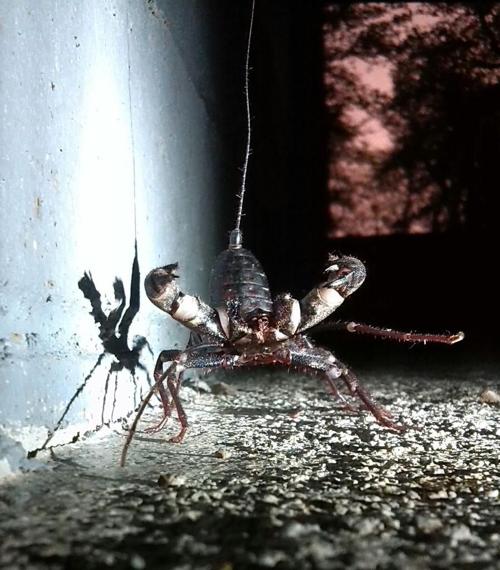
Q: Now this is a bug! What the hell is it? Eerily beautiful and frightful at the same time.
A: What you have is a whip scorpion. The only whip scorpion found in the United States is the giant whip scorpion, Mastigoproctus giganteus. The giant whip scorpion is also commonly known as the vinegaroon. To encounter a giant whip scorpion for the first time can be an alarming experience so I understand your fright. What seems like a monster at first glance is really a harmless creature.
Whip scorpions are found in the southeastern oak zone of Arizona east across the southern U.S. to Florida. They have a substantial but flat body 2-3 inches in length, with large spined, arm-like pedipalps in front. They are arachnids but have no venom. Whip scorpions are predators, active at night. The whip-like tail is used in defense and individuals can squirt acetic acid (vinegar) produced from a gland in the rear, hence their nickname: vinegaroon.
Q: I sent two photos of a bee genus/species that I am unfamiliar with but have been seeing inside my kitchen. Can you please identify it and let me know if it is a soil dweller or a hive builder, and if this particular bee causes any issue inside of our home? I did observe what looked like a stinger and veined transparent wings, since it has been flying around the ceiling nightly for two weeks and climbing up on my interior window daily.
A: The bees you photographed are from the Halictidae family, also called sweat bees. Sweat bees are very important pollinators for many wildflowers and crops, including stone fruits, apples, alfalfa and sunflowers.
Sweat bee populations can be encouraged with wildflower plantings and by providing nesting areas. Halictids typically nest in bare soil located in a sunny location. They are likely entering your home by accident and should be no trouble for you as a stinging insect. I expect there are flowering plants and/or bare soil near where they gain entrance to your home so that would be a way to start searching for the source of the problem. Once you discover how they are entering your home, you can seal it or if they are entering through a vent you can use fine mesh to keep them out.
Peter L. Warren is the urban horticulture agent for the Pima County Cooperative Extension and the University of Arizona. Questions may be emailed to plwarren@cals.izona.edu.
