


Before the Tucson Symphony Orchestra takes the stage, or Tucson Museum of Art unveils its latest exhibit, a cadre of passionate and devoted folks work behind the scenes to make sure the art can shine.
We found five people who work quietly behind the scenes to make art happen.

No two bands play exactly the same music in the same way, which means tweaks and adaptations for each show. Armed with a checklist, Bruce Momich, production manager for the Rialto Theatre, begins prepping for a show weeks before the performer arrives, communicating with band members and managers.
PRODUCTION MANAGER
The Rialto Theatre’s gritty rock-and-roll vibe belies the precise planning of production manager Bruce Momich and his crew.
Momich, who has been in the music business since the 1980s and started on the Rialto’s soundboard in 1998, oversees pre-show preparation, the minute-by-minute setup, the performance and teardown.
“We’re presenting the artwork of the band,” says Momich. “We want to present that art at its best without influencing style.”
People are also reading…
But no two bands play exactly the same music in the same way, which means tweaks and adaptations for each show.
Armed with a checklist, Momich, 59, begins prepping for a show weeks before the performer arrives, communicating with band members and managers.
Momich’s experience in the U.S. Navy as an aircraft handler on aircraft carriers apparently comes in handy as he is responsible for all the logistics of show day — including parking hulking tour buses and trucks in tight spaces near the downtown venue.
Most bands travel with their own sound and lighting equipment and crews.
Momich and his team coordinate move ins, set up and make sure everything is in the right place when the band strikes its first note.
After the show, at about 11 or 11:30 p.m, striking and loading trucks and buses begin, making a 12-14 hour workday.
Momich says the Rialto’s crew members are skilled professionals who can adapt to the varying needs of bands think of the differences among punk, metal, pop, hip-hop and world music styles and instrumentation as well as adapt to the needs of others events hosted at the Rialto, like a mixed martial arts event.
“The constant here is change.”

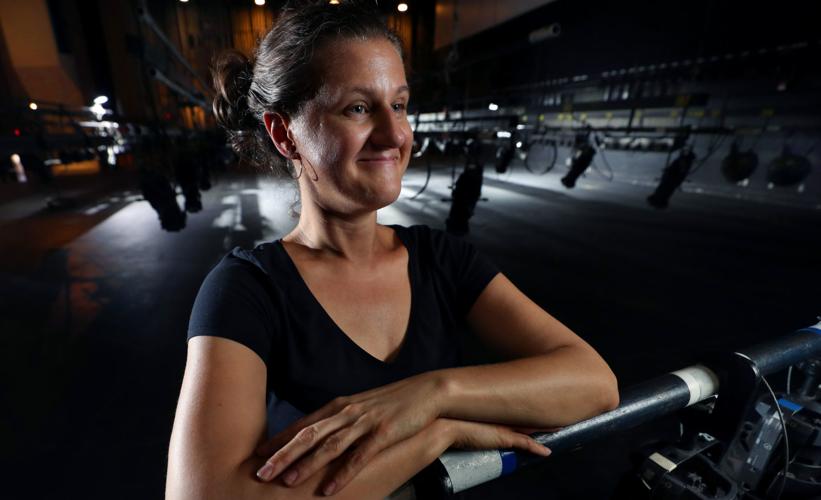
Stacey Hubert, the Tucson Symphony Orchestra’s stage manager, does just about whatever she can to make the conductor’s vision a reality.
“I help (the musicians) do their job.”
STAGE MANAGER
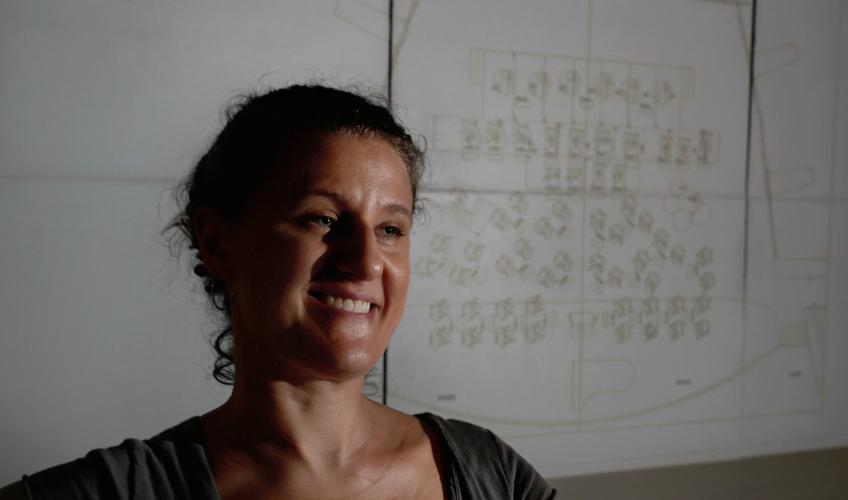
Stacey Hubert learned that there is no graceful way to move a cello platform on stage. “You’re stuck bending down,” she says.
Hubert, the Tucson Symphony Orchestra’s stage manager, does just about whatever she can to make the conductor’s vision a reality.
Once the season is decided and the scores are in hand, Hubert uses digital layouts of the venues’ stages to position essentials like risers, chairs and stools.
Before rehearsals and the performances, Hubert, 41, supervises and helps load the truck with equipment and sets up the stage. She pays attention to the minutiae, like which bass player prefers which stool height.
“I help (the musicians) do their job,” she says. The musicians need to be comfortable, read the music they are playing, and be able to see the maestro.
She’s on hand during performances and says she’s the “last line of defense” in ensuring the lights, sound and stage setup proceed as planned.
With 23 years of previous stage-hand and manager experience, Hubert is beginning her fifth season as TSO’s stage manger.
“I like getting to be part to making performances happen,” says Hubert.

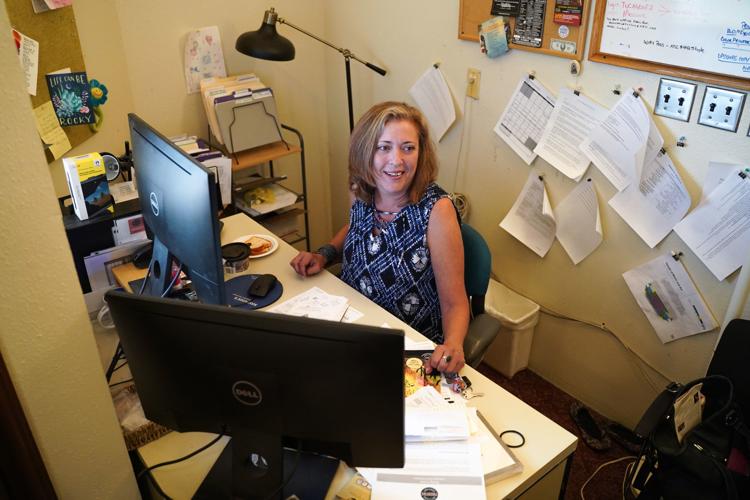
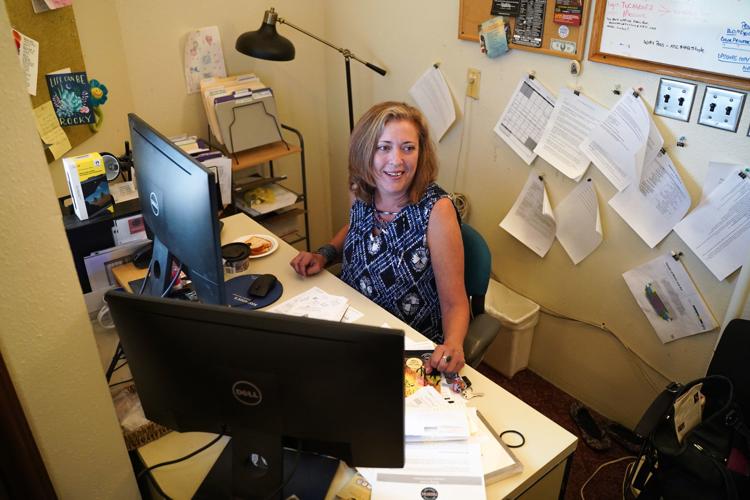
Sara Kavitch, box office manager for Arizona Theatre Company, says her multitasking job is about people, which is why she likes it. “I am a people person. I like helping people.”
BOX OFFICE MANAGER
Wispy puffs of paper dust were in the air at the Arizona Theatre Company box office in late July as Sara Kavitch and her team sent out about 3,000 subscriber packets.
Box office manager Kavitch says her multitasking job is about people, which is why she likes it. “I am a people person. I like helping people.”
She oversees a staff who matches seats with subscribers and releases tickets for general sale.
There are plenty of moving parts and challenges, says Kavitch.
Arizona Theatre Company has several subscription packages, bring-a-friend options, as well as single, community night and rush ticket options, a 50% off deal that is sometimes available the hour before a show.
Kavitch spends her days on the phone, emailing or helping at the ticket window during busy times.
She says she’s the “Sherlock Holmes” of box office challenges — she knows the data and the workarounds to help find seats. She recalls an upset woman who was a show-by-show ticket holder who wanted to be seated with a friend. With a little sleuthing, Kavitch was able to satisfy the request.
Kavitch, who is in her 40s, worked in hospitality and in various positions with ATC for 7 years. In July, she was named box office manager.
“Every day we are doing our very best to do the right thing and put our best foot forward,” Kavitch says.
“Like any other job it has its ups and downs, but the rewards are huge when you see how theater touches people.”

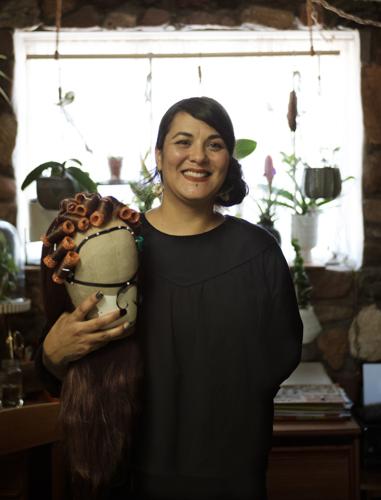
Alita Lopez, the lead wigmaker for Arizona Opera, has been with Arizona Opera for 18 years. She’s been a makeup artist, an assistant and an apprentice at the opera and now heads up the creation of wigs and makeup for the singers. The opera has a stock of over 1,000 wigs.
WIG, MAKEUP MANAGER
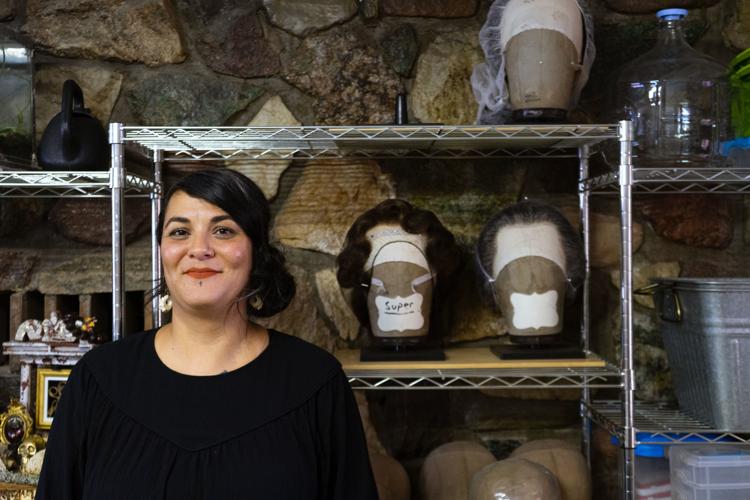
Alita Lopez became an opera fan when her elementary school class walked over to watch Arizona Opera rehearse downtown. She saw the power of music, voices, story, costumes and painted drops coming together.
Now Lopez, 38, helps transform singers into everyone from beloved characters from classic operas to edgy personalities in more modern works.
Lopez, the opera’s wig and makeup manager, has been with Arizona Opera for 18 years. She trained as an aesthetician and especially enjoyed the makeup aspects of the field. When she was referred to Arizona Opera by a friend in 2001, she expected an interview. But when she went in, she went to work. She’s been a makeup artist, an assistant and an apprentice at the opera and now heads up the creation of wigs and makeup for the singers.
The opera’s leads and most of the chorus, especially the women, wear wigs, says Lopez. Arizona Opera has a stock of more than 1,000 wigs, which are personalized for the performance and the singer.
Wigs are built or adapted from the stock, which is a time-consuming, tedious process as each individual hair must be pulled the lace or the foundation of the wig. Fitting requires head measurements, which might mean a three-dimensional tracing of a singer’s head.
The regular two to two-and-a-half weeks of rehearsals is an intense period of ensuring wigs are styled and fit properly.
“There’s little time for error.”
Lopez, who has a home studio in Tucson and a workshop at the opera’s headquarters in Phoenix, is at every performance. She’s often the first at the venue on performance days to touch up wigs and makeup for the performers.
Makeup usually takes about 30-45 minutes per each singer. Full body makeup might take more than an hour.
She’s behind the scenes to make touch-ups and adjustments, however during “Don Pasquale” several years ago, Lopez was on stage behind a screen to quickly switch the towel on the head of a singer to a wig.
The job is “fun, interesting and creative,” Lopez says. “I have a lot of creative energy.”

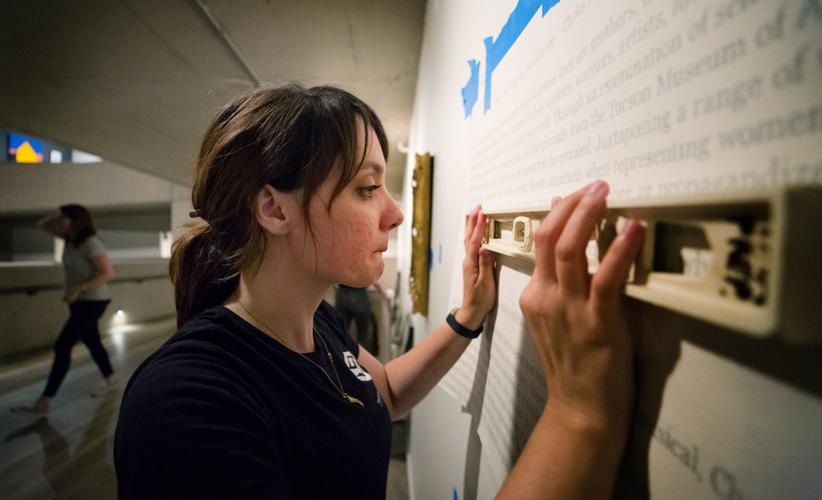
Katie Jones-Weinert, assistant registrar for the Tucson Museum of Art, is an intermediary between the artists and the audience. She received her undergraduate degree from the University of Arizona in studio art photography. Jones-Winert says she loves touching and handling artwork and working behind the scenes “to make an exhibition happen.”
ASSISTANT REGISTRAR
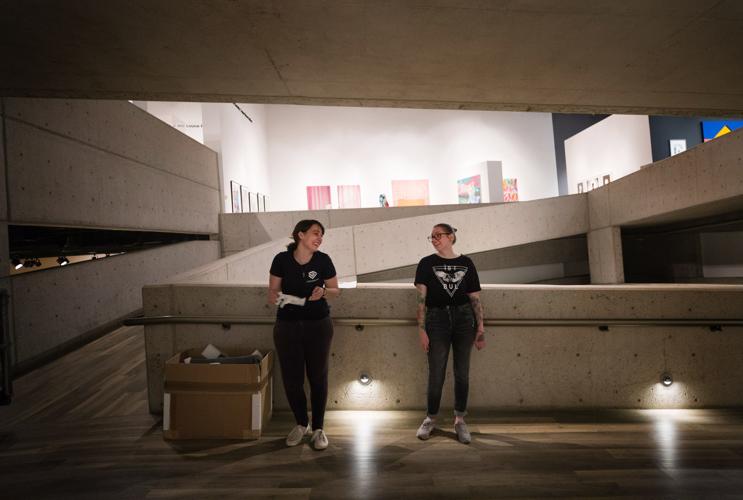
Katie Jones-Weinert is an intermediary between the artists and the audience.
The Tucson Museum of Art’s assistant registrar, Jones-Weiner attends to details of collections and exhibits, such as cataloging and organizing art, keeping it safe in environmentally-controlled space and managing image rights and reproductions.
Jones-Weinert, 28, received her undergraduate degree from the University of Arizona in studio art photography.
An internship at TMA piqued her interest and she received her master’s in museum studies from Johns Hopkins University with an eye on her present job, which she’s had for about a year and a half.
Curators have a vision that she helps implement, Jones-Weinert says.
She works with art lenders and institutions on the details to prep the work for display. On some exhibits, she even steps in and lends an installation hand.
Jones-Weinert says she loves touching and handling artwork and working behind the scenes “to make an exhibition happen.”