

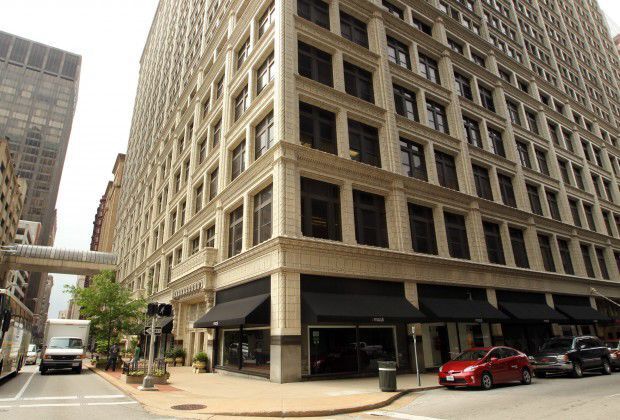
The closing of Macy’s could further slow the redevelopment of one of downtown’s largest buildings.
Despite their much-reduced size, the three-story department store and two floors of Macy’s corporate offices were still the largest tenant in the massive Railway Exchange Building. And tax revenue from sales at the store were supposed to help finance a $111.7 million renovation that would make the one-time headquarters of Famous-Barr and the Wabash Railway into modern-day office space once again.
In 2010, when developer Rick Yackey and some partners bought the building from Macy’s for $18.5 million, city officials authorized $27.8 million in tax increment financing and other local subsidies to redo the store and spruce up nearly 900,000 square feet of office space upstairs. The city’s development agency also pledged $17 million worth of federal New Markets Tax Credits towards the project, and Yackey was authorized for state historic tax credits.
People are also reading…
Much of that money has not yet been spent. And because it can still be used to redevelop the building, a spokeswoman for the St. Louis Development Corp. said, Macy’s closing will not trigger any repayment requirements.
Still, even paying off the Macy’s rehab has been a struggle.
In 2010, a city agency issued $4.6 million in bonds for the project, to be paid back with sales and payroll tax revenue from Macy’s. But despite upgrades to the store, sales failed to meet even the minimum projections, and fell 17.5 percent from 2011 to 2012, according to a letter UMB Bank sent to bondholders in April. Both in October and again in April, the project had to draw on its debt service reserve fund just to make $182,000 interest payments. At this rate, the fund will be dry within a year, which could put the bonds in default. The city, however, won’t be on the hook in the event of a default.
Yackey did not return messages seeking comment Monday. His attorney, David Richardson, said the closure of Macy’s downstairs would not necessarily prevent rehabbing upstairs, which is essentially a separate, second phase of the project. But there is no active construction under way.
“This part depends on securing tenants,” Richardson said.
Nearly three years after Yackey bought the place, progress has been slow.
Today the building, which at 1.2 million square feet has about the same floor space as the Jamestown Mall, mostly sits empty, just dark hallways, small offices and an out-of-date directory in the lobby. Elevator service is turned off to all but a few floors.
When Macy’s moves out later this year, the building’s biggest remaining tenant will be the Downtown T-REx technology incubator, which takes about two floors and does pay rent, Richardson said. The 16th floor houses a small law firm and the Regional Housing and Community Development Agency, an 11-person nonprofit group that got the space, rent-free, through a board member in the ’90s, said executive director Stephen Acree.
The place is quiet, Acree said, and he’s heard nothing about redevelopment plans in some time.
“We’re just kind of hanging out, waiting for the other shoe to drop,” Acree said. “We’ll stay here until someone tells us otherwise.”


