

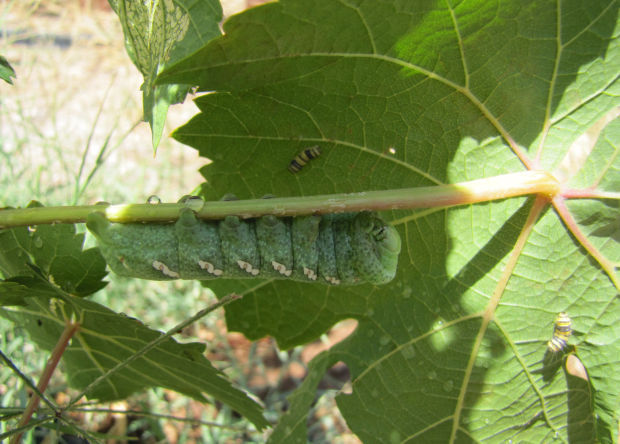
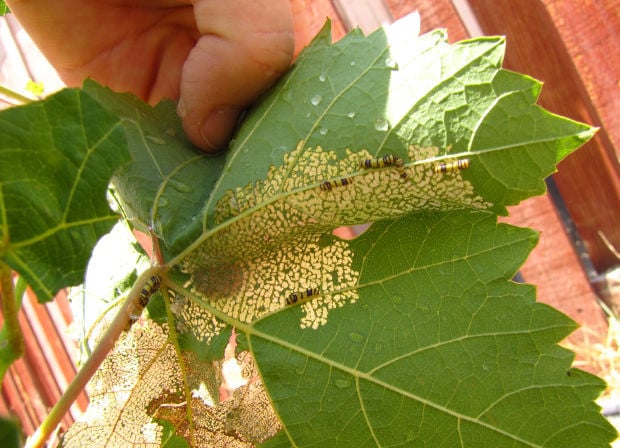
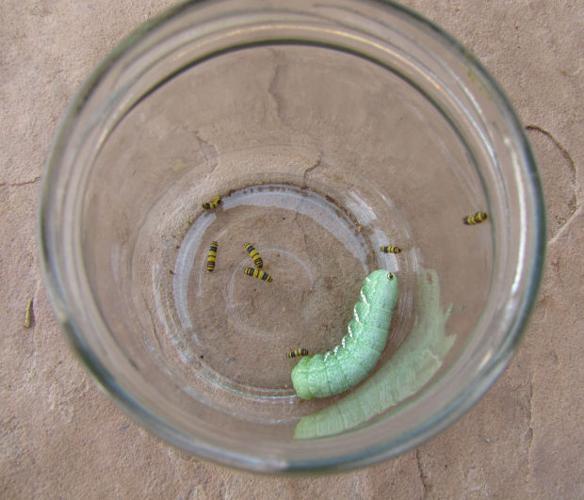
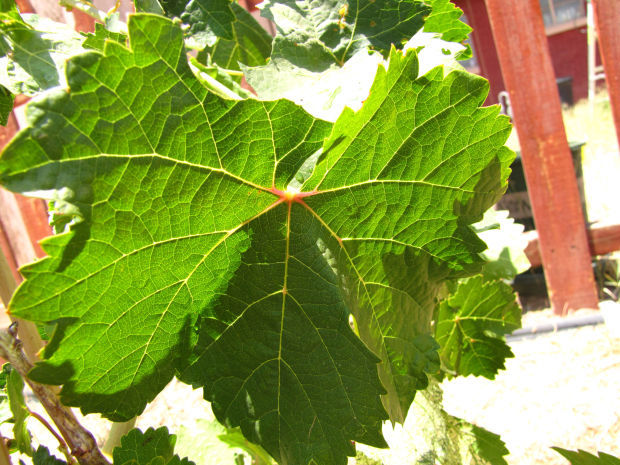
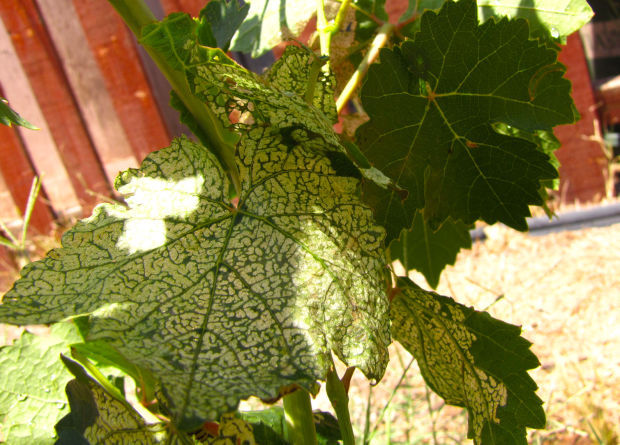
This is what I found yesterday feeding on my new grape vines — an ugly hornworm. And he had some bad company.
If you find one of these on your grape or tomato plants, pick it off and feed it to your chickens, if you have any. Or give them to your neighbor's chickens. If you don't have any chickens handy, drop them into a jar of soapy water to kill them.
Look for hornworms on eggplant and pepper plants, too.
To keep them away from your veggies in the future, try companion planting with dill or marigolds.
Now look a little more closely at the photo — see those striped little monsters? These grape leaf skeletonizers will strip your grape leaves in no time.
This time of year, you should be checking your vines daily for skeletonizers. These nasty critters cling to the underside of the leaves and munch away, destroying all your leaves if you don't find them first.
People are also reading…
Bug expert Peter Warren, the urban horticulture agent for Pima County Cooperative Extension at the University of Arizona, suggests using Bt, or Bacillus thuringiensis. Bt is a naturally occurring soil bacterium and is nontoxic to people and animals; it won't harm beneficial insects such as bees, praying mantises and ladybugs.
If there are just a few, you can pull them off but be sure to use gloves, as they have stinging hairs. I've heard that chickens don't eat them, so just go ahead and smash them or drop them in a jar of soapy water with a lid. (One of the skeletonizers almost crawled out of the jar before I had caught all of his little cousins.)
Here's another idea for skeletonizers and hornworms: Try food-grade diatomaceous earth.
- Sprinkle the powder around the plant and on the leaves, but remember — it won't work once it gets wet. And be sure to use FOOD GRADE diatomaceous earth — not the chemical-laced stuff you put in your pool filter.
- Buy DE at a nursery or feed supply store.
- Reapply it if it gets wet.
- Avoid breathing it; DE is nontoxic to people and animals, but wear a mask when you apply it.


