

Tombstone's historic credibility is either gut shot or better than ever, depending on which of the town's many historians you're asking.
Meanwhile, City Hall is crumbling and full of bees, bats and mold, and the mayor says he's willing to name it after Wal-Mart, Costco, Bill Gates or anyone who would give him the money to fix it up.
The credibility problem — the National Park Service declared Tombstone's National Historic Landmark status "threatened" nearly three years ago — concerns Mayor Andree DeJournett, although it doesn't have the immediacy of the crumbling walls, bees, bats and mold.
He says the town has a grant writer who is working on finding money for the tough town's crumbling past and present.
"This place needs millions of dollars," he says. "We need money for all the buildings here. We probably got $250,000 to $300,000 (in grants) this year."
People are also reading…
But while the City Council needs a safe place to meet — free of 1880s-era crumbling walls and modern bees, bats and mold — and the police and fire departments need new radios, the mayor also knows the importance of the city's historical status.
"Tourism," DeJournett says, "that's all we have here."
And tourism's economic clout is easily quantified, in some cases.
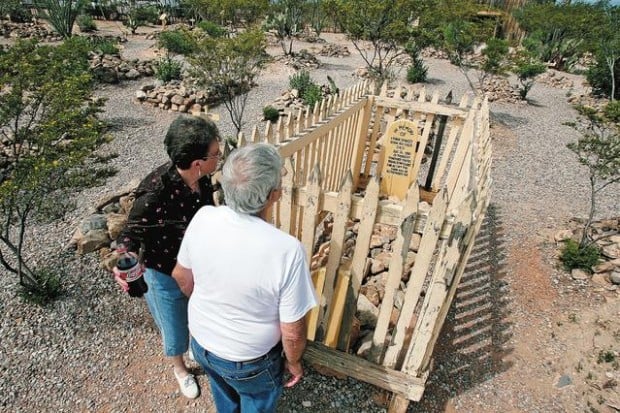
DeJournett says visitor donations alone at the city-run Boot Hill Graveyard (& Gift Shop) topped $115,000 for the most recent year. Every year, he says, roughly 600,000 people visit Tombstone.
Meanwhile, there's a ballot question in the November election that asks voters if they want the city to continue operating the famous boneyard or turn it back over to a contractor — the way it was for many years.
DeJournett says he's for keeping it under city control. He figures there's no way the town will make as much money off the property by leasing it out as by running it.
He also supports a proposed ordinance that would declare Boot Hill a historic district, making it hard for anyone — including a possible future Boot Hill concession operator — to do anything to damage the graveyard's historic credibility.
Things are bad enough already, says Bill Pakinkis, a retired Marine and amateur history buff who sits on the council's historic districts commission. He's a major force behind the historic district proposal.
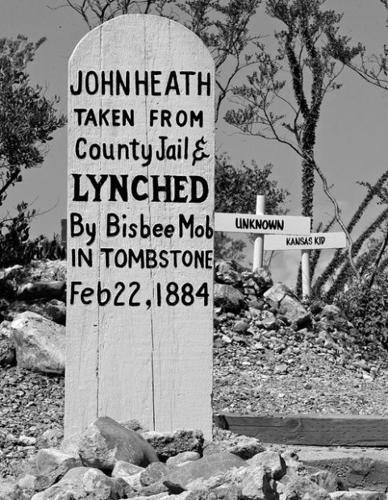
"People feel cheated when they come in here," Pakinkis says. "It looks like everyone was buried the same day," Pakinkis says, referring to the nearly identical beige-painted metal grave markers.
He says he's had tourists tell him, "When I walked into Boot Hill Cemetery, even though I didn't pay, I felt like I was robbed."
The problem didn't start with the National Park Service's National Historic Landmark watchdogs dinging Tombstone with that "threatened" status a couple of years ago, says Bob Frankeberger, an architect with the Arizona State Parks Department's State Historic Preservation Office.
He says a report by a bureaucrat visiting Tombstone for a 1963 National Historic Landmark audit rated it "poor … the commercial interests are ruining the integrity of this fine site."
And, he notes, he had warned the people of Tombstone that routing the then-new Highway 80 through town could "ruin landmark status."
But Frankeberger says modern Tombstone is in real danger of losing its historic landmark status, which would be a huge blow to tourism and its ability to obtain grants for preservation. He says the city's leaders responded correctly, apparently embracing the recommendations of a subsequent "charrette" — a collaborative report by a group of experts on what standards would assure a historically accurate town.
Frankeberger says the recommendations included a selection of authentic period paint colors, architectural elements and other details to be adopted by the City Council as part of the municipal building codes.
While nearly all the historians — degreed, amateur or self-proclaimed — can laugh at the sometimes outrageous arguments over nearly any detail of the Gunfight at the OK Corral, Frankeberger says the town hasn't defined its "period of significance" broadly enough.
"They had a narrow period of significance — just the five minutes of the OK Corral battle. We," Frankeberger says, "maintained that it (had) much greater significance than that."
Most of all, says DeJournett, it was a mining town. It was only because of mining that it existed. Even the Earps and other famous players came, directly or indirectly, because of mining.
In the end, Frankeberger says, the experts declared that the period of significance should extend from the camp's founding in 1878 or 1879 right up until around 1930, when it lost its county seat status to Bisbee and first saw itself as a tourist attraction by starting Helldorado Days.
That, says Frankeberger, means including authenticity regulations for buildings from the original adobe period through the San Francisco-influenced Italianate period — which the coming of the railroad made possible by allowing importation of large timbers and ornate elements — and into the big-window storefront period of the 1920s.
It's easy to concentrate on the problems, but there have been victories, says Frankeberger. He cites rehabilitation of the old firehouse for use as a senior center as a good example.
Grave markers the same
"Everything has the same markers on it," says Mesa resident and tourist Jeff French after walking through Boot Hill with his wife, Julie French. "I guess I expected to see boots on top of the graves."
"From what we've seen on TV, it seems to be fairly accurate," says Duke Garbrough of Indiana, here with wife, Lea Ann Garbrough.
And that is part of the problem, says Hollis Cook, a Tombstone historian who used to manage the former Cochise County Courthouse for Arizona State Parks and now leads walking tours of the Town Too Tough to Die.
"This is Tombstone, as much legend as it is real," he says.
"Hollywood doesn't seem able to make a horse opera without making some reference to the OK Corral." And that, Cook says, leads to misconceptions.
The locals cringe or chuckle at some of the misconceptions tourists pack into town, wanting to know why they can't find the graves of the Earps, Billy the Kid and Wild Bill Hickok in Boot Hill.
(1) The Earps aren't buried in Boot Hill. (2) Billy the Kid didn't come anywhere near Tombstone. (3) Hickok died in Deadwood before Tombstone existed.
Cook's favorite Hollywood history rewrite involves the 1993 "Tombstone," in which narrator Robert Mitchum spins some tale about the Red Sash Gang and how "they wore red sashes to identify themselves to other gang members."
"Utter nonsense!" sputters Cook.
He speculates that any cowdude silly enough to show up in a Tombstone saloon wearing a red sash would have been beaten even sillier, if not far worse.
Nevertheless, he says, the power of Hollywood is such that within a week of the movie's release, Tombstone's gunfight re-enactment troupes were wearing — yes — red sashes.
"And these re-enacters take great pride in getting their costumes right, shooting the right number of shots. Hollywood," he says, "creates history."
"Experts" get it wrong
But Tombstone historian Ben Traywick, a 38-year resident and author of more than 30 books, says there's no problem with the town's credibility except the occasional verbal gaffe by some of its many self-proclaimed experts.
"Everybody, four days after they get to Tombstone, is an expert," says Traywick.
He says most of Tombstone's sites are presented as what they were and as close as possible to the way they were.
Traywick is concerned that regulations about what colors, architectural styles and elements can be used on old buildings will be too much of a burden on local business owners.
But he acknowledges that credibility was so low in years past that many people thought that Boot Hill was a complete fake, that there weren't any graves there, or that it had been moved.
Traywick says he knows the origins of that rumor.
"It's a genuine old cemetery," he says. "And, no, it's not been moved. Until the late 1950s people came in (to town) on Allen Street," Tombstone's famous street of saloons and shootouts.
After Highway 80 was rerouted to bypass Allen Street, it went right by Boot Hill.
But Traywick says some oldtimers returning to Tombstone after many years wrongly concluded it was the cemetery that had moved, not the highway.
Cook, despite his historian's skepticism, says Tombstone is something to cherish.
"Tombstone is really about the only game in town, if you're going to look for an Old West town," says Cook. "There really aren't many places left.
"I really think if you brought Wyatt Earp back … I think he would recognize it."
 $25M distribution center to be built in Tucson


