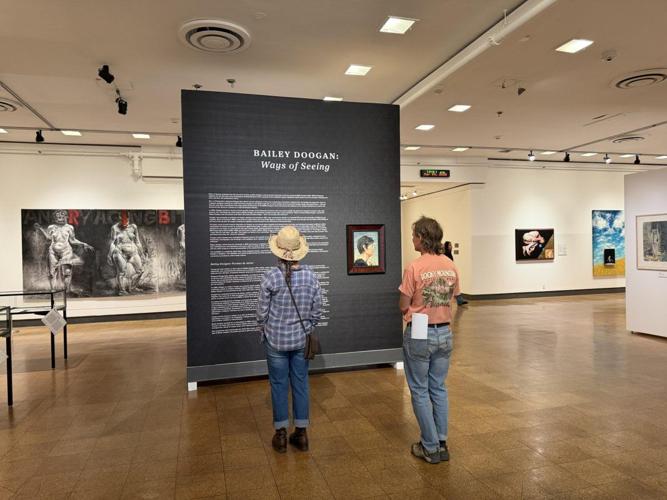
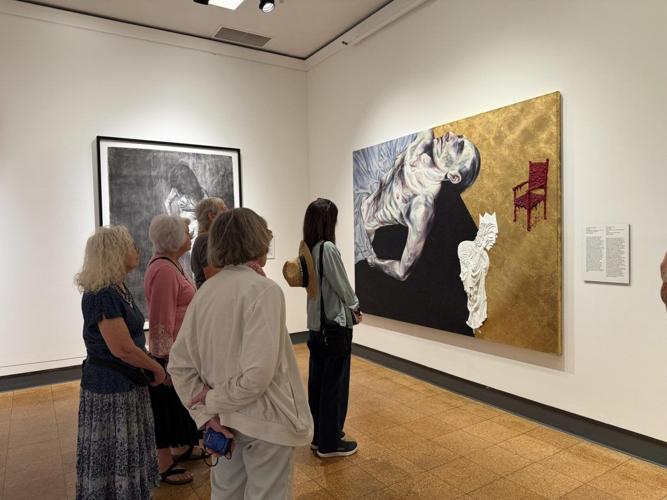
A University of Arizona Museum of Art exhibit, “Ways of Seeing,” celebrates Bailey Doogan, an artist and former UA professor whose work depicts aging and female bodies, among other darker subjects such as disordered eating and politics.
Because of those themes and the raw depictions of bodies, her artwork has at times been censored.
“Her work really did deal with the real body, which is really hard for people to deal with and take in,” said Moira Doogan, Bailey Doogan’s daughter.
Doogan’s artwork confronts the traditional ideas of the female body, Moira said. Several pieces also show the male body in vulnerable positions.
During a 1998 speech at the College Art Association Conference in Toronto, Doogan spoke on the censorship of her work: “I remember every one of those censorship experiences vividly,” she said.
People are also reading…
“Each time I found out that work had not been shown (or if shown, hidden in the back room behind a pylon with a warning label on it), removed during the exhibit (I actually had one piece ripped off the wall), or not purchased— because it was obscene; grotesque; too angry; too tough; insulting to women; insulting to men; harmful to children — my first feeling was shame,” she said.

Guests read the introduction to the exhibition “Ways of Seeing” at the University of Arizona Museum of Art.
But she said she turned that shame into inspiration and passion to continue her work.
“I feel an increasing urgency to make images of my own body, of other people’s bodies — to make them as specific as I can, marked with the experiences, both hallowed and polluted,” she said in the speech.
Even after her death on July 4, 2022, Doogan’s art has continued to face censorship, Moira said. It has been removed from walls, hidden in the back of exhibits and, even as it was put on display at the UA Museum of Art, rejected for printing by a binding company.
The museum decided to produce a book called “Luminous Bodies” with images and words about Doogan’s art to accompany the “Ways of Seeing” exhibit. But the bindery, after seeing the images, decided not to complete the job.
“So all the pages of the book were printed, and they just need to be bound, but the bindery refused,” said Violet Arma, assistant curator at the UA Museum of Art, who co-curated the exhibition.

Bailey Doogan’s daughter Moira Doogan guides visitors through her mother’s exhibition at the UA Museum of Art.
The bindery obstacle didn’t set back curators, who collaborated with Moira Doogan to collect and arrange the exhibit.
“The original vision was to have a survey of Bailey Doogan’s work and to highlight a few central themes: her legacy, her identity, her artistic process, as well as highlighting the body as a storyteller,” Arma said.
Artist legacy
Doogan made a significant impact on the art community in Tucson as a UA teacher, mentor and as a mother, Arma said.
Her daughter was often the first to see her work.
“Her studio was in our backyard. I got to wander back there and see what she was working on on a daily basis and it just felt like magic to me,” Moira said.
“Now, especially, since I’ve been doing this project of the book and the show, just a fuller view of her work and her as an artist and just being blown away by her talent and by her courage to make the work that she did,” she said.
A single mother, Doogan worked all the time, her daughter said. She was a full-time professor at the UA, freelanced as a graphic designer and painting in her free time.
And her bold work received backlash.
“I remember us getting phone calls to the house that were harassing,” Moira said. “She would talk about her struggles at work, how there’d be challenges at the art department and also just being taken seriously as a woman artist.”
Doogan handled the adversity with a sense of humor, Moira said, which shows up in works like “Angry Aging Bitch,” created after she received that insult from a student’s roommate.
Doogan’s art can be dark and explicit. But it also contains beauty, Moira said.
“These images of us with all of our imperfections and wrinkles and signs of a life lived, as she’d say, are beautiful, and I hope that they find that beauty in her work, the power in it, the beauty and I hope that they just find all of those things and magic,” she said.
Impact today
To honor Doogan and bring attention to her work, Gloria McMillan, coordinator of the UA Campus Women’s International League for Peace and Freedom and a former student of Bailey Doogan, organized a march across the UA to the museum on March 4.
McMillan, alongside local activist Manon Getsi and the Raging Grannies, a local activist theatrical group, hoped to draw attention to the feminist artist’s work and impact.
“It’s very visceral, and I think it comes from a huge place of compassion,” Getsi said of Doogan’s work. “It’s not easy having a body. I think a lot of people are very uncomfortable in their skin and their persona, and on some level she recognized that and was able to create a space for people to come out of their own shame around their forms.”
Doogan didn’t create art to be provocative, Moira said, but for reactions like Getsi’s.
“I think she wanted to make something that was in her mind and needed to get out to express something,” she said.
Doogan’s “Ways of Seeing” runs through April 4 at the UA Museum of Art. Despite setbacks, a book of her artwork and writing will also be for sale.
On March 31, Unitarian Universalist Church-Tucson Humanist will host a free talk and walk-through of the exhibit at 2 p.m.
Arizona Sonoran News is a news service of the University of Arizona School of Journalism.