

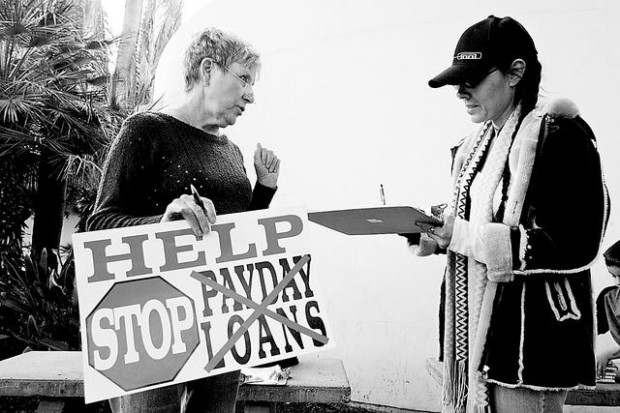
At a recent legislative breakfast, the audience of social-service advocates wanted to know what each lawmaker planned to do for Arizona families.
Rep. Marian McClure didn't focus on the hot topics of the state budget shortfall or reforming Child Protective Services. Instead, she made a pitch for 10,000 volunteers to gut the payday-loan industry.
McClure, who represents eastern Pima County, needs all the help she can get if she's to collect nearly 154,000 valid signatures by July to go to the ballot. Stop Payday Loans would make it a Class 5 felony to provide the short-term, high-interest loans.
"Typically, I would not attack any business because I'm a damn good Republican," said McClure. But there are limits to her willingness to let the market play out and buyer beware.
"If you even think about it for a minute, you'll realize these loans are costing Arizona businesses big bucks because people paying exorbitant interest are not able to buy other things. And most of the money is going out of state," she said.
People are also reading…
With efforts to change the industry thwarted in three legislative sessions, she decided to try her luck with the voters.
She took the petitions to the dealership when she bought a new car. She took them to her dental and hair appointments. She took them to business breakfast meetings. She's in front of churches on Sunday mornings and at libraries in the afternoons. No matter what her audience, she said, people sign. "This isn't a partisan issue."
The payday-loan industry, which argues that it provides viable credit options to people who need them, has formed a political action committee to try to convince the public that such concerns are overblown.
The state law allowing payday loans faced minimal opposition in 2000, passing 24-6 in the Senate and 45-13 in the House.
Then, legislative staff reports said there were four lenders operating in Arizona under a different regulatory format. Now, there are 689 branches operating in Arizona, with more than 100 in Pima County.
If it feels like those "Get Cash Quick" signs are on every corner, you're nearly right. By contrast, as ubiquitous as Starbucks seems, the coffee chain has just 324 sites in the state.
That boom mirrors a national trend. The payday-loan industry grew from 2,000 branches across the country in 1996 to 22,000 in 2006, extending some $40 billion in short-term loans, the Community Financial Services Association of America estimates.
Payday loans typically are short-term and $500 or less. They generally use a post-dated check as collateral, with interest of 15 percent per transaction. Let's say Ann wants $200. She'll write a check for $235.29 and walk out with $200. When the loan comes due in two weeks, if she doesn't have the amount in her account, she may extend the loan for another 15 percent.
Cheri Horbacz, project manager for Don't Borrow Trouble, a Freddie Mac-sponsored campaign to help people manage debt, has fielded 354 phone calls in the past year. About 20 percent are from people trapped in a cycle of payday loans.
The law — which expires in 2010 — says a person can extend the loan three consecutive times and can have only one loan at a time, but that isn't always the way it works.
Liz Lopez, 32, a Phoenix resident, got in touch with McClure after jumping on the loan treadmill last November. An originator in the mortgage business, she found her income shrinking with the economy until she was struggling to pay the rent.
Although Lopez was supposed to check a box if she had any outstanding loans, she didn't. When the bill came due, she still didn't have the money. She had six loans out at one time.
"By May, I couldn't even pay anymore and all of my other bills were falling behind," she said.
Her credit score, originally 742, is now in the 500s. She's on a payment plan for three of the loans and got a second job as a bartender, but she's still catching up. "If I had known what I was really getting myself into, I wouldn't have done it, but they make it so easy. As long as you have a pay stub, they'll give you the money.
"I just don't want this to happen to other people," she said.
Diane Robles, a 44-year-old mother of two, has a similar story. After losing a better-paying job in 2001, the Tucson woman was making less in her new job as an administrative assistant, but she faced fixed costs on her mortgage, utilities, food and outstanding credit-card bills.
Then she saw a place on the corner and got her first loan.
Robles started going to different lenders to get the loans. She had five loans at one time. "I'd do an extension and when it was time to pay them off, I'd pay them off. Then I'd have no money left at all and I'd have to go borrow all over again," she said, calling that two-year time period the "payday loan roulette."
Her credit tanked. She fell behind on her mortgage. Her kids comforted her one night as she huddled on the floor, sobbing. She had to declare bankruptcy.
Robles, who got her master's degree and now makes a decent living in information technology, admits she shares the blame. "I made my own choices, but they prey on people who are desperate. Desperate people do not look ahead to the future. They look at the here and now. "
With annual interest rates hovering in the range of 400 percent, the typical payday borrower pays $793 for a $325 loan, says a new report by the Center for Responsible Lending, a non-profit based in North Carolina.
That translates into $4.2 billion in fees across the nation, including $139 million each year in Arizona.
In Pima County, the loan recipients are paying $20 million a year in fees, according to a 2003 study by the Southwest Center for Economic Integrity.
"That money is coming from people who can least support it," said City Councilwoman Karin Uhlich, an ally in McClure's effort.
The amount vastly outstrips the resources Tucson funnels to low-income neighborhoods to help stabilize them, Uhlich said.
Brian Crump, a regional manager of QC Financial Services, which operates Quick Cash locations in Tucson, said his industry is not preying on the working poor. The working poor, he said, are the ones who need to use check-cashing services because they don't have access to banks. His industry requires banking accounts and proof of employment, he said.
People who use the service choose to do so because it's efficient or because they don't have other borrowing options, he said, and McClure's initiative won't eliminate the need to borrow. Instead, he said, people will be forced to pawn television sets or turn to unregulated Internet lending.
But Crump acknowledges that not everyone agrees with his worldview.
An old friend created a spoof profile for Crump on the social-networking site Friendster in which he purported to be Crump and wrote, "I rob from the poor and give to the rich. It's so easy to do here in Tucson because simple folk are so easy to intimidate."
Those words captured his friend's "sentiment about what I do," he acknowledged.
Tom Linafelt, the Kansas-based director of communications for QC, said industry data shows the majority of customers pay on time.
He suggested that animosity toward the business is at least in part "fed by negative media coverage that makes it seem like these troubled customers are more prevalent than they really are."
Credit unions and banks would like to see payday loans go away, he suggested, either because they'll get more business or will collect more bounced-check fees.
Payday lenders are prohibited from operating in about a dozen states.
After putting a halt to payday lending in 2006, North Carolina found in a study that households were choosing instead to use savings, pay bills late, borrow from family and friends or get credit-card advances. That prompted state Deputy Banking Commissioner Mark Pearce to declare that "hard-working North Carolinians have not missed payday lenders."
Linafelt, who questioned the methodology of the report, also disputed the findings, saying customers in states that have banned payday loans simply drive to neighboring states where they are legal or turn to higher-cost, unregulated loans on the Internet.
The industry formed a political action committee, Arizonans for Financial Reform, to lobby for its version of reform. Lobbyist Lee Miller could not be reached for comment.
But the group's Web site argues, "For too long, the Arizona state Legislature has debated the issue of payday loans without concrete action. It is time to reform the payday loan industry in Arizona!"
That's a premise even McClure can buy.
AVOID HOLIDAY DEBT
Using payday loans to get through the holidays could be a recipe for financial disaster, said Steve Bucci, a Rhode Island-based financial adviser who writes the weekly Debt Adviser column.
He suggests:
• "Rather than use a payday loan, try to give gifts that don't require taking out a loan. Give gifts of time — offer to baby-sit or cook dinner."
• Shop with a list. "If you shop without a list, you'll invariably spend more money."
• "You'll see sales coming up, enticing you to come in and buy. If the item isn't on your list, don't go. It's a bargain only if you need it."


 Hotel on the rise at Tucson’s Uptown project


